
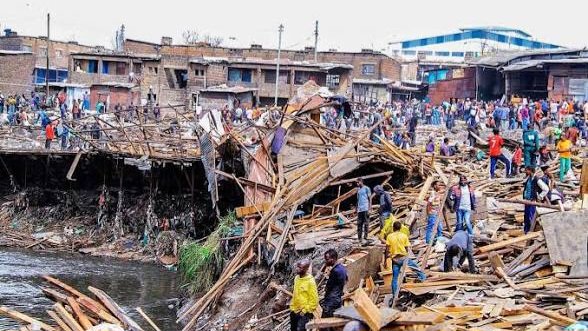

Bulldozers moved into sections of Gikomba market on Tuesday morning, flattening structures and leaving a trail of destruction that has thrown the livelihoods of thousands into limbo. The operation, which targeted specific zones of the sprawling trading center, signals a potential shift in the government's approach to managing one of East Africa's most significant commercial nerve centers.
The exercise began under tight security, catchng many traders by surprise. While the government has previously cited the need for clear access paths for emergency services, particularly fire engines, the scale of this week's activity suggests a more permanent change to the landscape.
Gikomba has long been plagued by frequent, mysterious fires that have gutted stocks worth millions of shillings over the decades. Despite numerous investigations and promises from successive administrations, a lasting solution has remained elusive. The locals, many of whom have operated in the market for generations, expressed disbelief as they tried to salvage what remained of their properties from the rubble.
The demolition comes at a time when the national government, under President Ruto, is aggressively pursuing the Affordable Housing Program. There has been ongoing speculation that parts of the land occupied by the market are earmarked for high-rise residential developments, aimed at replacing the informal settlements and temporary stalls that currently define the area.
For many years, the market has functioned as a critical entry point for second-hand clothes, footwear, and cereals. Its reach extends beyond Kenya's borders, serving wholesalers from across the Great Lakes region. The disruption of these supply chains is expected to have a ripple effect on the wider economy, given the volume of trade that passes through Kamukunji sub-county daily.
Officials from the Nairobi County government have previously stated that the reorganization of Gikomba is necessary to improve sanitation and security. However, the lack of a clear relocation plan for the displaced traders has sparked criticism from human rights groups and political leaders representing the area.
The traders argue that while they support modernization, the methods used to achieve it are often heavy-handed. Many lost their entire inventory during the Tuesday exercise, as they were not given sufficient time to move their goods to safer locations.
The future of the remaining sections of the market remains uncertain. If the current trend continues, the informal, chaotic charm that defined Gikomba for half a century may soon give way to concrete blocks and structured retail spaces. Whether this transition will include the original traders or price them out of the new developments remains a point of contention.
As the dust settles on the recent demolitions, the economic impact is already being felt. The loss of stalls means the loss of daily revenue for thousands of families, many of whom live hand-to-mouth. The government faces the difficult task of balancing urban development goals with the immediate survival of the informal sector.
For now, the site remains a scene of activity as scavengers and traders alike pick through the twisted metal and splintered wood. The era of Gikomba as a sprawling, unregulated marketplace appears to be drawing to a close, though what exactly will take its place is yet to be fully unveiled.
Comments (0)
Leave a Comment
No comments yet. Be the first to share your thoughts!