

The first professionally licensed indigenous Kenyan architect did it more than half a century ago. David Mutiso trained in the United Kingdom, came back shortly after independence, joined the Ministry of Works, and eventually rose to become Chief Architect between 1967 and 1974. His return shaped public building programmes and helped establish professional standards that influenced generations of designers after him. The pattern he established, of going abroad, acquiring something the local system could not yet offer, and bringing it back, has never fully stopped.
What has changed is the nature of what is being brought home.
Mutiso returned with a modernist sensibility and a commitment to nation-building at a time when Kenya needed to physically construct its identity as an independent state. The architects returning now are carrying a different set of tools. Climate modelling. Mass timber construction. Green building certification. Affordable housing frameworks built around passive design rather than mechanical systems. The context has shifted from building a nation to rescuing it from some of the consequences of how it was built.
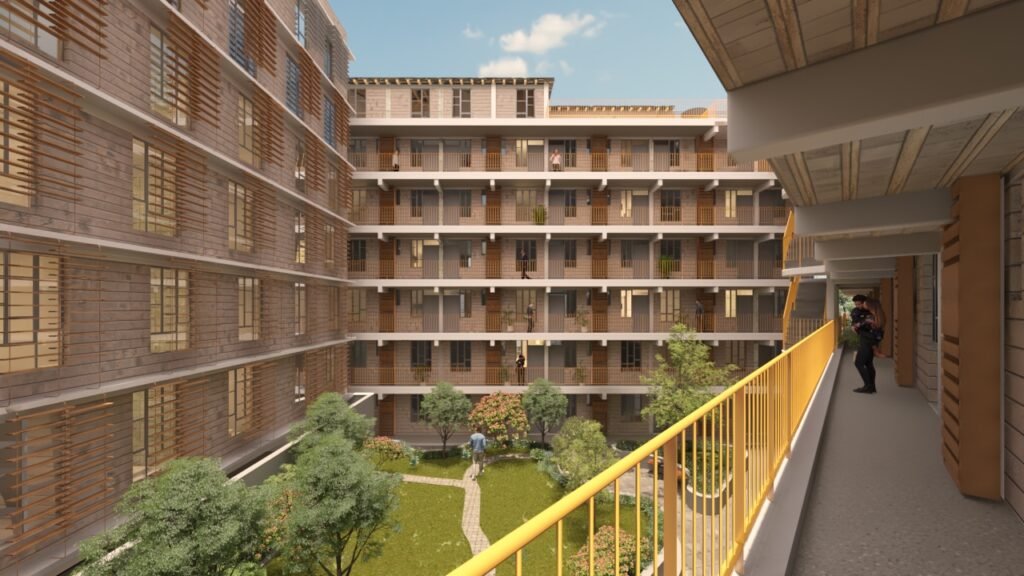
Etta Madete Mukuba is one of the clearer examples of what this looks like in practice. Born and raised in Kenya, she completed a Master's in Sustainable Architecture at the University of Nairobi before going to Harvard Graduate School of Design for a Master's in Real Estate. She returned to work as Affordable Housing Lead at BuildX Studio in Nairobi, and later founded Zima Homes, a 137-unit green-certified housing development whose average unit cost was designed to sit at around $23,000. The project became one of the first affordable housing developments in Kenya to achieve EDGE green building certification, with approximately 60 percent embodied carbon efficiency built into the design through passive ventilation, prefabricated systems, and rainwater harvesting.
BuildX Studio itself, founded in 2016 and co-led by Carolina Larrazábal, became the first architecture, engineering and construction company in Africa to achieve B Corporation certification. The firm has set a goal of building 10,000 affordable homes across Kenya by 2030. It is also pioneering mass timber construction in East Africa, running simulations to compare the carbon performance of timber against conventional concrete and block construction, and hosting visits from the Nairobi County Urban Planning Department, the Architectural Association of Kenya, and other industry bodies to demonstrate what the material can do.
Cave_bureau, founded in Nairobi in 2014 by Kabage Karanja and Stella Mutegi, operates at a different register but makes a similar argument. Karanja and Mutegi have exhibited their work at institutions including the Louisiana Museum of Modern Art in Denmark, and Karanja co-curated the British Pavilion at the 2025 Venice Architecture Biennale. Their studio draws on Kenya's volcanic cave systems and the landscape of the Great Rift Valley to explore what an ecologically grounded, post-colonial African architecture might actually look like. The work is globally recognised in a way that most Nairobi-based practices are not, and it was built without relocating.
Emma Miloyo, the first female president of the Architectural Association of Kenya and a first-class honours graduate of JKUAT, co-authored the second edition of Building in Kenya in 2023, a practical handbook for developers that became one of the country's architectural bestsellers. She holds an Eisenhower Fellowship and has been featured in RIBA's publication on 100 Women in Practice. Her firm, Design Source Limited, has completed more than 50 projects across Kenya, South Africa, Nigeria, and Tanzania.
These are not isolated cases. They are part of a wider pattern of Kenyan professionals who trained or gained exposure abroad and returned with both the credentials and the intent to redirect what Kenya builds and how. The challenge is that the conditions they return to are not always set up to use what they bring. Public procurement still moves slowly. Building codes have not been updated to reflect green building standards as a baseline. And the construction market, driven largely by cost competition, does not always reward the kind of design thinking that takes longer and costs more upfront, even when it saves money and carbon over the life of a building.
The Pan-African Biennale of Architecture, scheduled to open in Nairobi in September 2026, is expected to bring many of these conversations into one room for the first time. For Kenya's returning architects, it may represent the clearest moment yet to make the case that what they have built, and what they are still trying to build, is worth paying attention to.
Comments (0)
Leave a Comment
No comments yet. Be the first to share your thoughts!