
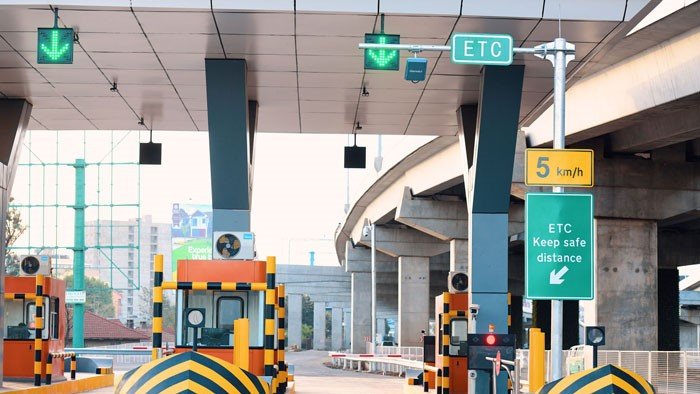


Motorists are now bracing for a significant change in travel costs along the crucial Northern Corridor, following the Kenya National Highways Authority's (KeNHA) announcement that the expanded Rironi-Mau Summit Highway will introduce a toll charge starting at Ksh 8 per kilometre for standard passenger vehicles. This key infrastructure project involves the dualling and expansion of approximately 175 kilometres of the A8 highway from Rironi to Mau Summit.
It is being executed under a 30-year concession Public-Private Partnership (PPP) model, with the China Road and Bridge Corporation (CRBC) and the National Social Security Fund (NSSF) Consortium emerging as the preferred developers. The base rate of Ksh8/km for passenger cars and 4WD vehicles (often categorised as Class 3) is a crucial figure. Still, the cost for larger commercial and public service vehicles, which constitute the backbone of the corridor's traffic, will be considerably higher, adhering to Kenya's National Tolling Policy that scales fees based on vehicle class and axle count.
The tolling structure for the Rironi-Mau Summit Expressway, like the existing Nairobi Expressway, is tiered, ensuring that heavier vehicles, which cause more wear and tear on the road, pay a commensurately higher fee. While the precise, final breakdown of per-kilometre charges for all classes under the new CRBC-NSSF agreement is yet to be gazetted, the established national policy and previous project estimates offer a clear indication of the proportional costs. Under typical tolling regimes, light vehicles with a high bonnet (Class 4), such as utility vehicles, pay a multiplier of the base rate, which can be around 1.5 times the saloon car rate.
More significantly, heavy commercial vehicles (HCVs) and buses will pay several times the base rate, with a typical structure seeing heavy vehicles with fewer than four axles (Class 5) paying around 4 times the base rate, and those with four or more axles (Class 6), primarily transit trucks, paying approximately 5 times the base rate. Applying the new Ksh8/km base rate, this translates to an estimated initial charge of Ksh32 per kilometre for Class 5 vehicles and Ksh40 per kilometre for the largest Class 6 trucks. For a heavy goods truck traversing the entire 175-kilometre stretch, the initial toll would therefore be around Ksh7,000, a cost which will rise annually by the planned 1% escalation rate to account for inflation and foreign exchange fluctuations.
The decision to adopt the CRBC-NSSF proposal was partly driven by the affordability of this toll rate, as their proposed Ksh8/km with a 1% annual escalation was significantly lower than a competing bid, which had suggested Ksh10/km with a 3% escalation. Nevertheless, the introduction of tolls, regardless of the class rate, remains a contentious issue, with critics arguing it amounts to double taxation since motorists already pay a Road Maintenance Levy in the price of fuel. However, the government and KeNHA maintain that the PPP model is essential to deliver a high-quality, four-to-six lane dual carriageway that would otherwise place an unmanageable burden on the national budget.
The benefits to the commercial sector, particularly logistics and transport companies, are expected to offset the new fee through massive savings in time, fuel consumption, and vehicle wear and tear, due to the elimination of the notorious congestion along the Nairobi-Nakuru corridor, a lifeline for East Africa’s trade. The project, which also includes a 4.5km viaduct in Nakuru town and several other safety features, is scheduled to commence before January 2026, with the expectation of delivering the finished expressway by mid-2027, marking a pivotal moment for Kenya's infrastructure and logistics sector.
Comments (0)
Leave a Comment
No comments yet. Be the first to share your thoughts!