
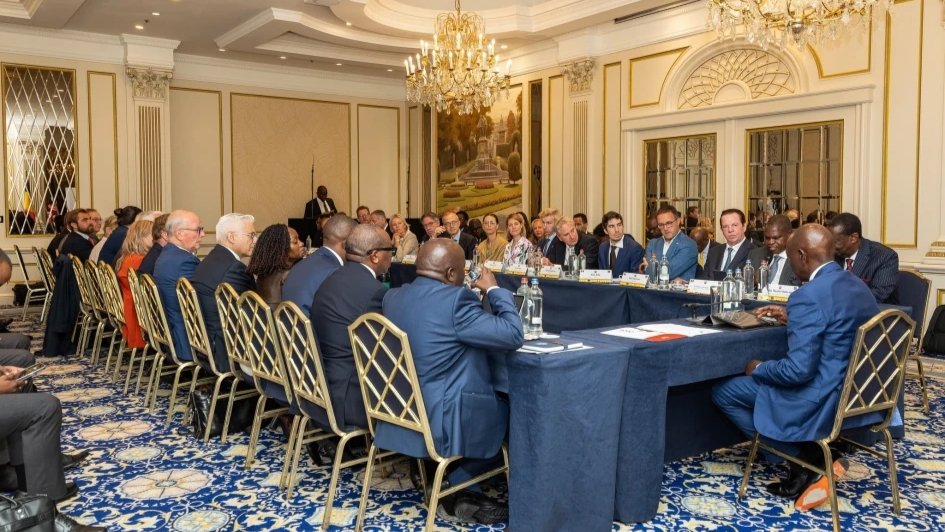

President William Ruto has called on European investors to focus on value addition and manufacturing within Africa. He delivered the message directly to Belgian businesses in Brussels on Monday.
Ruto urged them to set up industries in Kenya. The goal centers on processing minerals locally with clean energy. This approach would help create supply chains that benefit Europe and wider global markets.
Europe's Carbon Border Adjustment Mechanism now favours lower-carbon production. Kenyan goods made with geothermal power could enter European markets at reduced carbon costs. They also gain duty-free entry under the EU-Kenya Economic Partnership Agreement.
"I say to Belgian manufacturers: Do not buy Africa's raw materials to add value elsewhere. Come and build with us," Ruto said. "Process Kenya's minerals in Kenya and Africa, on clean power, and help Europe secure the supply chains it needs. Make it in Kenya. Make it in Africa. Make it clean. Sell it in Europe and to the world."
He spoke at the Kenya-Belgium Business Roundtable. There he launched the Kenya-Benelux Chamber of Commerce. The chamber will link Kenyan enterprises permanently with investors and markets in Belgium, the Netherlands and Luxembourg.
Ruto set two clear targets. Double the number of Benelux companies in Kenya. Raise bilateral trade from about $335 million in 2024 to $1 billion by 2030.
Four priority areas stand out. Agribusiness and agro-processing. Ports, logistics and cold-chain infrastructure. Technology and the digital economy. Clean energy and the circular economy.
Kenya supplies nearly 40 percent of Europe's cut flowers. It leads in black tea exports worldwide and ranks strong in avocados. Further cooperation should emphasize value addition in avocados, macadamia, horticulture and processed foods. New processing facilities would support this shift.
For ports and logistics, Ruto proposed a sister-port link between Antwerp-Bruges and the Kenya Ports Authority. It would improve reefer handling, pre-cooling and cut post-harvest losses. Such upgrades require substantial construction work on port infrastructure and storage systems.
In technology, ideas include a Konza-Leuven Silicon Bridge. This would combine Belgian semiconductor expertise with Kenya's young digital workforce for chip design skills. Partnerships in cloud computing, artificial intelligence and cybersecurity also drew interest.
Kenya generates more than 90 percent of its electricity from renewables. Geothermal accounts for nearly 40 percent of that mix. The advantage supports energy-intensive industries that meet European standards.
Ruto described Kenya as Africa's gateway. An investment there opens access to 1.4 billion people in a $3.4 trillion market under the African Continental Free Trade Area. Combined preferential access through various blocs exceeds $70 trillion.
Kenya alone among East African Community members has ratified the EU-Kenya EPA. This provides permanent duty-free and quota-free access for its products to the European Union. Exports to the EU have risen more than 20 percent since the agreement took effect in 2023.
The country holds East Africa's largest economy, valued at $147 billion. Foreign direct investment crossed $3 billion for the first time in 2025. Roughly $40 billion in infrastructure projects await public-private participation. A One-Stop Investment Centre runs now, with full digitisation of permits planned by year-end.
Kenya's population of 55 million has a median age around 20. Financial inclusion stands at 85 percent. Annual mobile money flows top $300 billion. Fibre-optic networks cover most areas.
Later Ruto met European Commission Executive Vice-President Henna Virkkunen. They noted €102 million for digital transformation and €37 million for the Blue Raman submarine cable extension. These projects enhance connectivity across Kenya and neighbours.
Belgian business leaders responded with commitments. Steven Pope of SIEG Trade Solutions highlighted tea value addition potential. It could create over 50,000 jobs and add $180-250 million in revenue by 2031. Others from Renasci, Sirona Technologies and BIO expressed plans for investments in agro-value chains, renewables and clean cooking.
For Kenya's construction sector, these ambitions translate into demand for new factory buildings, power infrastructure, logistics hubs and port expansions. Such developments align with ongoing efforts to strengthen industrial capacity across the country.
Comments (0)
Leave a Comment
No comments yet. Be the first to share your thoughts!