
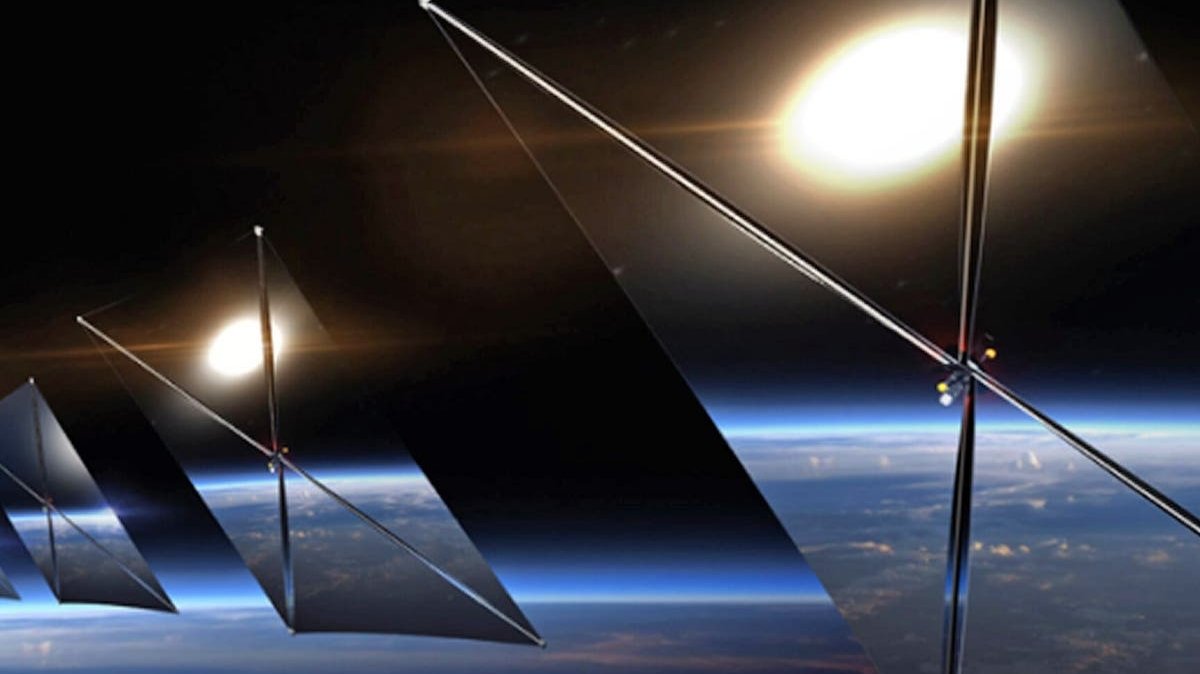

The Federal Communications Commission has approved a test launch by Reflect Orbital, a start-up company based in Hawthorne, California. The company plans to send a satellite carrying a large mirror into low Earth orbit to reflect sunlight back to Earth at night.
The demonstration satellite, roughly the size of a dorm fridge, will unfurl a square mirror nearly 60 feet wide. It would illuminate a circular patch about three miles wide on the ground. The company hopes to eventually deploy thousands of larger mirrors, some nearly 180 feet wide, capable of reflecting light equivalent to 100 full moons.
Reflect Orbital aims to use the technology to power solar farms by extending daylight hours, provide emergency lighting for rescue operations and illuminate city streets. The firm argues the mirrors could help reduce fossil fuel use by allowing more consistent solar power generation and support construction or farming activities at night.
The FCC license covers only a single demonstration satellite. The commission described it as a potentially groundbreaking technology that could advance American leadership in space. It noted that its role is limited to ensuring radio communications do not interfere with others and that the satellite can be safely disposed of at end of life.
Astronomers and wildlife experts have raised strong objections. They warn that the mirrors could interfere with astronomical observations, distract pilots and disrupt circadian rhythms in humans, animals and plants. The American Astronomical Society argued the project would not serve the public interest and could harm federally funded research facilities.
Samantha Lawler, an astronomer at the University of Regina, expressed concern that one country could alter the night sky for the entire world. She emphasised the need for dark skies to conduct research effectively.
The company’s co-founder and chief executive, Ben Nowack, said the approval allows rigorous testing of the technology and built-in safeguards. Reflect Orbital plans to charge customers for the light service and has discussed revenue-sharing models with solar farm operators.
This is not the first attempt at space-based sunlight reflection. In the 1990s a Russian satellite briefly reflected sunlight in an experiment over Siberia before the project was abandoned after a later test failed.
The FCC approval highlights ongoing debates about commercial activities in space and their impact on Earth’s environment. While the commission approved the test, broader environmental concerns fall outside its primary regulatory scope.
For global infrastructure watchers, the project represents an ambitious attempt to engineer additional daylight using orbital technology. If successful at scale, it could influence energy production, emergency response and urban planning in new ways, though the environmental and scientific trade-offs remain subjects of intense discussion.
Comments (0)
Leave a Comment
No comments yet. Be the first to share your thoughts!