
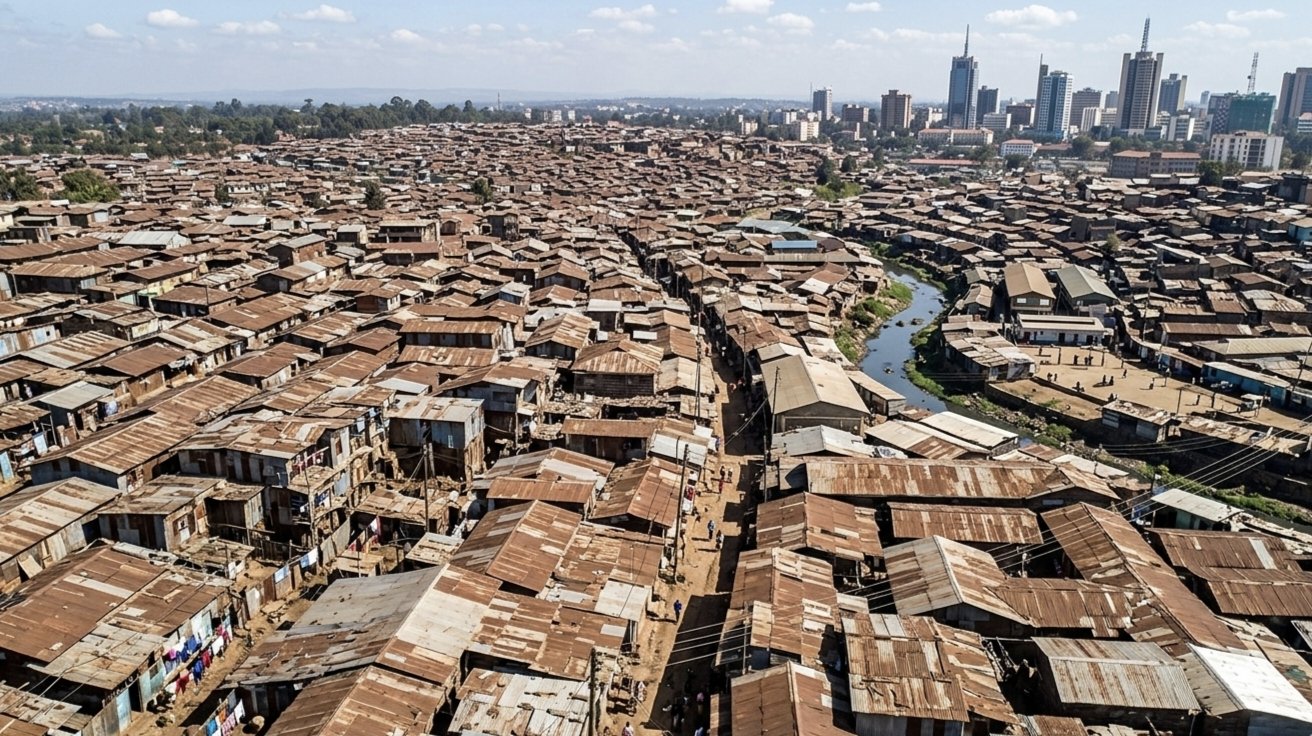

Architecture school teaches students to design for space. The assumption built into most formal design education is that there is enough of it, that setbacks can be observed, that rooms can meet minimum floor areas, that light and ventilation are problems solved by adequate planning rather than ingenuity. In Nairobi's informal settlements, none of those assumptions holds. And the built environment that has emerged from that condition is, in certain respects, more spatially intelligent than anything a planning department has produced.
This is not a romantic argument. Living conditions in settlements like Kibera, Mathare, Korogocho, and Mukuru are defined by overcrowding, inadequate sanitation, insecure tenure, and infrastructure that the city has historically chosen not to provide. None of that is desirable. But within those conditions, residents have developed spatial strategies that professional architects and urban planners are only beginning to study seriously.
Consider density management. Informal settlements in Nairobi operate at population densities that would be considered extreme by any planning standard, yet they remain navigable, commercially active, and socially coherent. That coherence does not happen by accident. It is produced by incremental spatial decision-making, by the way structures are positioned to create shared thresholds, by the unwritten rules that govern which paths stay open and which spaces become collective. Settlements self-organise around movement logic that formal planners typically impose through zoning. Here it emerges from use.
The vertical dimension is particularly instructive. As plot pressure increased over decades, residents in many settlements began building upward, adding floors to single-storey structures using whatever materials and structural logic were available. The results are uneven in safety terms, but the spatial thinking behind them is not naive. Upper floors are often rented as residential units while ground floors operate as commercial or productive spaces. Mixed use, which formal development frameworks in Nairobi have struggled to deliver at neighbourhood scales, exists as a default condition across most of the city's informal fabric.
Transitional spaces reveal another layer of design intelligence. In settlements where indoor living areas are minimal, the threshold between a dwelling and the shared path outside carries an enormous functional load. These spaces, a step, a small projection, an awning, a bench fixed to a wall, act as extensions of the home, as social infrastructure, as economic space. They are designed, even if not drawn. The people who created them understood how space would be used before they built it, which is precisely what architecture is supposed to do.
Water access has produced some of the most inventive spatial arrangements. Where piped water is absent or unreliable, communities have organised shared collection points, storage solutions, and distribution hierarchies that shape how settlement space is structured. The positioning of water kiosks, the routing of informal pipes and the location of washing areas; all of these embed a service logic into the settlement fabric that formal infrastructure planning often fails to integrate as naturally.
The academic and professional interest in these environments has grown. Organisations working in participatory design have documented how residents in Nairobi's settlements engage in planning processes with a level of spatial literacy that surprises outside facilitators. People who have never seen a floor plan can read one quickly because they have spent years managing space under conditions that demand constant spatial thinking. That is not a skill that formal housing produces in its occupants.
What the city has largely failed to do is treat this knowledge as transferable. The government's current approach to informal settlements, visible in the ongoing redevelopment of Kibera under the affordable housing programme, replaces the existing fabric with high-rise residential blocks. The sanitation and structural improvements that come with that replacement are real and necessary. What gets lost is the spatial complexity, the commercial ground floors, the layered thresholds, the mixed tenure arrangements, and the density that functions rather than merely packs people in. Designing that complexity back in, rather than starting from a blank grid, is the harder and more interesting architectural problem. It is also the one most worth solving.
Comments (0)
Leave a Comment
No comments yet. Be the first to share your thoughts!