
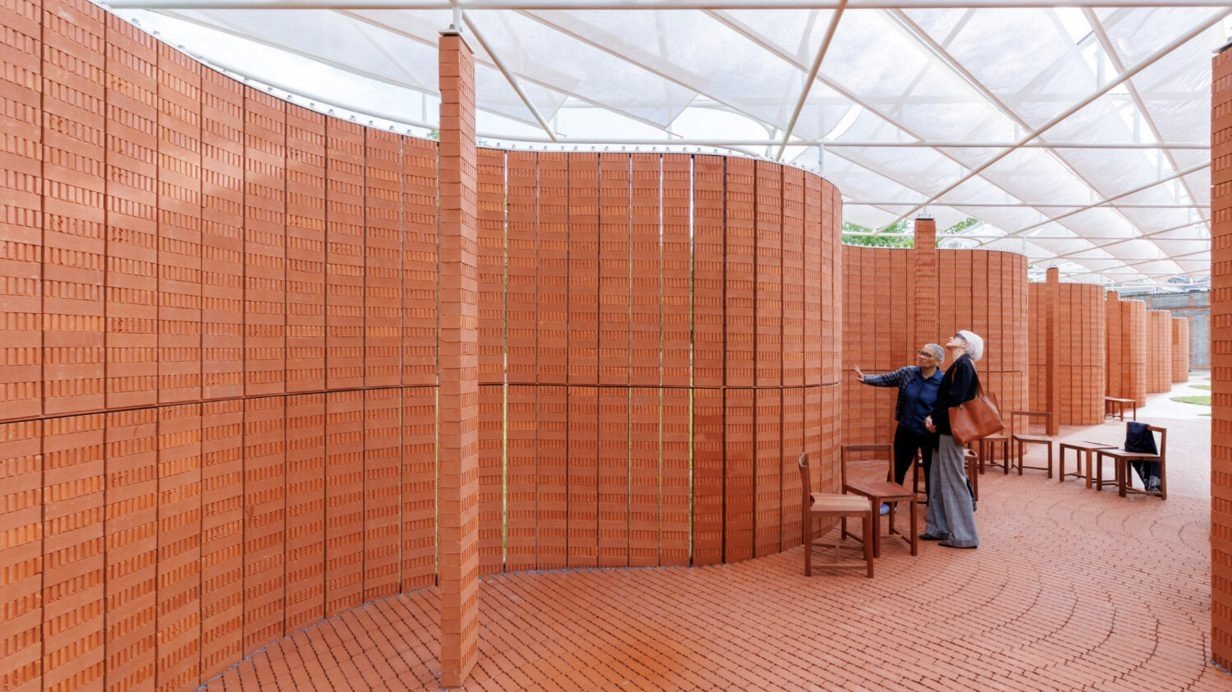

Mexico City-based Lanza Atelier has completed this year's Serpentine Pavilion in London using a winding wall technique borrowed from rural England, reviving a construction method originally devised to avoid a historic brick tax.
The pavilion, the 25th edition of the annual commission at Serpentine Galleries in Kensington Gardens, draws on the geometry of crinkle-crankle walls, a serpentine wall typology found across parts of rural England. Studio founders Isabel Abascal and Alessandro Arienzo said the form was historically developed as a way to cut material costs.
"There was a very strong tax on bricks, so people were looking for ways to use as little bricks as possible," Abascal told Dezeen in a video interview. She explained that a straight wall typically requires two lines of bricks to remain stable, whereas a serpentine or crinkle-crankle wall achieves the same stability using only one line, with the wave-like curvature itself providing structural strength.
Beyond the structural logic, the architects said the project was shaped by contrasting cultural meanings attached to the serpent. "In the UK, usually the serpent is related to the dragon that St George killed, so it somehow has negative meaning," Abascal said. She contrasted that with Mesoamerican cosmogony, where the serpent functions as a protective force connecting earth, water, air, and the heavens. "We like to subvert things, we like to question things," she said. "For us, to work around the notion of the serpent as something that provides protection was very interesting."
Rather than replicating the historic wall type directly, the studio said the pavilion reinterprets it using contemporary construction methods. "We are directing the attention towards these vernacular ways of construction, but at the same time we are giving them a twist," Abascal said, describing the result as a reenactment of the serpentine wall "in a way in which it has never been built before."
The brick walls are paired with a lightweight white canopy structure fitted with projecting fins angled toward the south to block direct sunlight. "We always wanted to have a very bright atmosphere for this pavilion," said Arienzo. The canopy sits atop a series of rhythmic brick columns, a composition the architects said was deliberately designed to create a visual dialogue with the adjacent Serpentine South gallery building, linking the brick walls to the gallery's facade and the white roof to its handrail.
Lanza Atelier also designed accompanying furniture, including stools and chairs that can be arranged in either straight or curved configurations, echoing the pavilion's own geometry.
Founded by Abascal and Arienzo in 2015, Lanza Atelier was selected to design this year's pavilion as part of a commission first launched in 2000 with a structure by Zaha Hadid, since becoming one of the most closely watched temporary architectural projects in the world.
The Serpentine Pavilion is open to the public until October 25, 2026.
Comments (0)
Leave a Comment
No comments yet. Be the first to share your thoughts!