
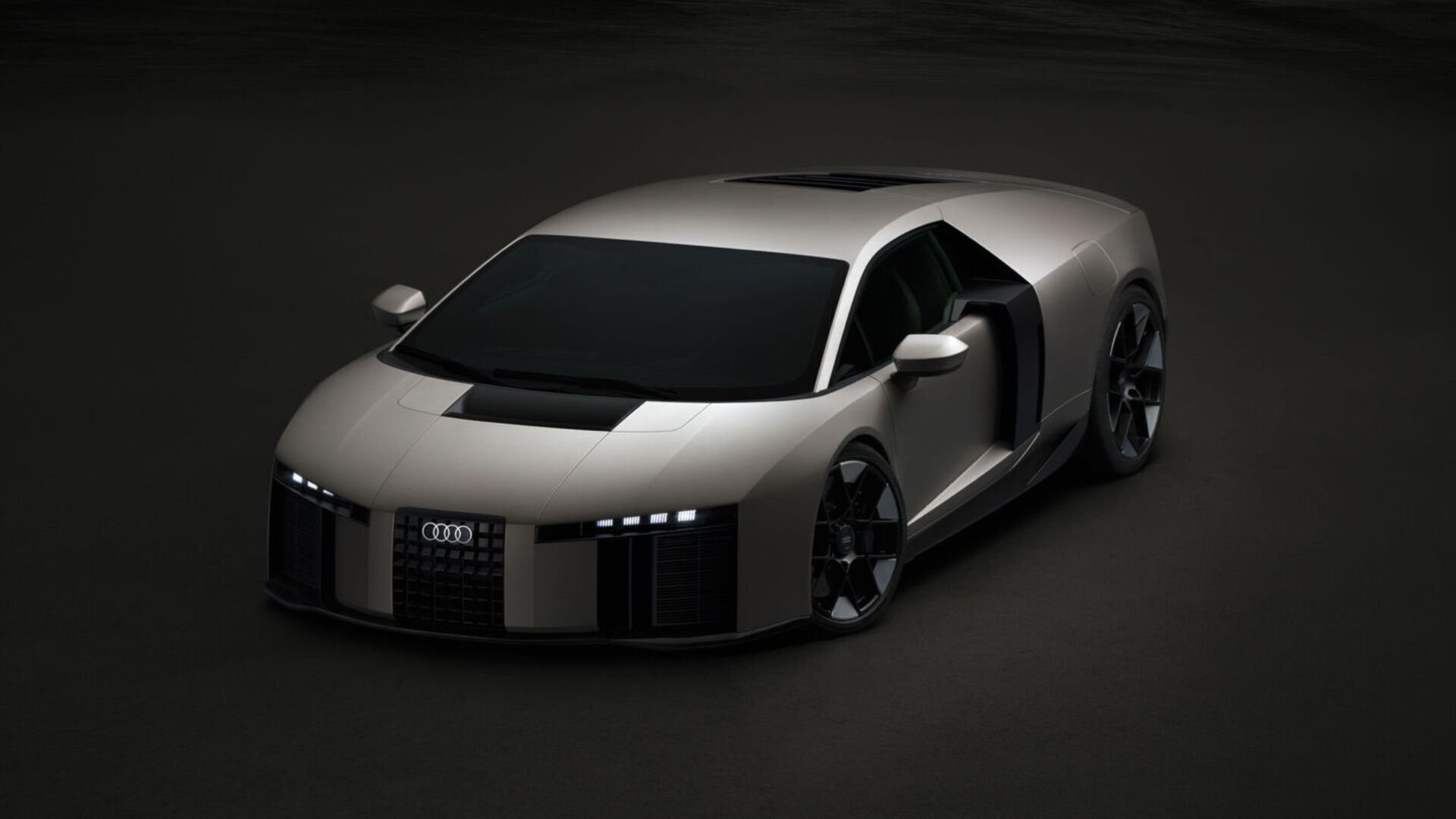

Audi has pulled the wraps off the Nuvolari, a limited-production hybrid supercar developed in secrecy and inspired by legendary racing driver Tazio Nuvolari. The high-performance machine breaks cover as the fastest and most powerful production vehicle in the history of the brand, signaling an aggressive shift in engineering capability.
The mid-engine vehicle uses an advanced powertrain combining a 4.0-liter twin-turbocharged V8 engine with three axial-flux electric motors. This system delivers a maximum system output of 987 horsepower, enabling the vehicle to rocket from zero to 62 miles per hour in just 2.6 seconds.
The combustion engine revs up to 10,000 revolutions per minute, a territory traditionally reserved for pure motorsport applications. Two oil-cooled electric motors sit at the front axle to provide variable torque distribution, while a third motor is positioned between the mid-engine setup and the transmission.
Engineers utilized carbon fiber reinforced polymer (CFRP) bodywork developed with expertise drawn directly from Formula One (F1) racing operations. The car marks the first instance where Audi has paired its signature Space Frame architecture with a complete carbon exterior, maximizing torsional rigidity while minimizing mass.
Active aerodynamics define the monolithic exterior design, featuring an adjustable rear wing that alters its setup across three distinct configurations. The vehicle incorporates a steering-wheel-activated Drag Reduction System (DRS), allowing the driver to manually reduce aerodynamic drag on straight sections to reach a top speed exceeding 217 miles per hour.
Road dynamics are managed by a new predictive ride control system, which continuously analyzes data from integrated vehicle sensors. By monitoring steering angle, acceleration, yaw rate, and real-time grip, the control platform proactively distributes longitudinal and lateral torque to stabilize the chassis before traction loss occurs.
Deceleration relies on an integrated brake-by-wire system working in unison with a specialized ceramic braking layout. The mechanical and electrical recovery systems combine to absorb up to 2.8 megawatts of energy during heavy braking sequences, providing stopping power that matches modern Grand Prix racing specifications.
Production will be strictly limited to 499 units globally, with customer deliveries scheduled to commence in the first half of 2027. The pre-production prototype, finished in a signature Titanium paint, will be demonstrating its track performance publicly during the upcoming race weekend events in Monaco.
Comments (0)
Leave a Comment
No comments yet. Be the first to share your thoughts!