
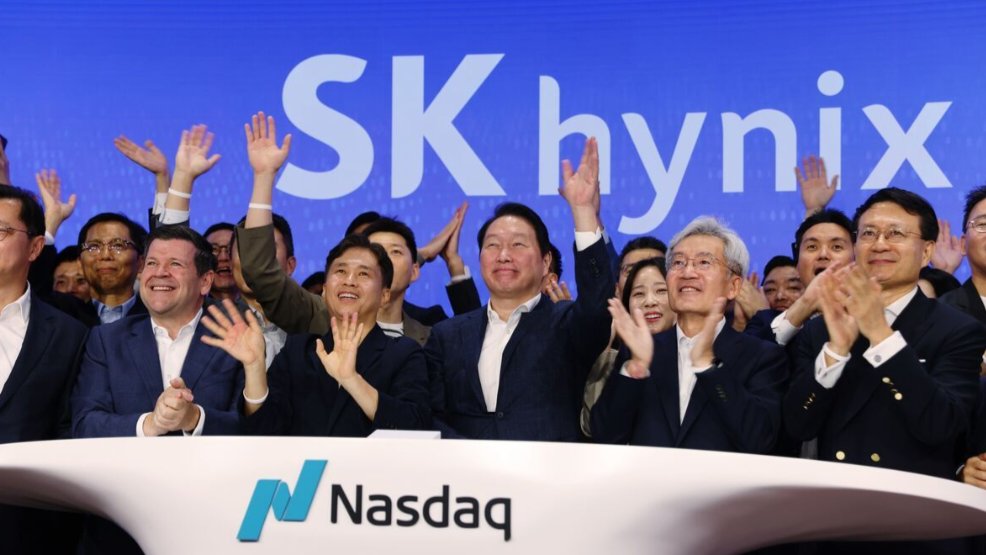

South Korean memory chip giant SK Hynix Inc. suffered its steepest single-day stock decline on record on Monday. The plunge came immediately after its historic $26.5 billion United States (US) trading debut, catching market participants by surprise.
Shares of the semiconductor company plummeted 15.4 percent on the Korea Exchange in Seoul. This sharp contraction dragged down competitors, with Samsung Electronics Co. dropping 10.7 percent on the same day.
The dual decline wiped out billions in market value, and triggered a brief trading halt on the benchmark Korea Composite Stock Price Index (KOSPI). The index fell 9 percent, forcing market regulators to activate a circuit-breaker to stem panic selling.
Analysts attributed the sharp sell-off to institutional and retail investors locking in profits following the highly successful Nasdaq listing. Local market players opted to "sell the news" after months of speculative positioning ahead of the dual-listing milestone.
On Friday, the chipmaker made a spectacular debut in New York. Its newly launched American Depositary Receipts (ADRs) jumped 13 percent above their offer price of $149, ending the first session at $168.49.
That blockbuster sale ranked as the second-largest Initial Public Offering (IPO) in American history, surpassed only by a recent capital raise from SpaceX. It was also the largest-ever US listing by a foreign corporation.
Despite the American triumph, domestic sentiment soured as foreign funds began offloading local shares. Many international investors are reportedly shifting their capital directly to the US-listed dollar assets, which are easier to trade, and maintain a premium over Seoul-listed equities.
Underwriters reported that the Nasdaq offering had been oversubscribed more than seven times. The massive demand underscored the global appetite for infrastructure supporting Artificial Intelligence (AI), a sector where the South Korean manufacturer holds a commanding position.
The firm is the leading supplier of High-Bandwidth Memory (HBM) chips, which are critical components for processors built by Nvidia Corp. The explosive growth of generative computing has kept the manufacturer’s production lines running at maximum capacity.
However, recent domestic research reports have injected caution into the market. A new analysis estimated the company’s second-quarter operating profit at 60.4 trillion Korean won, representing a huge jump, but missing the market consensus of 65 trillion won.
The company plans to use the capital raised from the New York listing to expand its local manufacturing base. Regulatory filings show the funds will finance new fabrication plants in Yongin, and advanced packaging facilities in Cheongju.
The massive capital inflow of $26.5 billion is expected to bolster local manufacturing capabilities. Government officials, including President Lee Jae Myung, reiterated support on Monday for accelerating these massive semiconductor infrastructure projects to maintain global competitiveness.
Local authorities noted the capital inflow provides crucial support for the domestic currency, which traded at 1,503.4 won against the dollar following the market volatility.
While some analysts express concerns over the long-term sustainability of the current chip cycle, others argue that long-term supply contracts will stabilize earnings. The shift from quarterly average selling price growth to structural profitability remains a key point of debate among industry experts.
Industry observers point out that these massive infrastructure projects in Yongin and Cheongju are critical for industrial strategy, aiming to secure supply chains, as global demand for next-generationhardware continues to climb.