
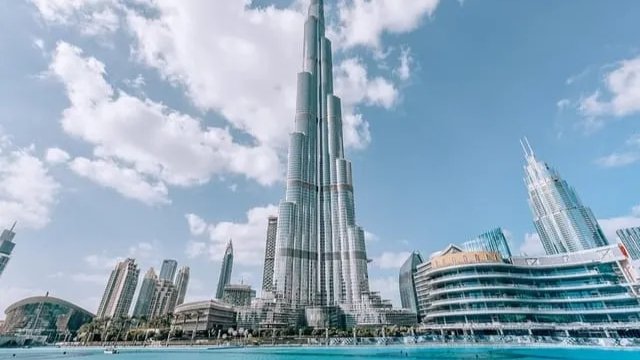

Burj Khalifa in Dubai stands 828 metres tall and holds the title of the world’s tallest building. Completed in 2010, the tower features 163 floors and a distinctive Y-shaped plan that helps resist wind. It currently outranks every other completed structure. The planned Jeddah Central Tower in Saudi Arabia aims to surpass it with a height exceeding 1,000 metres once finished, and they are already past 100 floors after long periods of delays.
The Burj Khalifa uses a buttressed core system. A strong central concrete core connects to three wings that brace one another. High-strength concrete and steel reinforcement carry the enormous loads from height and wind.
Engineers designed the structure with a service life of at least a century under normal maintenance. Regular inspections, repairs to the facade, corrosion protection and foundation monitoring keep the tower safe and functional far beyond basic code requirements.
If humans suddenly vanished, that maintenance would end immediately. The tower would begin a slow process of deterioration driven by its environment and materials. Dubai’s hot, dry climate combined with salty groundwater near the coast would play major roles. Without people to repair seals or control humidity inside, the building envelope would fail first.
Within the first 10 to 30 years, the aluminium and glass curtain wall would lose integrity. Seals and gaskets would weather and crack. Water would enter floors and reach steel connections. Panels could detach during strong winds and fall.
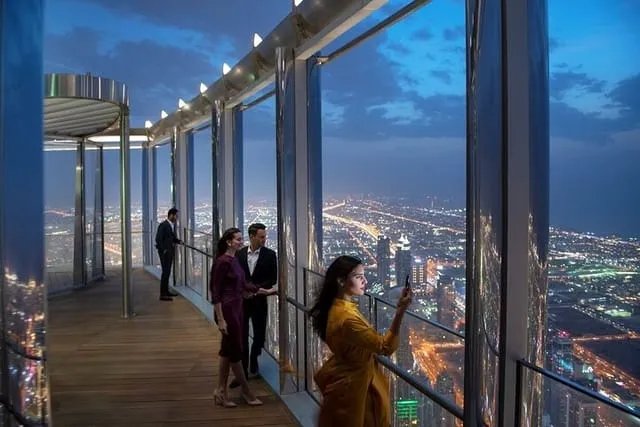
Views from the 124th floor at the Burj Khalifa. /Photo: Pelago
Mechanical systems would stop, allowing temperature swings that stress the concrete. These early changes would not threaten the main structure but would open pathways for faster damage later.
Over the following decades, corrosion would become the dominant issue. Reinforcing steel inside the concrete relies on an alkaline environment to stay protected. Carbon dioxide from the air slowly penetrates the concrete and reduces that protection. In Dubai’s arid conditions the process moves gradually, but once steel starts to rust it expands and cracks the surrounding concrete.
Chloride ions from saline groundwater would attack the foundation piles and raft more aggressively. The 3.7-metre-thick raft and deep piles were built with dense concrete to resist this, yet without ongoing protection the steel would eventually corrode.
100 to 200 years after humans disappear, visible damage would appear across lower and mid-level sections. Spalling concrete and exposed rebar would weaken perimeter columns and parts of the core.
The upper sections and spire would suffer less because they experience different exposure, but overall stiffness would decline. Wind loads, which the tower was shaped to handle efficiently, would produce greater movement as the structure loses rigidity. Fatigue in connections would accumulate.
Foundation performance would also change. Differential settlement between piles could increase as individual elements lose capacity from corrosion. The raft itself would remain largely intact for a long time because of its mass and depth, but progressive weakening at pile heads would reduce overall stability.
The foundation consists of a 3.7-metre-thick reinforced concrete raft supported by bored piles 1.5 metres in diameter and approximately 43 to 50 metres long. These piles penetrate marine deposits and weak calcareous rock. Most buildings have a headroom of 3m or less. The raft was 3.7m of concrete.

The massive raft that distributes the building's loads to the deeply buried piles. Photo: GK/LinkedIn
Full collapse would most likely occur between 300 and 800 years after humans vanished, though this range carries significant uncertainty. A major wind event or further loss of a critical load path in the core or one wing could trigger progressive failure.
The tower would not topple overnight like in disaster films. Instead, increasing damage would reach a tipping point where the remaining structure could no longer support its own weight under environmental loads. The spire and upper mechanical levels would probably detach earlier.
These estimates draw from established models of concrete durability and observations of abandoned structures. High initial construction quality and the dry climate would slow some processes compared with buildings in wetter regions.
Still, without any human intervention the long-term outcome remains structural compromise followed by eventual failure. The exact timing depends on many variables that engineers can model but cannot predict with precision.
Comments (0)
Leave a Comment
No comments yet. Be the first to share your thoughts!