
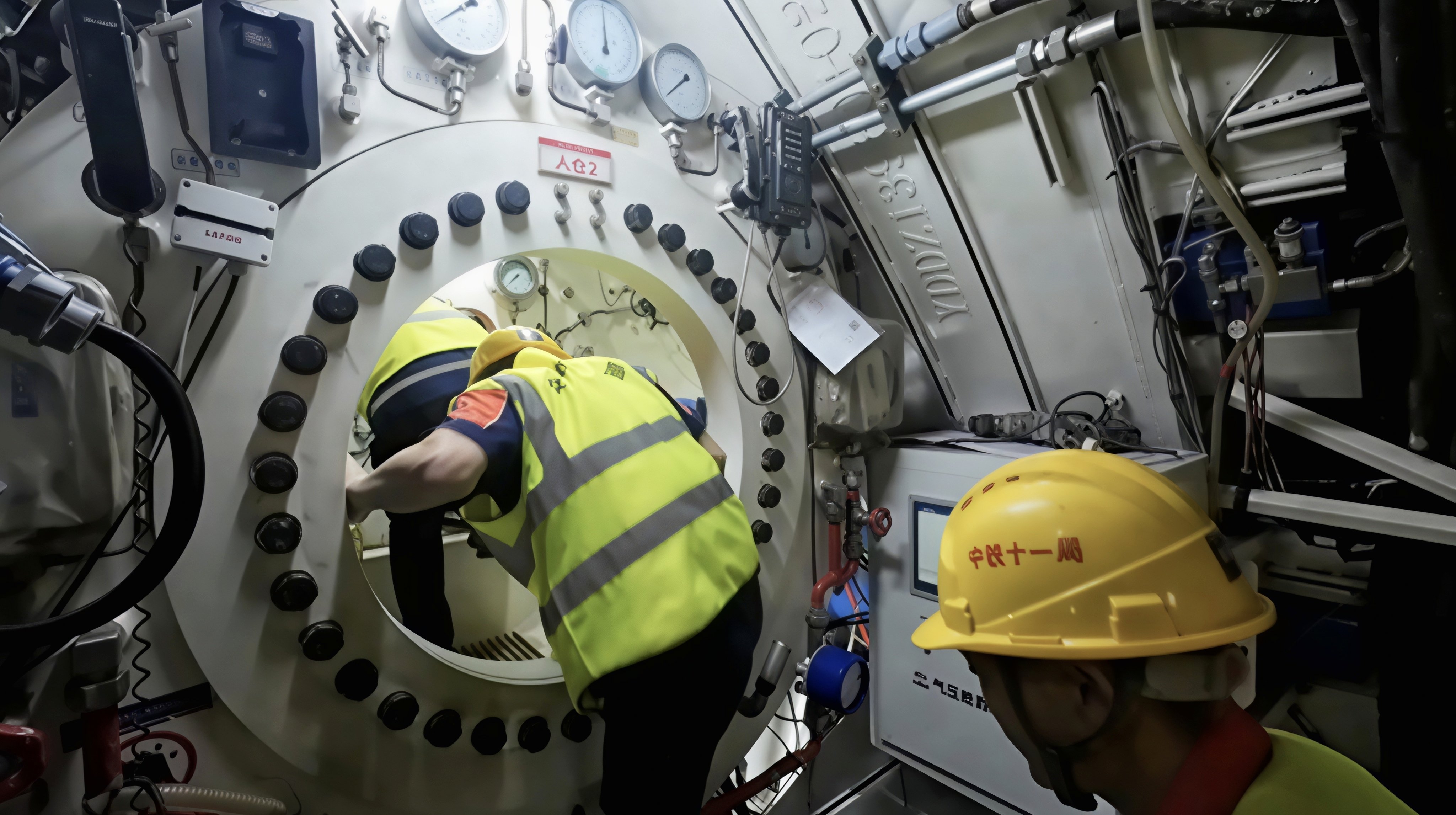

China Railway 11th Bureau Group has completed a large-scale cutterhead tool replacement inside the Jintang Undersea Tunnel under ultra-high-pressure conditions, using equipment the company describes as the world's first "triple-mix gas" hyperbaric intervention system for shield tunneling. The operation took place in the tunnel's Zhoushan section in Zhejiang Province.
The Jintang Undersea Tunnel forms a key section of the Ningbo-Zhoushan Railway and will become the world's longest undersea high-speed railway tunnel once complete. It stretches 16.18 kilometres across the waterway between the two cities, including an 11.21-kilometre shield-tunneled section.
At its deepest point, the tunnel reaches 78 metres below sea level, where water and soil pressure can climb to 0.85 megapascals, roughly equivalent to 30 kilograms of force pressing on an area the size of a one-yuan coin. Engineers say working safely at that depth has long posed one of the biggest global challenges in undersea tunnel construction.
The difficulty stems from the tunnel boring machine's path through shifting ground conditions. As the machine moves from soft soil into hard rock, its cutting tools must be swapped for disc cutters suited to harder material, work that traditionally requires depressurizing the tunnel face, a slow and risky process under high water pressure.
The newly deployed system instead scientifically blends helium, nitrogen and oxygen to support pressurized operations during cutter inspection and replacement, allowing workers to carry out the swap without fully depressurizing the tunnel face. The technology first entered active service on the Zhoushan side of the project on May 8, 2026.
Thursday's operation set multiple world records in shield tunneling, including the greatest operating depth, highest pressure, largest number of tool changes and longest continuous operating period recorded for this type of work, according to China Railway 11th Bureau Group.
Two super-large-diameter tunnel boring machines, named Dinghai and Yongzhou, are excavating the tunnel from opposite ends. Each measures 135 metres in length, weighs 4,350 tonnes and carries a cutterhead spanning 14.57 metres in diameter, fitted with hundreds of custom-designed cutting tools to handle the crossing's 28 transitions between soft and hard rock layers.
Once complete, expected around 2028, the tunnel will connect Ningbo's Beilun district to Zhoushan City, cutting travel time between the two by rail to a fraction of the current road journey and linking Zhoushan into China's wider high-speed rail network for the first time.
Comments (0)
Leave a Comment
No comments yet. Be the first to share your thoughts!