
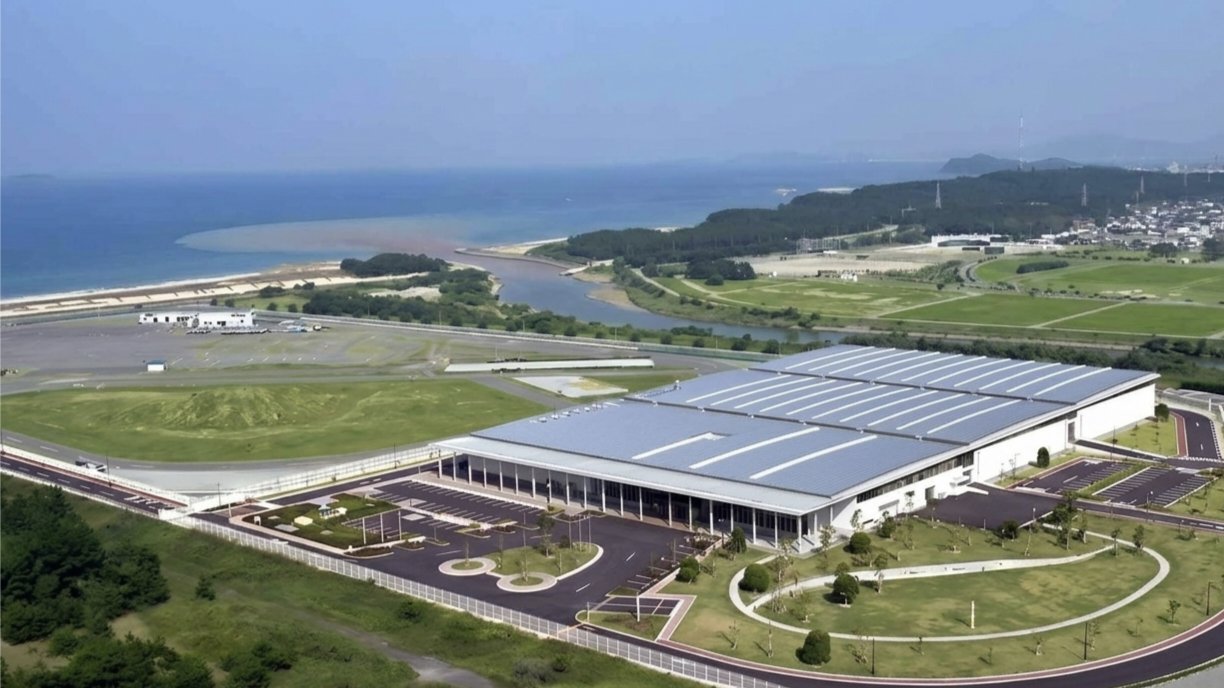

A small power plant in southern Japan has been generating electricity continuously since August 2025, drawing energy not from fuel or sunlight but from the natural pressure difference between fresh water and seawater. It is Asia's first osmotic power plant, and only the second of its kind running continuously anywhere on the planet.
The facility sits inside the Uminonakamichi Nata Seawater Desalination Center in Fukuoka. Its opening ceremony was held on August 5, 2025. The technology it uses is called pressure-retarded osmosis (PRO), which works on the same basic principle that pulls water up through a tree's roots: when fresh water and salty water are separated by a membrane, the fresh water pushes across to dilute the salt, building pressure on the salty side. That pressure drives a turbine, and the turbine generates electricity. No combustion, no emissions, and almost no moving parts.
What makes the Fukuoka plant unusual, even within this niche, is what it feeds the process. Instead of ordinary seawater, the salty side runs on concentrated brine, the waste liquid that a desalination plant normally discards after removing fresh water. The fresh side uses treated wastewater from a nearby sewage facility. Both inputs are materials that would otherwise be thrown away.
The projected annual output is around 880,000 kilowatt-hours, roughly equivalent to the yearly electricity needs of between 220 and 300 average Japanese households. That is a modest figure, and the plant's operators have not pretended otherwise. What the facility offers that solar and wind cannot is consistency. Operators put the utilisation rate at around 90 percent, meaning it runs close to flat out regardless of weather, season, or time of day. The power feeds back into the desalination plant next door, effectively reducing the cost of producing drinking water for Fukuoka and surrounding towns.
The concept is not new. A US researcher first proposed salinity gradient power in the 1970s, and Norway's Statkraft built the world's first osmotic power prototype at Tofte on the Oslo Fjord in 2009. That plant proved the physics worked. It also proved the economics did not, at least not yet. Statkraft's membranes produced somewhere between 1 and 3 watts per square metre, and the accepted threshold for commercial viability is around 5 watts per square metre. By January 2014, Statkraft had shut the project down.
The cost gap remains real. One analysis in an American Chemical Society journal estimated the cost of osmotic electricity from a seawater source at around $2.37 per kilowatt-hour, a figure that cannot compete with conventional grid power today. Fukuoka does not solve that problem. It sidesteps it by pairing the plant with an existing desalination facility, where the brine waste is already being produced and the power output has an immediate, local use.
Akihiko Tanioka, a professor emeritus at the Institute of Science Tokyo who spent decades researching this technology, said at the launch that he felt overwhelmed to see it reach practical use, and expressed hope it would spread beyond Japan.
Denmark opened a continuously running osmotic plant in Mariager in 2023, drawing on geothermal brine. Pilots have run in South Korea, Spain, Qatar, and Norway. The theoretical global resource from salinity gradients has been estimated at around 1,600 terawatt-hours per year. Whether that ceiling ever becomes reachable depends almost entirely on whether membrane costs fall far enough, fast enough. Fukuoka is not the answer to that question. It is the question asked out loud, in hardware, for the first time in Asia.
Comments (0)
Leave a Comment
No comments yet. Be the first to share your thoughts!