
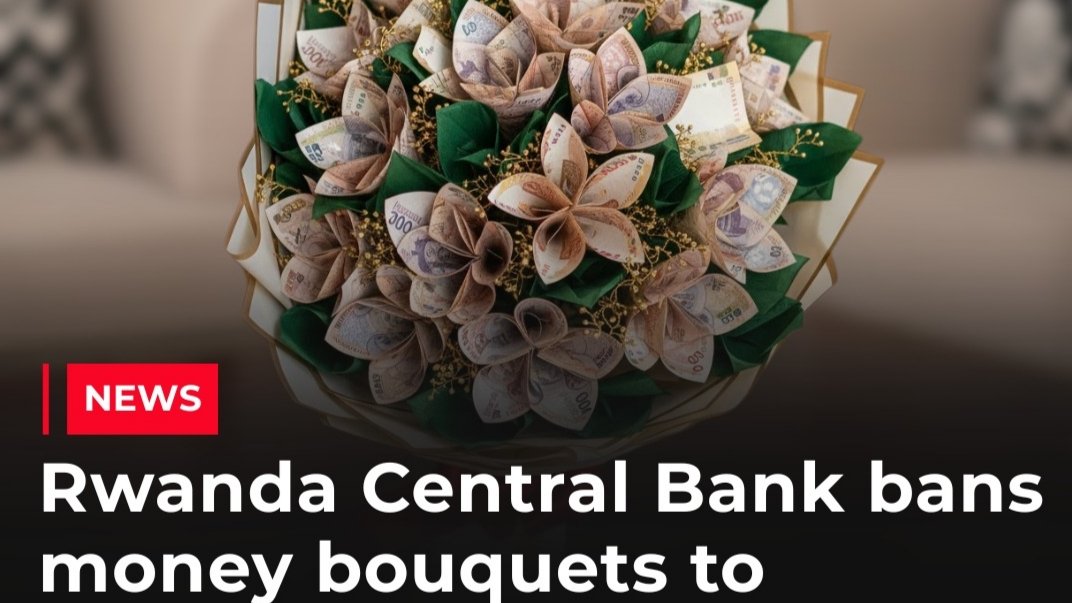

The National Bank of Rwanda has told the public to stop using Rwandan Franc notes in money bouquets or other decorative items. In a February 2026 statement, the NBR said folding, gluing, taping or pinning notes damages them, makes them unusable in machines and raises replacement costs. The practice is illegal in Rwanda, with penalties including one to two years in prison and fines of Rwf1 million to Rwf3 million.
Kenya's Central Bank moved first on the issue around February 2, 2026, issuing a notice about the growing use of cash bouquets ahead of Valentine's Day. The CBK listed folding, rolling, gluing, stapling and pinning as common ways notes are altered, pointing out that adhesives and fasteners stop notes from working in ATMs and counting machines. Kenya's Penal Code allows for up to seven years' imprisonment for serious defacement, though the CBK has stuck to public reminders rather than arrests.
The Bank of Uganda followed with its own advisory, stating that mutilating Uganda Shilling notes or coins breaches the Bank of Uganda Act. The bank singled out fresh notes used in floral bouquets, money cakes and gifts for events such as kwanjulas. Florists, event organisers and anyone who knowingly damages currency can be held liable. The advisory noted that damaged notes jam equipment and force early replacements.
Tanzania has not released a similar recent notice on decorative currency use, though laws protecting legal tender exist across the region.
The three alerts came within days of each other and target a social media-driven trend that has spread quickly. Central banks see the practice as wasteful because it shortens the life of notes and adds to printing expenses paid through public funds.
These warnings happen against a backdrop of steady, if slow, progress toward the East African Community's monetary union. The EAC Monetary Union Protocol was signed in 2013 with an original ten-year target for a single currency. That deadline passed without a launch, and the roadmap was updated. The current plan sets 2031 as the date for full implementation of the East African Monetary Union.
To reach that point, the six partner states—Burundi, Kenya, Rwanda, South Sudan, Tanzania and Uganda—must meet and hold four macroeconomic convergence criteria for three consecutive years by 2028. These are inflation not exceeding 8 per cent, fiscal deficit no higher than 3 per cent of GDP, public debt below 50 per cent of GDP, and foreign exchange reserves covering at least 4.5 months of imports. Central banks have been working on harmonising monetary policy frameworks, banking supervision standards, payment systems and statistical reporting. In 2025 the EAC approved a Cross-Border Payment System Masterplan designed to lower transaction costs, speed up settlements and encourage greater use of local currencies in regional trade.
Trade integration efforts continue in parallel. Intra-EAC trade volumes have risen in recent years, helped by better management of transport corridors and digital tracking tools. Late in 2025, Kenya and Tanzania agreed to clear all remaining non-tariff barriers between them by March 2026. Of the 68 barriers identified earlier, most have been resolved, including duplicate taxes, stamps and insurance demands. The EAC maintains a Trade Information Portal and regular meetings to handle complaints, though some sectors still face obstacles. The African Continental Free Trade Area adds another layer, but success depends on consistent implementation to link supply chains and cut costs.
Preserving the usability of national currencies remains a practical concern for central banks. Damaged notes reduce confidence in cash systems at a time when the region is building toward greater monetary coordination. While a common currency is still years away, the steps being taken now—on convergence targets, payment infrastructure and barrier removal—are meant to lay the groundwork for that eventual shift.
Comments (0)
Leave a Comment
No comments yet. Be the first to share your thoughts!