
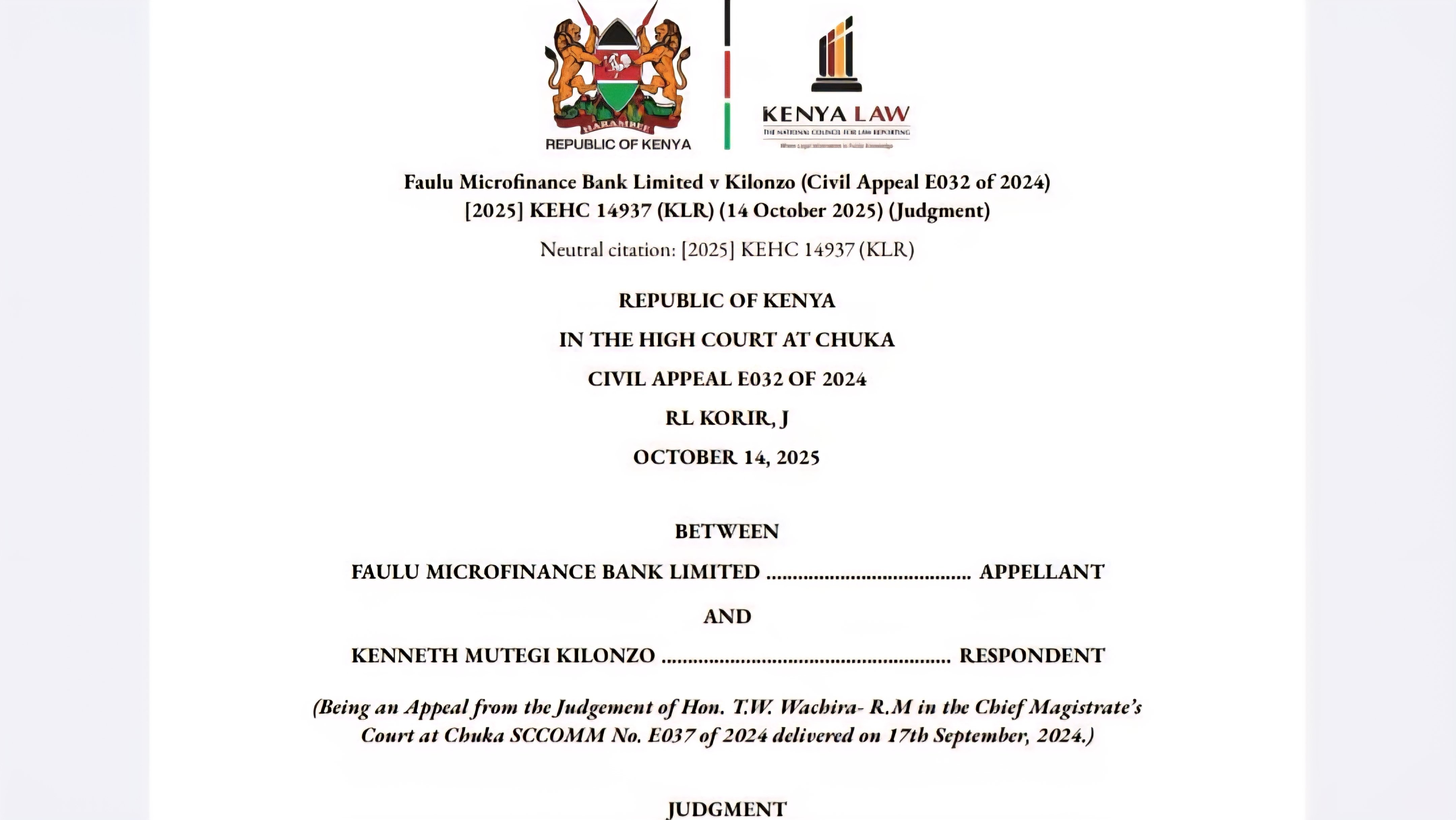

The High Court at Chuka has issued a significant clarification on the limits of debt recovery for microfinance institutions, ruling that interest accrued on a loan cannot exceed the original principal amount. The decision, delivered by Justice RL Korir, reinforces the application of the in duplum rule across a broader spectrum of the financial sector.
The ruling arose from an appeal by Faulu Microfinance Bank Limited against a judgment involving Kenneth Mutegi Kilonzo. The bank had challenged a lower court decision that limited the amount it could recover after the respondent defaulted on a loan facility.
Central to the dispute was whether microfinance providers fall under the same restrictive interest laws as commercial banks. Justice Korir found no error in the trial court’s decision to apply Section 44A of the Banking Act, which codifies the in duplum rule.
This rule dictates that interest and other charges on a non-performing loan must stop accumulating once they equal the outstanding principal at the time of default. For construction firms and small-scale contractors who often rely on microfinance for equipment and working capital, the ruling provides a critical safeguard against ballooning debt.
The appellant bank had argued that the trial court miscalculated the recoverable amount and failed to enforce an acceleration clause. Such clauses typically require a borrower to pay the full balance immediately upon default. However, the High Court held that the statutory ceiling on interest remains paramount regardless of such contractual terms.
Evidence presented in the case showed the loan was disbursed, but the court maintained that the legal burden of proof for the exact amount owed remains with the lender. The court accepted bank statements and loan application forms as proof of disbursement but upheld the cap on total liability.
The respondent had defaulted on the facility in April 2022. The court ordered that interest be charged at court rates from the date of default until full payment is made, but only within the bounds of the established legal limit.
This judgment follows a trend in the Kenyan judiciary to protect borrowers from predatory interest structures. While the Banking Act specifically mentions banks, this decision clarifies that the definition of an institution under the Act extends to licensed microfinance entities.
For the construction industry, where project delays can lead to temporary cash flow issues and loan defaults, the clarity on interest caps offers a predictable legal environment for managing financial distress. Lenders are now clearly barred from seeking sums that dwarf the original capital provided to the borrower.
Costs of the appeal were assessed at 15,000 shillings against the respondent. The decision effectively limits the bank’s recovery to the arrears and a capped interest amount, rather than the higher figures sought through the bank's internal calculations.
Comments (0)
Leave a Comment
No comments yet. Be the first to share your thoughts!