
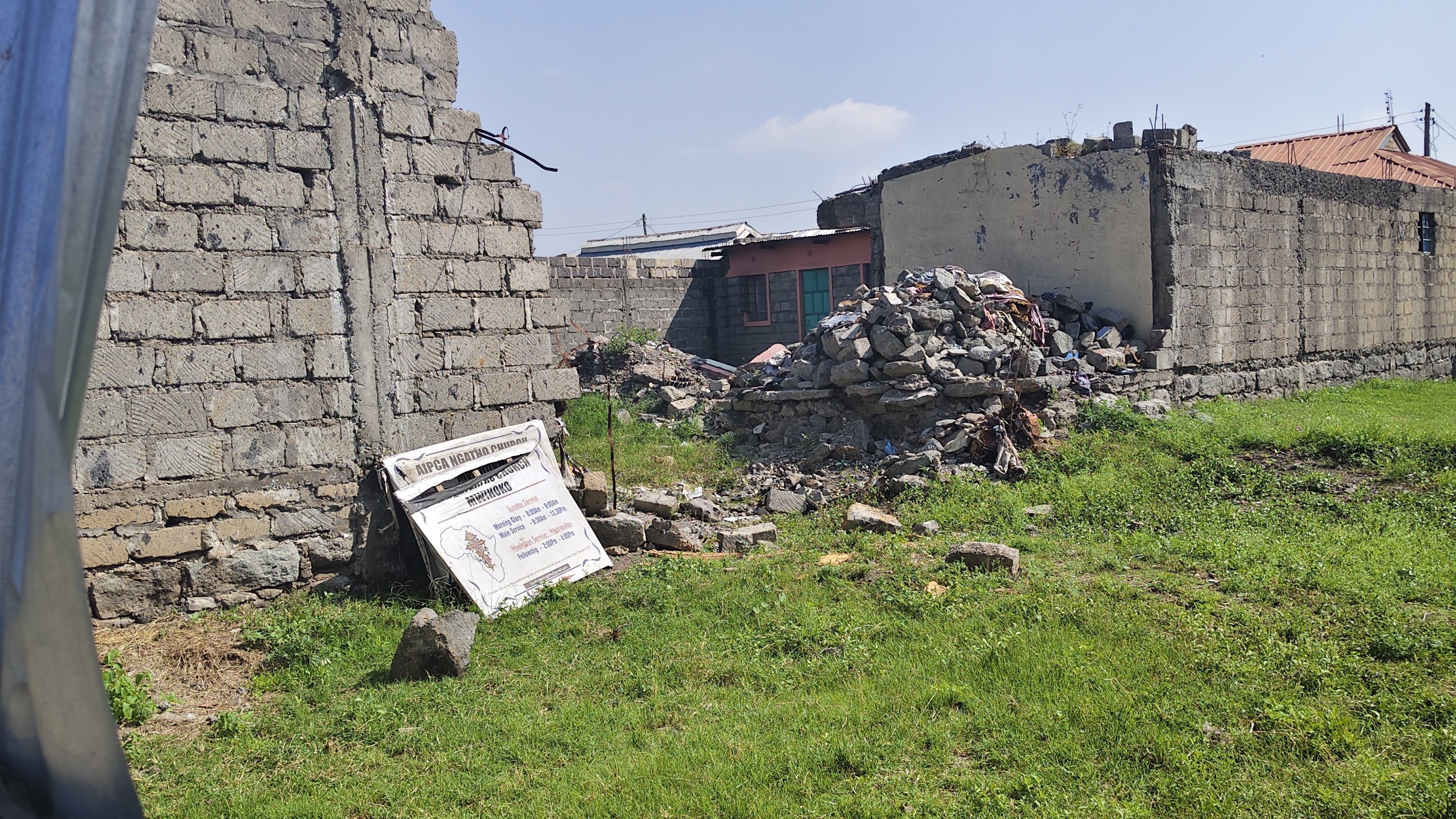

Many Kenyans building outside major towns assume approvals are a formality reserved for city developers, but county planning, environmental and construction rules apply regardless of location. Skipping them does not just risk a demolition order, it can leave a homeowner without recourse when disaster strikes.
That risk became visible on August 7, 2025, when an AMREF Flying Doctors air ambulance lost contact with air traffic control minutes after leaving Wilson Airport and crashed into residential houses in Mwihoko, an area straddling the Kiambu and Nairobi county border. Six people died, including two residents inside a house the aircraft struck, and several families were left homeless.
Mwihoko's land history complicates any recovery effort for affected homeowners. Kiambu County had previously acknowledged widespread problems in the area, where residents had put up buildings on plots that did not legally belong to them, a pattern only partly resolved when the county issued roughly 1,000 title deeds for the Ting'ang'a 'B' section in 2024. Without a title deed or an approved building plan on file, a homeowner has little documentary basis to prove ownership or claim the full value of a destroyed structure.
This is where formal approvals matter well beyond city limits. Under Kenya's building approval framework, any structure with a foundation, whether a bungalow in a rural trading centre or a maisonette in a gated estate, requires stamped architectural and structural drawings submitted to the county physical planning office, which issues a PPA2 approval form once satisfied.
Depending on the project's scale and location, developers may also need registration with the National Construction Authority (NCA), which confirms that a qualified, accredited contractor is handling the works, and in some cases an Environmental Impact Assessment (EIA) license from the National Environment Management Authority (NEMA) for developments near sensitive ecosystems or water sources.
Structures near flight paths carry an additional layer of scrutiny. The Kenya Civil Aviation Authority (KCAA) reviews tall structures and developments close to airports and approach corridors, a requirement that exists precisely because of incidents like Mwihoko, where a low-flying aircraft passed directly over a dense residential area before losing contact.
Building without these approvals leaves owners exposed on multiple fronts. County authorities can issue stop orders, deny utility connections or order demolition of noncompliant structures, according to guidance published by construction industry consultants. More importantly, a home built without an approved plan, registered contractor or clear title record has no official record establishing what was there, its value, or who owned it, precisely the documentation insurers, courts and compensation schemes need after a disaster.
For rural and peri-urban homeowners, the lesson from Mwihoko is not that plane crashes are common, but that any structure can be lost to fire, flood, structural failure or an external accident. An approved building plan, a registered contractor and a properly processed title deed do not prevent tragedy, but they are often the difference between a documented claim and a family left appealing for help with no paperwork to support it.
Comments (0)
Leave a Comment
No comments yet. Be the first to share your thoughts!