
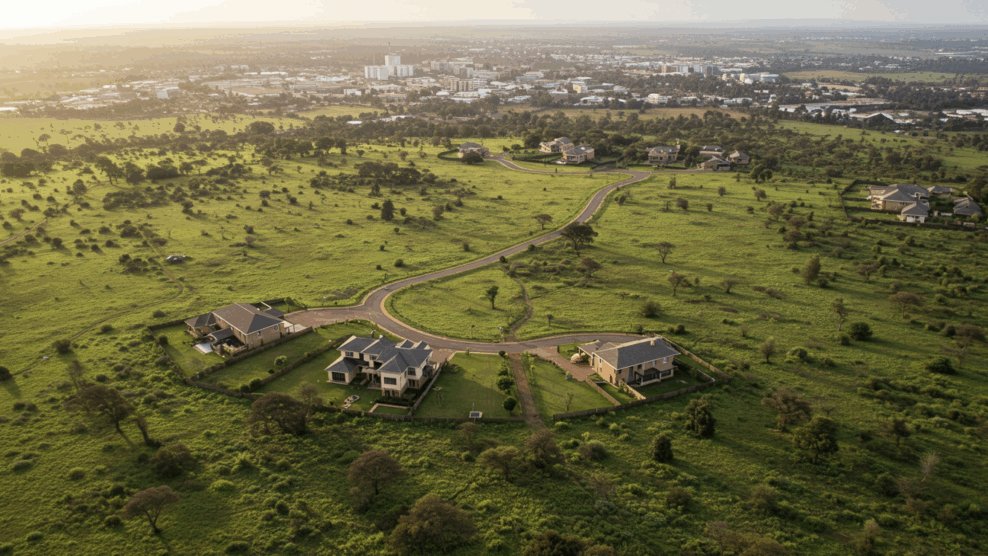

The satellite towns that carried Nairobi's land price boom for a decade are cooling down. The data is now clear enough that buyers are starting to act on it.
According to HassConsult's Land Price Index for the first quarter of 2026, released on April 29, seven of the 14 satellite towns surveyed recorded negative price movement in the quarter. Athi River posted the steepest decline at 2.5 percent, with the average price of an acre falling from Ksh 21.3 million to Ksh 20.8 million in three months. Ngong followed at negative 1.7 percent, where an acre now averages Ksh 35.6 million. Syokimau dropped 0.7 percent to Ksh 39.5 million per acre. Limuru and Tigoni each recorded falls of 0.7 percent and 0.9 percent respectively. Kiserian and Mlolongo posted marginal declines of 0.1 percent each.
In Nairobi's established suburbs, five locations also recorded contractions. Muthangari led with a 2.8 percent drop, followed by Loresho at 2.0 percent, Kitisuru at 1.5 percent and Muthaiga at 0.7 percent.
HassConsult Co-Chief Executive Officer Sakina Hassanali identified two forces behind the softening. The first is that the infrastructure-led uplift that drove satellite town land values over the past decade has largely been priced into current valuations. The road expansions, expressways and bypass projects that made Athi River, Ngong and Syokimau attractive to buyers have already done their work on prices. The speculative upside has narrowed. The second is that middle-income Kenyans, historically the engine of self-build demand in satellite towns, are under financial pressure. Tightening household finances have reduced the flow of buyers able to clear the initial hurdle of a land purchase, even at the more affordable price points these areas offer.
The report also flagged a broader shift in investor behaviour. Capital that previously went into land purchases is increasingly moving into government securities and unit trusts, reflecting a wait-and-see stance ahead of the 2027 elections and amid ongoing economic uncertainty.
Not all locations are declining. Ruiru along Thika Highway posted the strongest satellite town performance at 2.8 percent quarterly growth, followed by Juja at 1.2 percent, Ongata Rongai at 0.9 percent and Kitengela at 0.8 percent. In the suburbs, Nyari led with a 3.1 percent rise to Ksh 125 million per acre, Lang'ata grew 2.4 percent to Ksh 90.9 million, and Kileleshwa rose 1.6 percent to Ksh 336.2 million.
At the top of the market, Upperhill remains the most expensive location in the country at Ksh 561.1 million per acre, with Westlands close behind at Ksh 501.6 million per acre.
For developers and self-builders watching the market, the divergence is the story. Infrastructure corridors like Thika Road are still performing. Areas where the infrastructure story is complete and economic pressure has reduced buyer activity are giving ground. The window where satellite town land was simultaneously affordable and rising is narrowing. What replaces it will depend on whether household incomes recover and whether the pipeline of institutional developers filling the gap left by individual buyers proves deep enough to sustain values.
Comments (0)
Leave a Comment
No comments yet. Be the first to share your thoughts!