
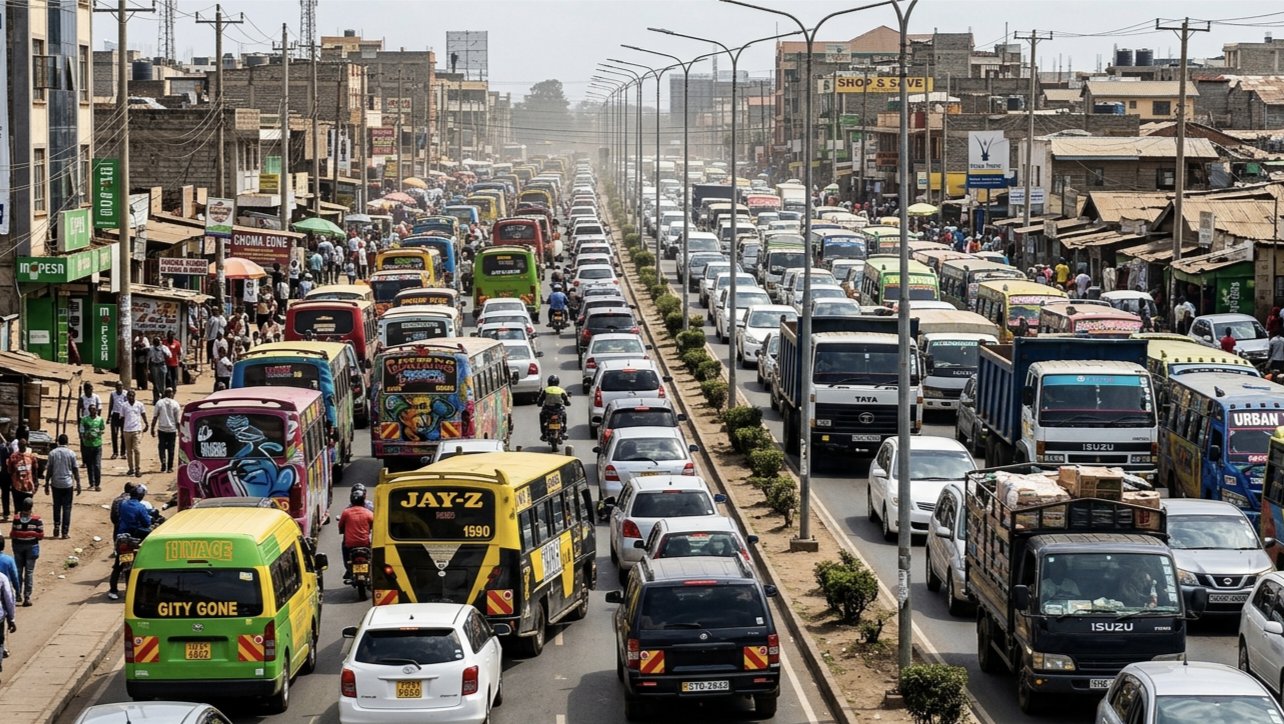

A Sh7.6 billion infrastructure contract for one of Nairobi's most congested corridors was awarded to a Korean firm, signed, and entered its implementation phase, all while a local contractor was still fighting it in court.
That is where Nairobi's Bus Rapid Transit (BRT) Line 5 project currently stands.
The Kenya Urban Roads Authority (KURA) signed a contract with YOUNGJIN Joint Venture on March 4, 2026, for the construction of a 10.5-kilometre dedicated bus corridor along Nairobi's Outer Ring Road, running from the former Taj Mall site in Embakasi to the Allsops interchange on Thika Road. The project is funded by a USD 59 million loan from the Export-Import Bank of Korea under the Economic Development Cooperation Fund (EDCF) framework.
That funding structure is the source of the controversy. EDCF loans come with tied procurement conditions, meaning the borrowing government is required to restrict bidding to firms from the lending country. When KURA published the tender notice in September 2024, it was explicitly limited to companies from the Republic of Korea. No Kenyan contractor, no matter their capacity, could bid.
Beyond Trading Company Limited, a Nairobi-based contractor, went to the High Court in January 2026 arguing that the restriction was unconstitutional and in violation of fair procurement principles. The firm maintained that locking out local and other international bidders denied Kenyan companies a legitimate business opportunity on a project being built on Kenyan soil with money borrowed in Kenya's name. CK Solutions Limited, a Korean multinational with a local representative also involved in the dispute, had separately challenged the award before the contract was signed.
KURA Director General Silas Kinoti, speaking at the contract signing ceremony on March 4, acknowledged the delays the project had experienced but said the authority was committed to fast-tracking delivery. KURA and the Public Procurement Administrative Review Board (PPARB) had opposed the court applications throughout, arguing that the procurement process complied with the law and that halting the project would disrupt critical infrastructure development.
The court allowed the case to proceed but did not issue an injunction stopping the contract. Construction is now underway.
What YOUNGJIN Joint Venture will build is substantial. The project includes a two-lane dedicated BRT road, three river bridges, two overpass flyovers, 13 BRT stations, pedestrian footbridges, comprehensive drainage works, street lighting, Closed Circuit Television (CCTV) surveillance, vehicle enforcement systems and an intelligent fare collection system. A dedicated BRT depot covering 1,365 square metres will also be constructed. Completion is targeted within two years of the March 2026 contract signing.
BRT Line 5, also known as Nyati, is one of five BRT corridors planned for Nairobi under the Nairobi Metropolitan Area Transport Authority (NAMATA) integrated urban development masterplan. The other lines are Ndovu, running from Limuru through Kangemi to the Central Business District (CBD); Chui, from Njiru to the Showgrounds off Ngong Road; Kifaru, from Mama Lucy Hospital to T-Mall on Langata Road; and a fifth line connecting Ruiru to Kenyatta National Hospital. The Ruiru to KNH line had Ksh 3 billion allocated by Parliament in June 2024 for completion of remaining works.
The Outer Ring Road corridor serves some of Nairobi's most densely populated residential and commercial areas, including Eastleigh, Donholm, Embakasi and Umoja. Daily congestion on the route costs commuters hours and businesses productivity. Whether a Korean-built BRT system delivers the relief the corridor needs, and whether the legal dispute shadows its implementation, will become clearer as construction advances through 2026 and 2027.
Comments (0)
Leave a Comment
No comments yet. Be the first to share your thoughts!