
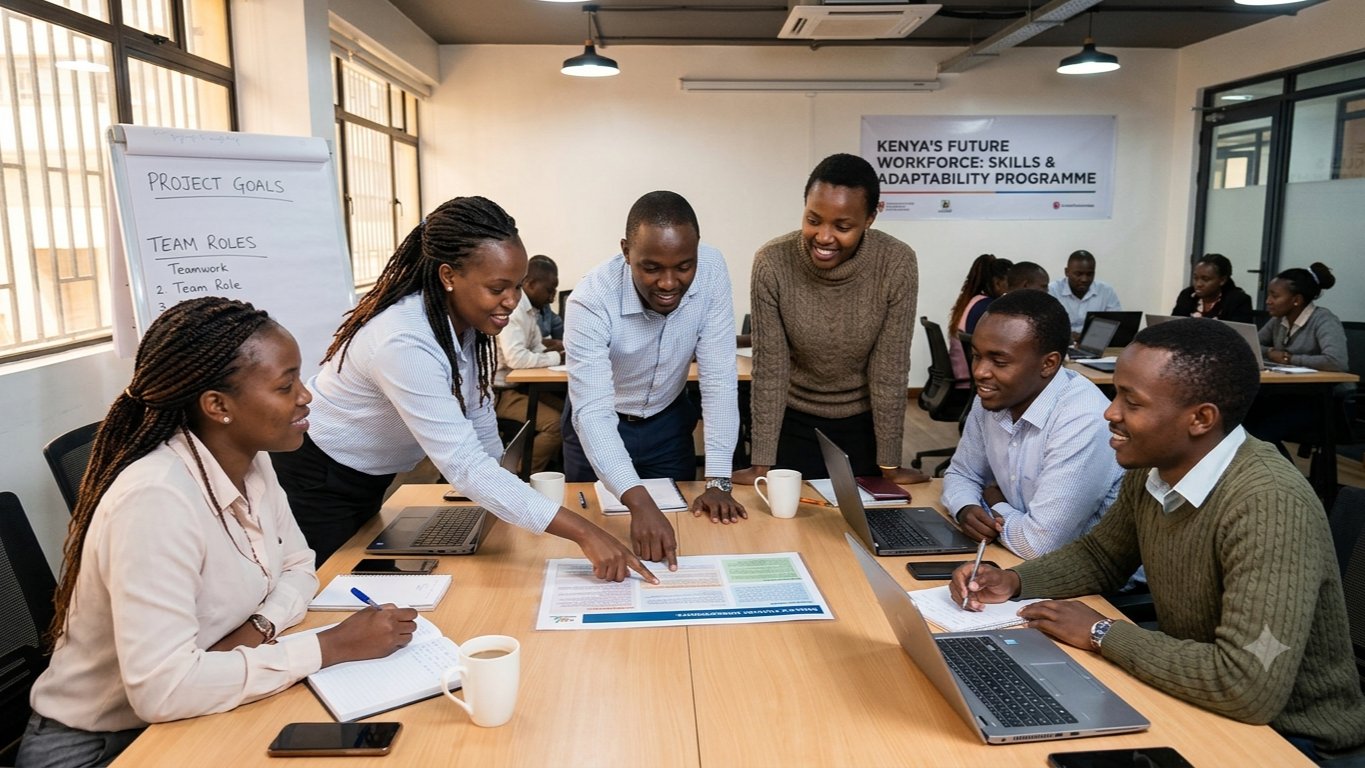

Preparing young people for employment has grown more complicated in Kenya as industries evolve under pressure from new technologies and shifting economic realities. Technical and vocational training still matter. Yet employers increasingly seek capabilities that go beyond specific job skills.
Vincent Otieno Odhiambo, Regional Director at Ashoka East Africa, made this point in a recent contribution. He noted that artificial intelligence, climate pressures, and demographic changes are reshaping entire sectors. Careers that exist today may look very different in a decade or disappear altogether.
This situation raises questions about how education systems, training institutions, and employers approach workforce development. For years the emphasis in Kenya has fallen on expanding access to technical courses in areas such as engineering, construction trades, information technology, and agriculture. Those foundations remain necessary.
However, Odhiambo argues they are no longer enough on their own. Young people also need strengths that allow them to operate in uncertain conditions. These include the ability to solve problems that lack clear instructions, work across different teams and cultures, and adjust quickly when circumstances change.
Africa’s youthful population adds urgency to the discussion. Millions of young Kenyans will enter the job market in coming years. Formal wage employment will not absorb everyone. Many will need to create opportunities through entrepreneurship or community initiatives. Success in those roles often hinges as much on interpersonal and adaptive abilities as on pure technical knowledge.
Cognitive empathy sits high on the list of needed attributes. It involves understanding other people’s perspectives and experiences. In practice this helps professionals design better products, build more inclusive workplaces, and resolve conflicts within organisations. Construction firms, for example, increasingly manage diverse teams drawn from different counties and backgrounds. Leaders who can bridge those differences tend to deliver projects more smoothly.
Collaborative leadership represents another key area. Traditional top-down models are giving way to approaches that bring together government, private companies, civil society, and local communities. Large infrastructure projects in Kenya often require exactly this kind of coordination. Roads, housing schemes, and port expansions succeed when stakeholders align around shared goals rather than working in isolation.
Creative problem-solving gains importance as well. Many future challenges in sectors such as climate-resilient building or sustainable urban planning do not have ready-made answers. Professionals who can experiment, test ideas, and adapt hold an advantage. Kenya’s construction industry already faces issues ranging from material costs to environmental regulations. Those who can innovate within those constraints stand out.
Sophisticated teamwork ties these elements together. Modern projects rarely involve single disciplines. Engineers work with environmental specialists, financial experts, and community liaison officers. The ability to communicate across those lines and integrate different kinds of expertise has become a practical requirement on Kenyan work sites.
Odhiambo frames these capabilities as mutually reinforcing. Empathy helps identify real needs. Creative thinking generates options. Collaborative leadership brings people together. Teamwork turns ideas into results. Taken as a package they support both individual employability and broader national competitiveness.
Kenyan institutions have started responding in various ways. Some universities and technical colleges have introduced modules on entrepreneurship, leadership, and soft skills. Certain large employers run internal training programmes that blend technical upgrading with teamwork exercises. Yet scaling these efforts across the country remains a work in progress.
The conversation comes at a time when Kenya continues investing heavily in infrastructure and industrial growth. Realising the full value of those investments will depend on having workers who can not only operate new systems but also improve and adapt them over time.
Africa does not need a generation trained only to fit existing structures, Odhiambo concludes. It needs people equipped to strengthen and reimagine those structures for the benefit of wider society. How quickly education and training systems move in that direction could influence economic outcomes for years ahead.
Comments (0)
Leave a Comment
No comments yet. Be the first to share your thoughts!