
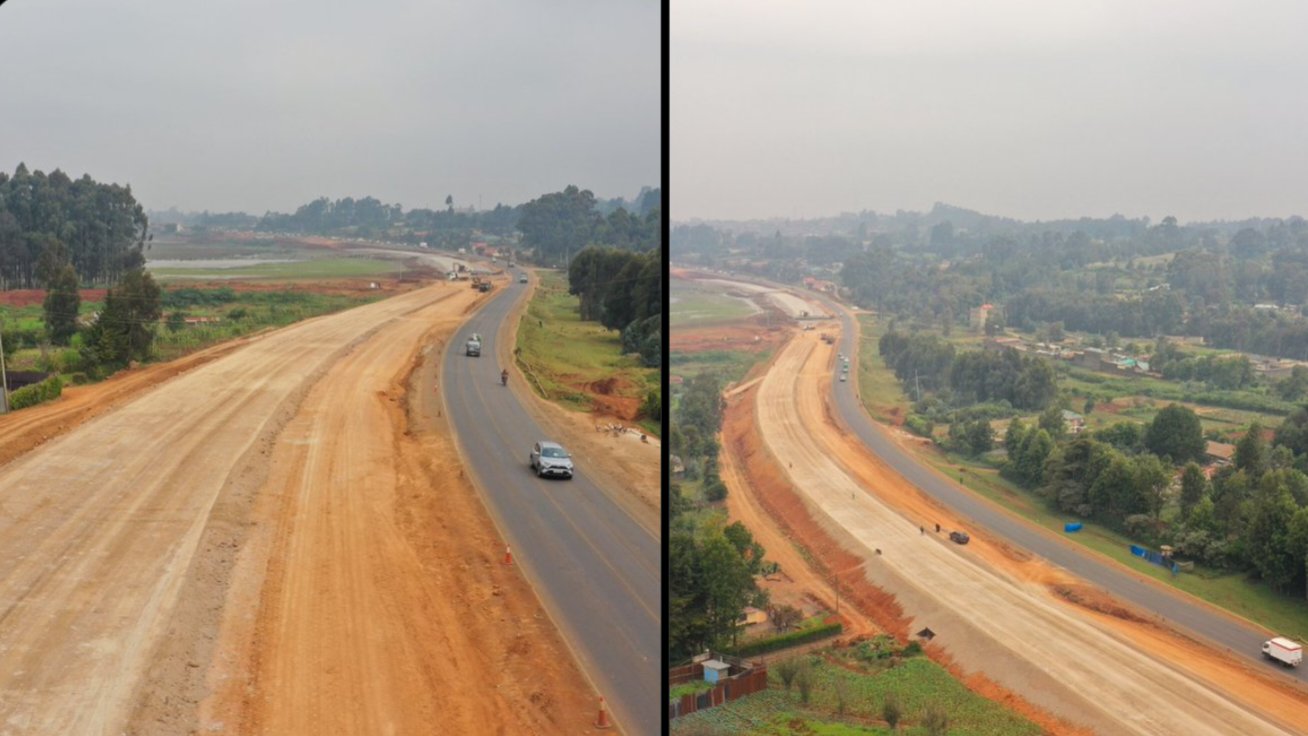

The construction of the Rironi to Mau Summit road project is making steady physical progress on multiple fronts. The state agency responsible for national highways confirmed the development, which follows ongoing site assessments along the busy transport corridor.
Contractors are actively executing earthworks, road widening, and drainage system installations across the heavily congested route. The multi-billion shilling infrastructure initiative aims to modernize the Northern Corridor, which improves regional transport efficiency.
The Kenya National Highways Authority (KeNHA) maintains a technical project completion timeline targeted for June 2027, although President William Ruto directed the contracted engineering firms to expedite construction operations for an earlier delivery by April 2027.
Roads and Transport Cabinet Secretary Davis Chirchir stated that the crucial Rironi to Naivasha section should open to motorists by August 2026. This initial section forms part of the broader effort, which aims to ease traffic snarl-ups quickly.
The entire project expands approximately 233 kilometres of the existing highway, which links Nairobi to western parts of the country. According to engineering designs, the road starts at Rironi as a four-lane dual carriageway extending to Naivasha town.
From Naivasha to Nakuru, where traffic volumes reach peak levels, engineers are widening the highway into three lanes on each side. An elevated road section will be constructed through Nakuru City, which bypasses intense local urban congestion.
The development is divided into distinct construction sections managed by different international engineering firms. China Road and Bridge Corporation (CRBC) is currently executing construction works on the initial section, which lies between Rironi and Gilgil.
This specific phase involves a Public-Private Partnership (PPP) arrangement between the Chinese firm and the National Social Security Fund (NSSF). The state pension fund holds a 40 per cent financial stake, which protects local workers' investments.
The remaining section from Gilgil to Mau Summit is being handled by Shandong Hi-Speed Road and Bridge International. This 94-kilometre portion is being delivered under a design, build, finance, operate, maintain, and transfer framework agreement, which spans thirty years.
KeNHA officials reported during recent inspections that CRBC completed roughly 15 per cent of its assigned works. Meanwhile, the engineering teams from Shandong Hi-Speed Road and Bridge International achieved approximately 10 per cent completion, which aligns with initial expectations.
The private investors bear full demand and revenue risks during the concession period, which protects public funds. The National Treasury structured the contract to omit any minimum revenue guarantees, but the developers will share excess profits with the state.
Motorists will pay a designated toll fee calculated at approximately eight shillings per kilometre once the expanded highway opens. The government confirmed that alternative public roads will remain fully open for drivers, who choose not to pay.
Current site activities focus heavily on relocating public utilities like power lines, water pipes, and communication networks. KeNHA is coordinating with utility firms to ensure these realignments do not slow down the physical construction pace, which requires careful planning.
The existing corridor handles around 40,000 vehicles daily, which causes frequent travel delays and safety challenges for regional cargo trucks. Local businesses expect the expanded dual carriageway to reduce overall fuel consumption, but drivers must brace for short-term diversions.
The infrastructure expansion also supports regional trade by connecting the Port of Mombasa to landlocked neighboring countries. President Ruto indicated that future development phases will eventually extend the high-capacity highway to the Malaba border town, if additional financing is secured.
Comments (0)
Leave a Comment
No comments yet. Be the first to share your thoughts!