
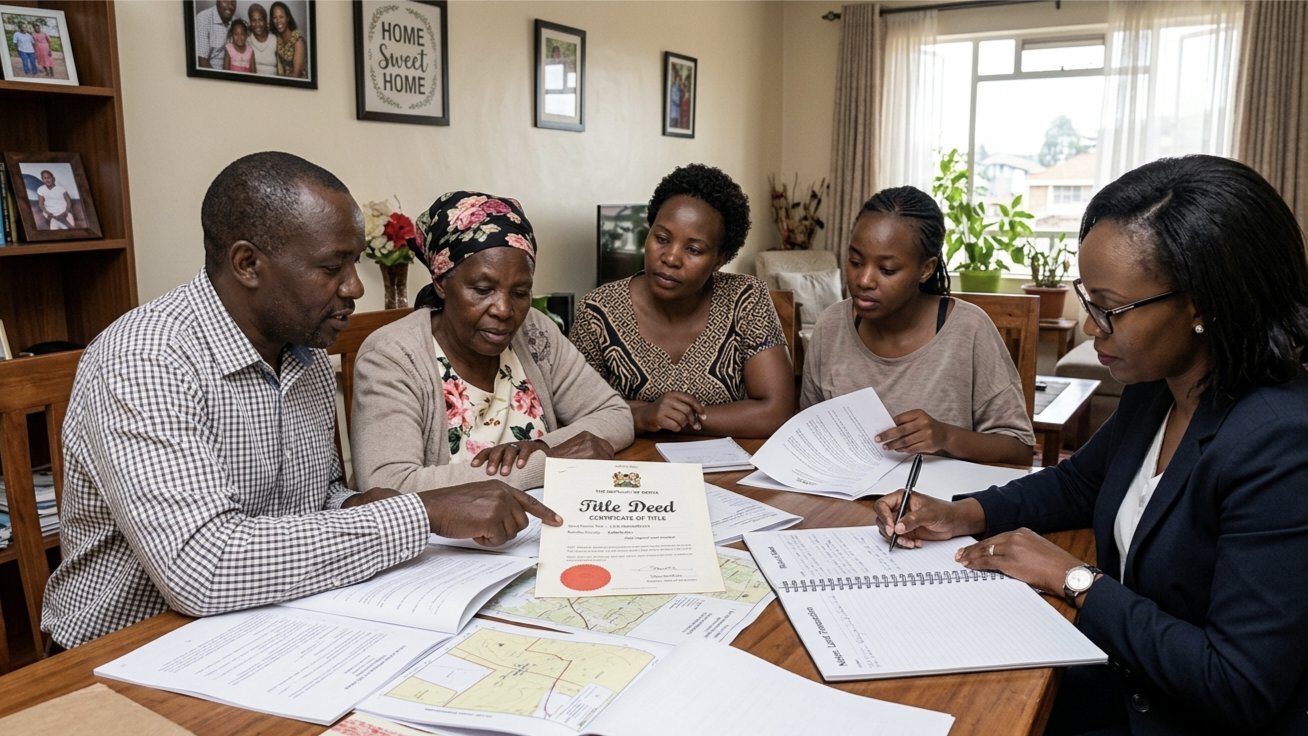

She worked alongside her husband for decades, helped build their home and raised their children. When he died without a will, she found herself fighting his relatives for property she believed was hers.
That scenario is playing out in courtrooms across Kenya every day.
Kenya's Law of Succession Act, Chapter 160 of the Laws of Kenya, has governed inheritance since 1981. It has barely changed since. When a person dies without a valid will, the law describes them as having died intestate, and the Act prescribes exactly how their estate is divided. The problem is that most Kenyans either do not know the rules or assume that family agreements will override them. They rarely do, and courts are the ones left to untangle the consequences.
Under intestate succession, a surviving spouse does not automatically inherit the entire estate. If the deceased left a surviving spouse and children, the spouse receives the personal and household effects absolutely and a life interest in the rest of the estate. A life interest means the spouse can use and benefit from the property during their lifetime but cannot sell, transfer or subdivide it without court approval. Upon the surviving spouse's death, the estate passes to the children. If the deceased left no children, the spouse inherits the entire estate outright.
The complications multiply in polygamous households, which remain common across many Kenyan communities. Where a man dies leaving multiple wives and children from each, the estate is divided among the houses, and disputes over which children belong to which house, which house received more during the deceased's lifetime, and which property was acquired before or after a particular marriage are extremely common. A deceased man with four wives and 31 children, as appeared in one documented 2025 court case, leaves a succession process that can take years and cost the estate more in legal fees than some of the assets being disputed are worth.
The gender dimension of Kenya's succession law has also attracted judicial attention. Section 29C of the Law of Succession Act requires a surviving husband to prove he was financially maintained by his deceased wife before he can inherit her estate. No equivalent burden is placed on widows. In 2025, the High Court declared that provision unconstitutional, finding that it imposed an unfair gender-based hurdle exclusively on men.
For property specifically, the process of transferring a title deed after death requires a grant of representation from the High Court or a Resident Magistrate's Court with jurisdiction in succession matters. The process involves filing a petition, publishing notices, waiting for objections, obtaining a grant, confirming the grant and finally transmitting the property into the names of the beneficiaries. For an uncomplicated estate with no disputes, the process takes a minimum of six to twelve months. For contested estates, it can run for years.
The most common source of disputes is not malice. It is the absence of documentation. When a title deed remains in a deceased person's name for years after death, and family members informally occupy, develop or sell portions of the land without going through the succession process, the resulting tangle of undocumented interests, informal agreements and competing claims becomes extremely difficult and expensive to unwind.
The fix is straightforward but requires action while a person is still alive. A valid will, drawn up by an advocate and properly witnessed, allows a person to direct exactly how their property should be distributed. It does not eliminate succession, but it gives the court a clear instruction to follow rather than a family argument to resolve. A will that is properly drawn costs a fraction of what a contested succession case costs in court fees, advocate fees and lost time.
Kenya's courts are full of disputes that a single document could have prevented.
Comments (0)
Leave a Comment
No comments yet. Be the first to share your thoughts!