
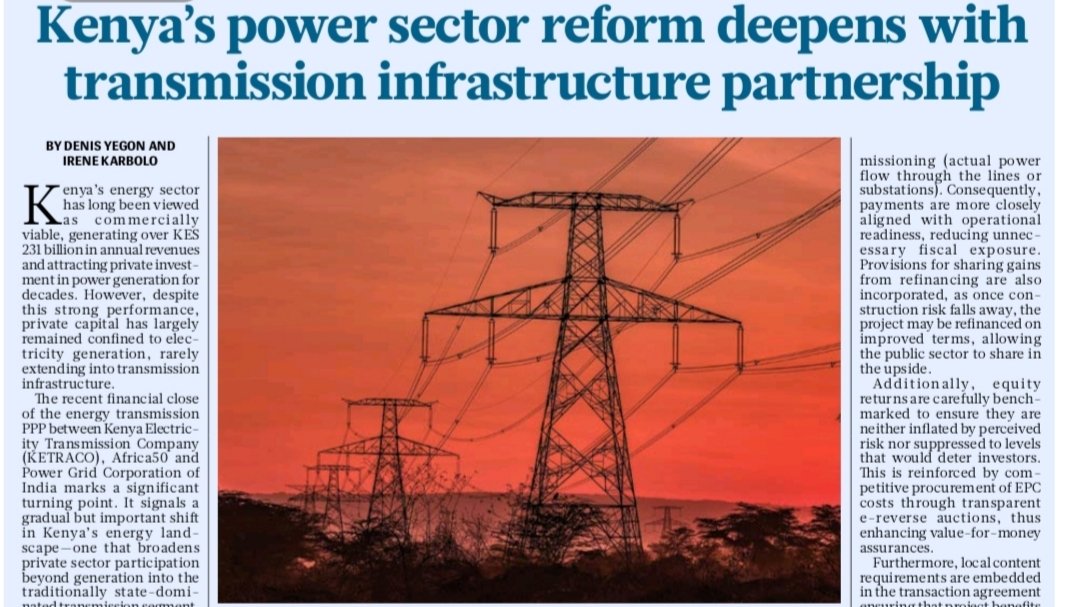

Kenya’s Public Private Partnerships Directorate has confirmed commercial close on the country’s first transmission PPP transaction. The agreement between KETRACO, Africa50 and POWERGRID takes private capital beyond power generation and directly into the national grid for the first time.
Transmission projects have always demanded heavy upfront investment. Once built, however, they deliver predictable operating costs and reliable long-term cash flows. Those qualities now draw institutional investors such as pension funds that seek stable infrastructure returns.
The deal tackles Kenya’s persistent transmission financing gap while supporting the rapid growth of renewable energy. Although the power sector already produces annual revenues above KES 231 billion, private money has historically stopped at the plant gate.
Two lines anchor the transaction. The 400kV Lessos–Loosuk line offers an alternative evacuation route for the Lake Turkana Wind Power project and crosses the North Rift geothermal zone, positioning it as the main corridor for future geothermal output. The 220kV Kibos–Kakamega–Musaga line extends high-voltage supply into Western Kenya, boosting renewable penetration in underserved regions and expanding access.
Together the projects are expected to displace costly thermal generation in the west, reduce system losses, connect new customers and improve reliability. While availability payments may cause a modest short-term tariff rise, the long-run marginal cost of electricity should fall.
Project selection rests on the Least Cost Power Development Plan, which gives investors transparent data on future demand and load growth.
The structure uses an availability-based payment model under which the private partner is paid for keeping the assets operational to agreed standards rather than for actual power flows. This approach matches national grid realities and follows best practice in Latin America and India.
A blended currency tariff splits payments between local and hard currency to reflect the project’s cost base and protect against forex volatility. Commissioning is divided into cold and hot stages so payments begin only when lines or substations reach operational readiness.
Refinancing gains will be shared with the public sector, and equity returns have been benchmarked to avoid extremes. Competitive e-reverse auctions lock in EPC costs, while local content clauses ensure domestic benefits.
Officials say the transaction offers broader lessons. Tenacity proved essential through lengthy negotiations that were sometimes adversarial. Strong coordination among government agencies, sponsors and lenders, backed by structured public engagement, helped keep the process on track.
Yet the milestone has drawn criticism. On social media, some voices argue the arrangement will saddle Kenya with KES 44.05 billion in new debt and impose a fresh tariff on power bills for the next 30 years to repay the loan. One commentator described it as auctioning public services to private interests and insisted that republics are not private enterprises.
The PPP Directorate maintains that the model remains a template for scaling grid modernisation and advancing clean energy goals. Services on the two lines are now expected to move forward under the agreed framework.
Comments (0)
Leave a Comment
No comments yet. Be the first to share your thoughts!