

Kenya is set to gain two new undersea fibre optic cables before 2027, part of a wider scramble across Africa for greater bandwidth as artificial intelligence adoption accelerates.
The first is a 4,108-kilometre (2,553-mile) subsea cable connecting Oman to Mombasa, developed through a partnership between Meta and Safaricom, according to telecom research firm TeleGeography.
The second, known as Africa-1, is a roughly 10,000-kilometre (6,214-mile) international submarine cable running from France to the Middle East via the African coast. TeleGeography expects it to land in Kenya next year.
Undersea cables, also called submarine communications cables, are laid along the ocean floor to carry data between continents. They form the backbone of global internet traffic, supporting email, web browsing and video calls worldwide.
One widely cited estimate holds that more than 95 percent of international internet traffic moves through undersea cables rather than satellites.
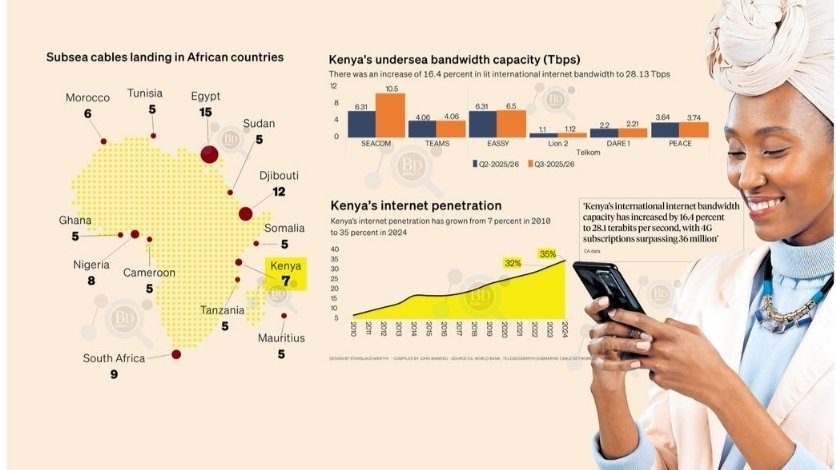
Kenya currently hosts seven subsea cable landings, ranking fifth in Africa behind Egypt's 15, Djibouti's 12, South Africa's nine and Nigeria's eight, according to the report.
The two additional cables would expand Kenya's capacity as the country works to close the gap with the continent's leading connectivity hubs.
Satellite internet services such as Starlink have grown more accessible in recent years, but remain considerably costlier than undersea cables for transmitting large volumes of data.
Major technology firms have poured significant capital into subsea cable infrastructure globally. Google has said its own cable investments aim to deliver strong connectivity across five continents while supporting its artificial intelligence operations.
Kenya's international internet bandwidth capacity rose 16.4 percent to 28.1 terabits per second, while fourth-generation mobile subscriptions surpassed 36 million by March 2026, according to the report.
The new cables are expected to help meet rising demand for digital services among households and businesses across the country.
Kenya's push to secure additional submarine cable landings reflects a broader strategic effort to support the infrastructure needed for data centres, digital trade and continued innovation across East Africa, as investment in artificial intelligence and cloud computing accelerates regionally.
Comments (0)
Leave a Comment
No comments yet. Be the first to share your thoughts!