
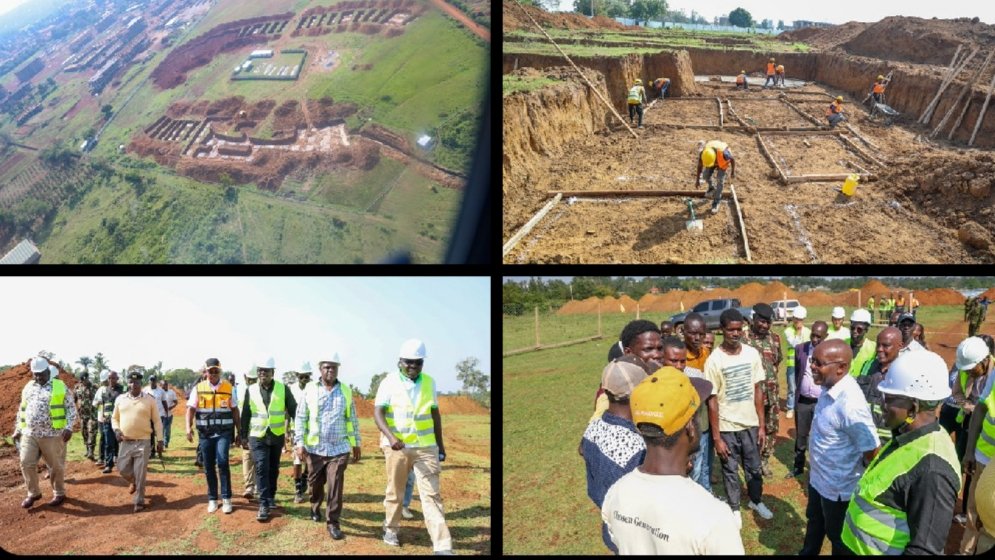

Principal Secretary for Defence Dr Patrick Mariru undertook a site inspection visit to the proposed Busia Stadium in Busia County on Friday morning. He assessed the progress of construction and reviewed the milestones being achieved on the national sporting infrastructure project.
The project is currently at approximately 5 percent completion. Excavation works for the Western and Eastern Pavilions are ongoing, alongside blinding works.
Upon completion, Busia Stadium will have a 10,000-seater capacity. It will feature a FIFA-standard natural-grass football pitch supported by a modern pop-up irrigation system, an eight-lane tartan athletics track, and dedicated facilities for field events.
The scope of works also includes three VIP lounges, changing rooms, spectator ablution blocks, equipment stores, a roof canopy covering the entire stadium, a perimeter wall, a ring road, cabro-paved parking areas, as well as comprehensive mechanical and electrical installations.
Managed by the Ministry of Defence, the project is designed to meet modern international sporting standards. It will transform Busia’s sporting landscape by providing a quality facility for training, competitions and major national and regional sporting events.
Beyond sports, Busia Stadium will create opportunities for youth empowerment, talent development, employment and increased economic activity. Officials remain committed to ensuring that the project is delivered to the highest standards and that the people of Busia receive a modern sporting facility.
The early stage of works focuses on preparing the ground for the main structural elements. Excavation and blinding for the pavilions form the foundation for the seating areas that will eventually accommodate 10,000 spectators.
The FIFA-standard pitch and pop-up irrigation system are intended to support high-quality football matches and training. The eight-lane tartan track and field-event facilities will allow the stadium to host athletics competitions as well.
A full roof canopy is a notable feature. It will provide weather protection across the entire seating area, improving spectator comfort during both dry and rainy seasons.
Support facilities such as VIP lounges, changing rooms and ablution blocks are included to meet the operational requirements of a modern stadium. Equipment stores and comprehensive mechanical and electrical systems will support day-to-day running of the venue.
The perimeter wall, ring road and cabro-paved parking are designed to improve access, security and circulation around the stadium. These elements form part of the overall site development.
Ministry of Defence management of the project is presented as a guarantee of technical oversight and adherence to standards. The inspection by the Principal Secretary forms part of regular monitoring of progress.
Once complete, the stadium is expected to serve as a regional sporting hub. It will offer local athletes better training conditions and create a venue capable of attracting larger events.
Youth empowerment and talent development are listed among the wider benefits. Employment during construction and later operational phases is also anticipated to support the local economy.
The 5 percent completion mark reflects the current focus on foundational works. Subsequent phases will see the rise of the pavilions, installation of the pitch and track, and completion of all support facilities.
Comments (0)
Leave a Comment
No comments yet. Be the first to share your thoughts!