
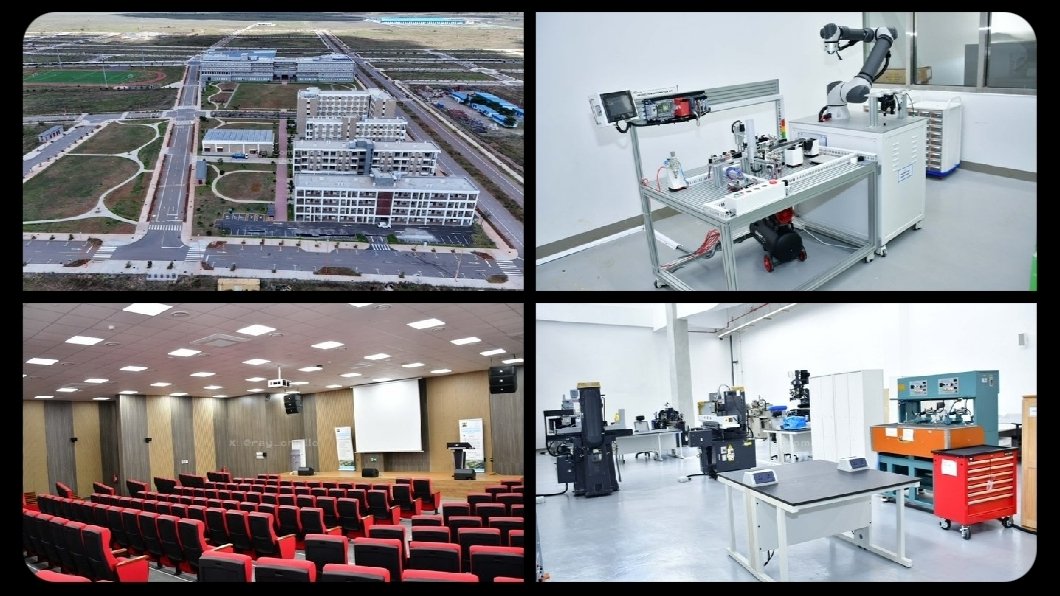

The Kenya Advanced Institute of Science and Technology has received its charter from President William Ruto. The institution becomes Kenya’s first public postgraduate-only university and sits squarely inside Konza Technopolis. It is fully funded through scholarships.
Modelled directly on the Korea Advanced Institute of Science and Technology, the new university aims to produce world-class scientists, engineers and researchers. Its establishment marks a deliberate step toward building a knowledge-driven industrial base.
The campus occupies a strategic position within Konza’s industrial ecosystem. It stands alongside advanced manufacturing zones, including the Lucky DJX Jeans EPZ hub, and the National Data Centre. A dedicated robotics innovation space forms part of the layout.
Facilities include a comprehensive utility building that handles potable water supply, rainwater harvesting and fire-water systems. Residential hostels cater for both single and married postgraduate students. The design supports a “plugged-in” model where research prototypes, patents and systems can move quickly from laboratory to nearby production facilities.
Power infrastructure draws on Konza’s 2N+1 architecture plus a 200kVA backup system. Water reclamation systems ensure reliable supply for high-performance computing and laboratory work. These features create the uninterrupted environment required for advanced research.
Seven core disciplines anchor the academic programme: Mechanical Engineering, Nuclear Engineering, Electrical and Electronics Engineering, IT Engineering, Civil and Environmental Engineering, Chemical Engineering, and Agricultural Biotechnology.
The State Department for Internal Security and National Administration plays a supporting role. It safeguards the institute as a critical national asset, coordinates secure movement of sensitive research prototypes and maintains a protected knowledge corridor linking the university, data infrastructure and industrial zones.
Training and research systems are already in place. Facilities, expertise and an innovation ecosystem have been established to develop highly qualified professionals. The institution stands ready to drive technological advancement and support Kenya’s broader industrial transformation.
For the construction and infrastructure sector, Kenya-AIST represents a live example of integrated smart-campus development. The project demonstrates how research institutions can be embedded directly into larger technopolis planning rather than built as isolated campuses.
The charter award in May 2026 removes the final legal hurdle. Operations can now scale with certainty. Postgraduate students will soon occupy purpose-built hostels while laboratories and workshops begin full activity alongside neighbouring manufacturing and data facilities.
Success here would strengthen Kenya’s position in global science and technology networks. It would also reinforce Konza Technopolis as a functioning innovation district rather than a paper plan. Research-to-industry linkages built into the physical layout could shorten the time from idea to commercial application.
The combination of secure power, water systems, data connectivity and proximity to production zones creates conditions rarely found in traditional university settings. Kenya-AIST is therefore positioned to deliver practical outcomes in engineering, biotechnology and digital technologies.
Government officials describe the move as part of a wider strategy to align Kenya’s development path with lessons from leading innovation economies. The physical integration of the institute within Konza’s existing and planned infrastructure gives that strategy a concrete foundation on the ground.
Comments (0)
Leave a Comment
No comments yet. Be the first to share your thoughts!