
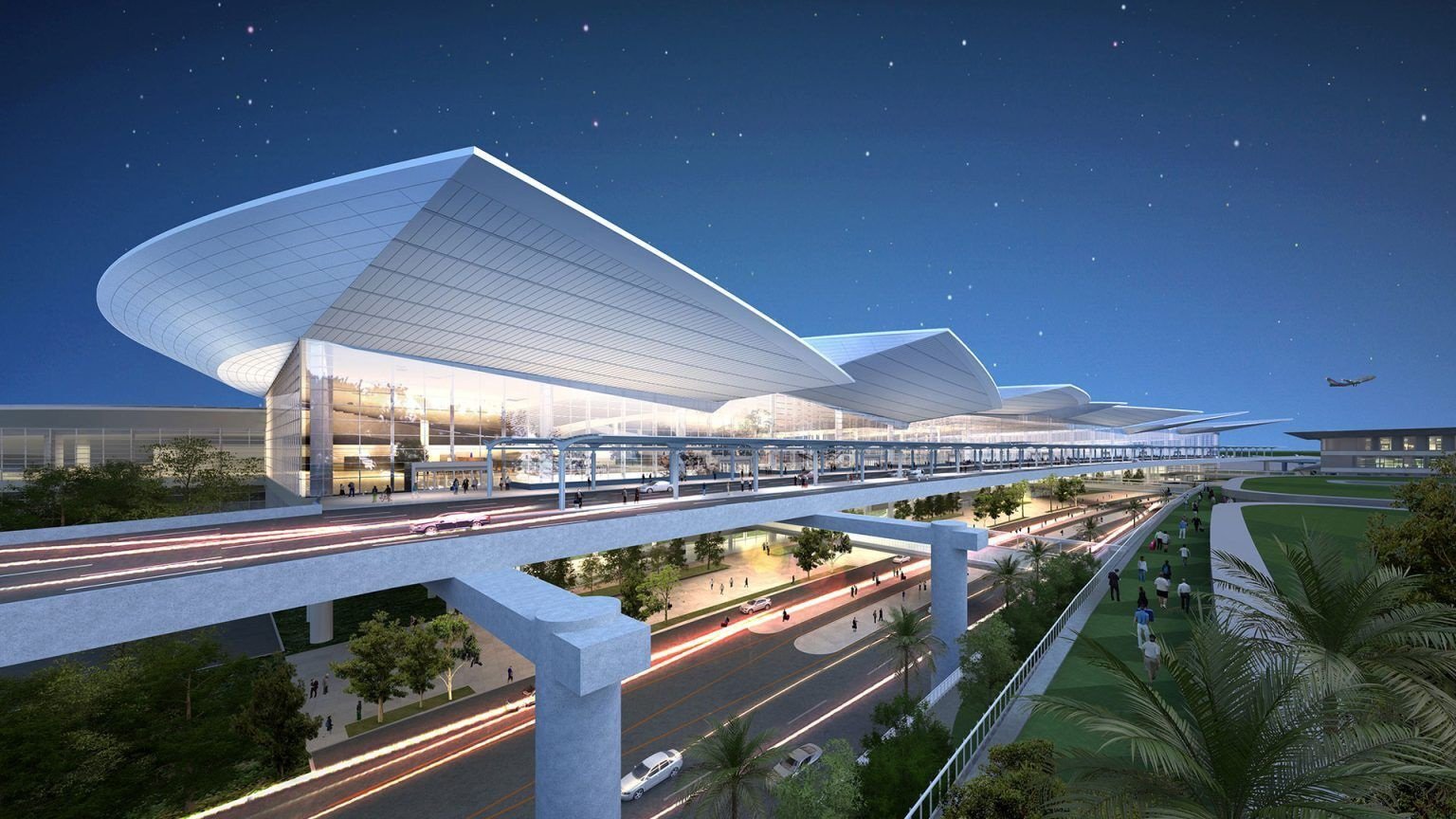

Vietnam has launched into a major regional aviation infrastructure race, backing a $16 billion greenfield hub designed to challenge established transit strongholds. The development of Long Thanh International Airport (LTH), located approximately 40 kilometers east of Ho Chi Minh City, signals an aggressive move to capture global transport market share.
The extensive project covers 5,000 hectares of land, a footprint larger than four London Heathrow airports combined. This vast scale targets regional dominance, putting Vietnam in direct competition with Singapore Changi International Airport.
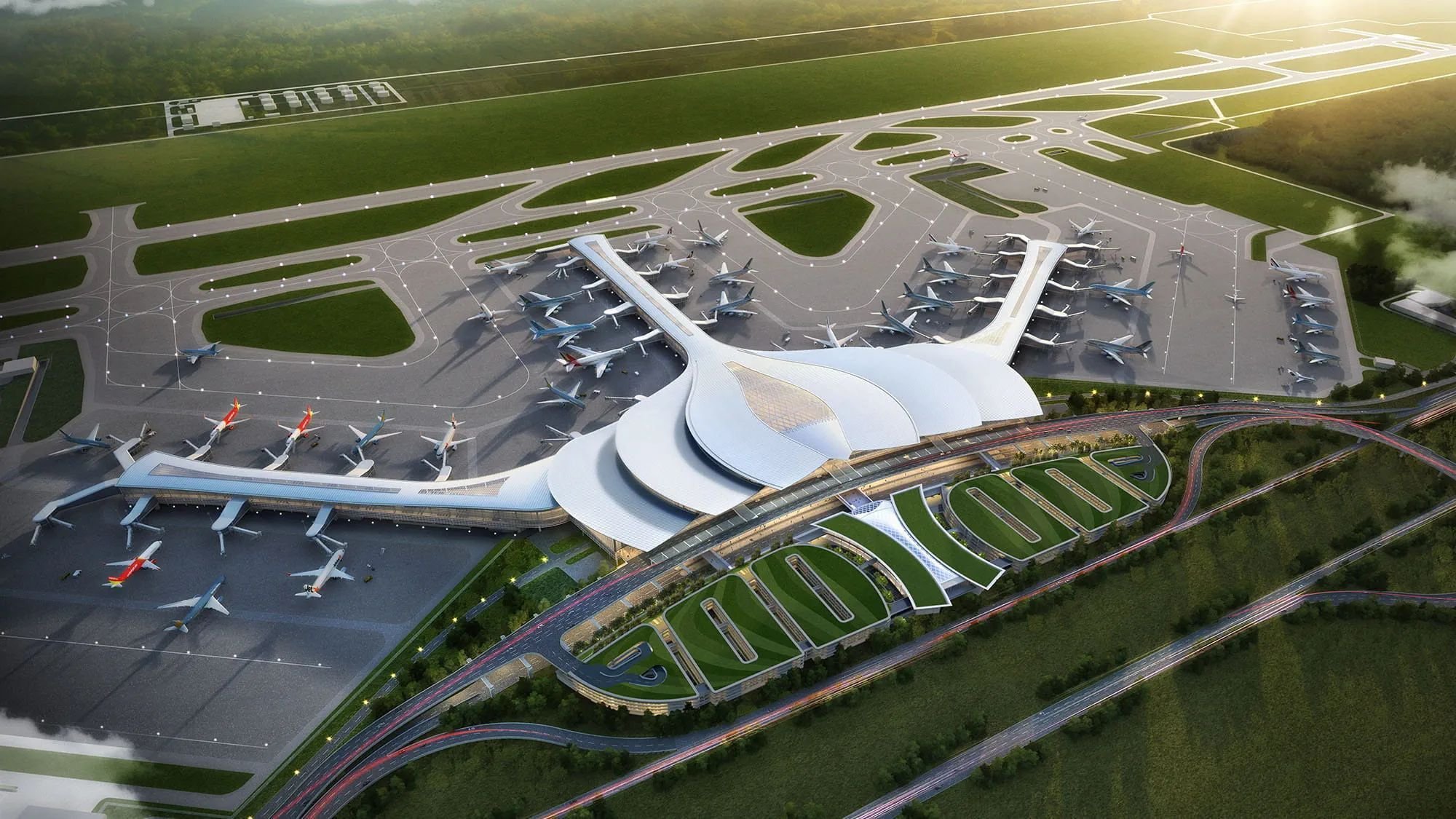
Aerial view render of the mega terminal /B1M
Singapore is currently executing its own $10 billion Terminal 5 expansion to raise total capacity to 150 million annual passengers by the mid-2030s.
The structural justification for the massive investment sits short distance away at the existing Tan Son Nhat International Airport. That facility handles roughly 40 million passengers annually, creating severe logistical gridlock.
Surrounding urban density blocks any physical expansion at the older site, forcing the government to build a brand-new gateway from scratch.
The Master Plan splits the megaproject into distinct construction phases. Initial works deliver a 373,000-square-meter terminal building spread across four floors.
Engineers opted for a complex steel-frame structure supported by heavy reinforced concrete columns. The building features a notable 82-meter clear-span roof engineered with five layers of steel to provide insulation and waterproofing without requiring dense internal support pillars.
A 123-meter-tall air traffic control tower, styled to resemble a lotus bud, manages the changing airspace. Crews have also poured the concrete for the first 4,000-meter runway, while an 8,668-meter perimeter wall encloses the active job site.
This first phase allows the facility to process 25 million passengers and 1.2 million tonnes of cargo every year.
Subsequent construction phases will add more assets to the site. Phase two adds a parallel runway and a second passenger terminal to elevate capacity to 50 million travellers.
The final build-out expands the asset portfolio to four passenger terminals and four 4,000-meter runways. Upon total completion, maximum capacity scales up to 100 million passengers and 5 million tonnes of freight annually, matching the throughput of major international logistics junctions.
Civil works have encountered distinct site challenges, particularly regarding the local geography. The airport is founded on red basalt soil, which creates highly visible dust plumes during heavy earthmoving operations.
High winds and heavy vehicle traffic have carried the bright red dust clouds up to seven kilometers away, blanketting nearby residential communities and drawing scrutiny.
The complex architectural forms also drive up technical difficulty. The lotus-inspired curves require more complicated structural geometries than standard right-angle layouts, increasing field labor and engineering oversight.
The state-backed Airports Corporation of Vietnam (ACV) remains under pressure to deliver the infrastructure, though the long-term financial returns depend on building high-capacity transit links like railways and expressways to Ho Chi Minh City.
Comments (0)
Leave a Comment
No comments yet. Be the first to share your thoughts!