
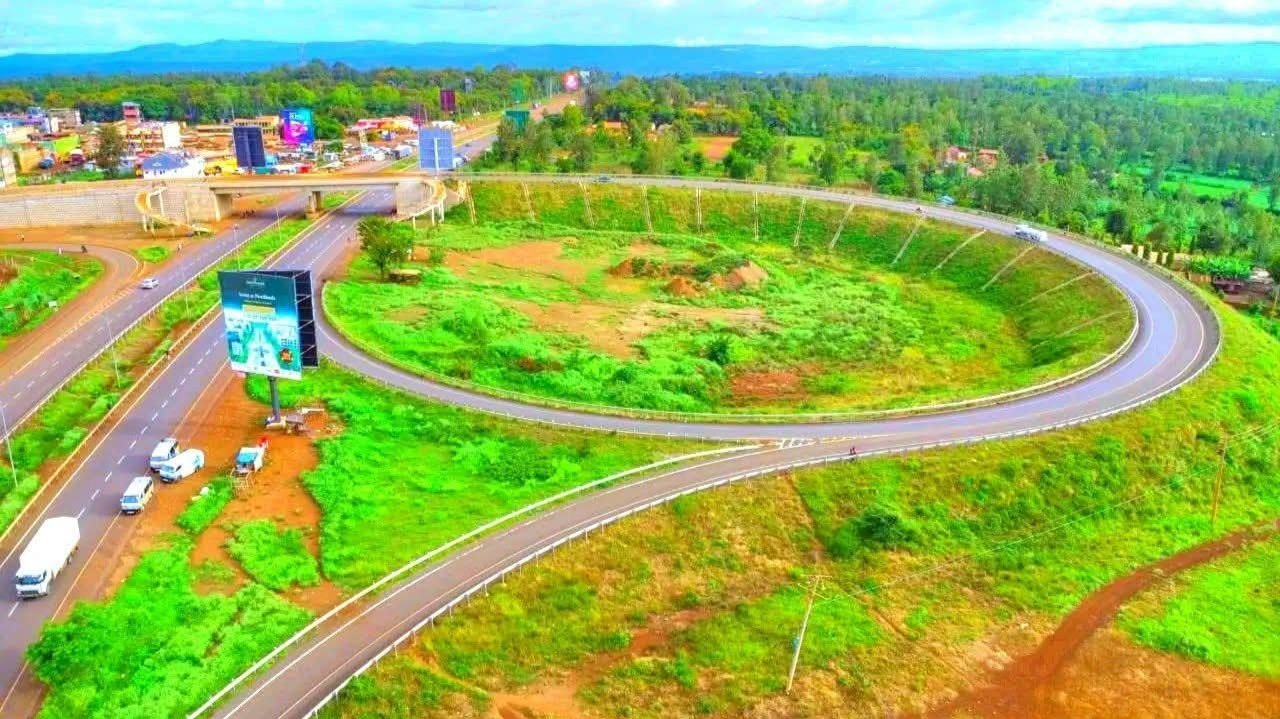

The Webuye Interchange has become an unlikely flashpoint on Kenyan social media, with multiple posts questioning why the government borrowed money to build a structure that, to the untrained eye, appears to carry little traffic.
Boss Yator, a well-known construction commentator and contractor with a strong following in Kenya's infrastructure space, was direct. "Why exactly did Uhuru Kenyatta take a loan to build this one? Clearly there are no vehicles here, there wasn't need to decongest, nonsense!!" The post drew over a thousand likes and 519 comments.
Separately, verified Facebook user Duncan Ndung'u posted the same aerial photograph with a more measured but equally pointed question: "What did this interchange try to achieve?" That post pulled 223 likes and 98 comments.
The structure in question is a trumpet interchange, a three-leg grade-separated junction built for exactly the kind of T-intersection found at Bungoma County, where the A1 Webuye–Kitale Road meets the A104 Northern Corridor. Its single looped ramp allows traffic to transition between the two roads without crossing opposing streams at ground level.
Completed in 2019, the interchange was part of the broader Webuye–Kitale road modernisation project. Chinese contractor Jiangxi Zhongmei Engineering Construction Co was engaged by the Kenya National Highways Authority (KeNHA) for the 58-kilometre stretch, at an initial cost of approximately Ksh 3.3 billion, funded jointly by the Government of Kenya and the World Bank.
The A104 is no minor road. It forms part of the Northern Corridor, the primary overland trade route linking the Port of Mombasa to landlocked countries including Uganda, Rwanda, and Burundi. Heavy freight from Kitale and Trans-Nzoia County filters onto this corridor daily at this exact junction.
Commenters in both posts pushed back on the criticism. "The fact that there is no congestion shows that the project is serving its purpose well," wrote one user. Another was blunter: "The vehicles are not congested there because the interchange is there."
Trumpet interchanges are not built to resolve existing gridlock alone. They are designed to handle projected traffic volumes over decades while eliminating the at-grade conflict points that cause accidents on busy corridors.
There is also the question of what "no vehicles" means in a single aerial photograph. A still frame is not traffic data.
Public scrutiny of Kenyan road spending is not without basis. Official transport ministry data shows at least 26 road projects between 2007 and 2017 overshot their budgets by more than Ksh 20 billion combined. The Webuye Interchange is not among those flagged projects.
What these posts may have exposed is a persistent gap between the technical rationale behind infrastructure investment and how it is communicated to the public who fund it.
Comments (0)
Leave a Comment
No comments yet. Be the first to share your thoughts!