
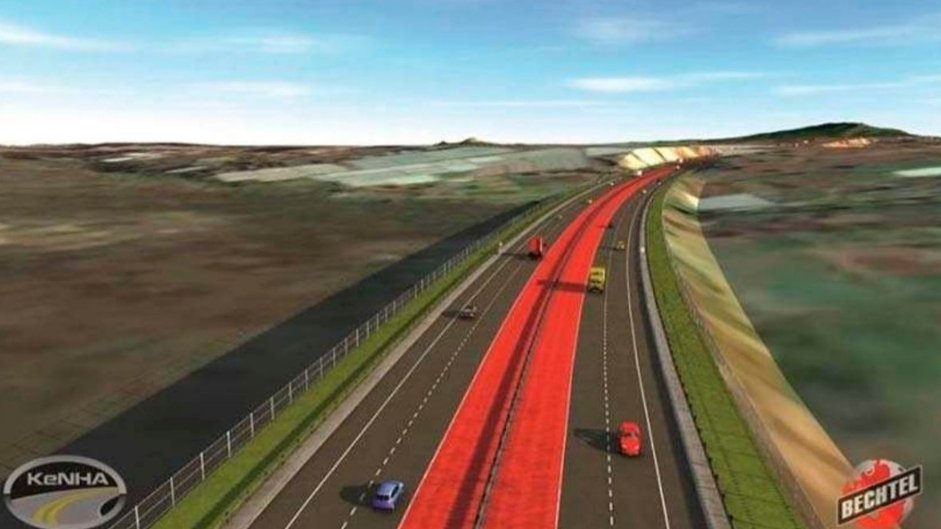

An American firm has lost its legal battle to salvage the proposed Sh468 billion Nairobi-Mombasa toll expressway.
The Public Private Partnership Petition Committee rejected the petition filed by Everstrong Capital and upheld the state’s decision to cancel the project.
The tribunal cited the company’s financial and technical weaknesses as the decisive factors.
The case drew attention to underlying China-US tensions in Kenyan infrastructure. Kenya had noted the American firm’s reluctance to partner with a Beijing-backed entity.
Everstrong Capital had submitted a privately initiated proposal for the 419-kilometre Usahihi Nairobi-Mombasa Expressway. It asked the tribunal to overturn the Public Private Partnership Committee’s rejection.
The panel ruled the project failed to meet statutory thresholds on financial capacity, technical feasibility and overall viability under the Public Private Partnerships Act.
At the heart of the collapse lay the exit of Portuguese contractor Mota-Engil.
The firm had been expected to supply both equity financing and specialist construction know-how. Its departure left the consortium without a cornerstone partner.
Mota-Engil is 40 percent owned by the Mota family and 32.41 percent by China Communications Construction Company. The latter is the parent of China Road and Bridge Corporation, which delivered Kenya’s standard gauge railway.
American lenders refused to back the highway while Chinese ownership remained in the consortium.
Tribunal filings showed Everstrong lacked proven experience delivering projects of comparable scale and complexity. The loss of Mota-Engil deepened doubts about its ability to raise the necessary equity.
Its financial position was judged too thin to support the multi-billion shilling venture.
Mota-Engil itself maintains a broad portfolio. It has completed construction works in roughly 50 countries, spanning roads, motorways, railways, airports, ports and dams.
The proposal had moved forward to the project development phase in 2023. That progress rested on the original partnership with Mota-Engil.
Later documents confirmed the contractor’s withdrawal.
Everstrong challenged the PPP Committee’s March 9 decision. It lodged the petition on April 1, arguing that earlier discussions had created a legitimate expectation of approval.
The firm pointed to a parallel procurement launched by authorities for transaction advisory services and fresh feasibility studies.
It accused the Public Private Partnership Directorate and Kenya National Highways Authority of breaching fairness, transparency and good faith.
The claims also alleged violations of the Constitution and the Public Private Partnerships Act.
The tribunal found otherwise.
It noted that Everstrong had not replaced Mota-Engil with a partner of equivalent financial and technical strength. State agencies had repeatedly flagged insufficient proof of equity contribution and fund-raising capacity.
“The evaluation process was structured, multi-layered, and based on statutory criteria,” the tribunal stated.
No procedural breach had been demonstrated.
Conditional approval was granted in 2023. Initial feasibility studies arrived in May 2025 but fell short of requirements.
In July 2025 the government instructed a restructuring. The scheme shifted from a new greenfield corridor to an expansion of the existing Mombasa Road.
A revised submission reached authorities in January 2026.
Shortcomings remained. Technical documentation was weak. Legal and land issues stayed unresolved. Financial modelling contained gaps.
The seven-member tribunal, chaired by Stephen Odhiambo Anditi, concluded the project did not satisfy technical, financial, social or environmental feasibility standards.
Some agreements between Everstrong and Kenyan entities coincided with President William Ruto’s 2024 state visit to the United States.
The investor insisted the evaluation had been rushed and unfair. It said it was denied a proper hearing and that the outcome appeared predetermined.
The tribunal rejected that view.
It confirmed the process followed statutory timelines and that extensions had been granted to address concerns.
“Following statutory timelines cannot, by itself, amount to unfairness,” the panel ruled.
Participation in the PPP process, it added, does not guarantee approval.
“There was no clear or express representation that the proposal would be approved or proceed to implementation.”
Land acquisition costs emerged as another obstacle. Officials estimated them at Sh12.9 billion. Those expenses would ultimately flow to motorists through tolls.
Projections showed tolls of Sh12 to Sh13 per kilometre, pushing a full Nairobi-Mombasa trip above Sh5,000.
The government considered the levels unsustainable and favoured upgrading the existing highway to sidestep inflated land costs and speculation.
Everstrong had also requested policy guarantees. It wanted heavy trucks and long-distance buses compelled to use the new route to guarantee revenue.
Authorities declined. Such measures risked public backlash and conflicted with current transport policy.
The tribunal dismissed arguments that the separate transaction-advisory procurement signalled bias. It ruled the processes were distinct and lawful.
In its final decision the panel found the investor had failed to prove its case. The petition was dismissed in full.
A bigger highway between Mombasa and Nairobi has sat on the wish list of successive governments. The goal has always been to ease chronic congestion on the route serving the country’s main port.
Comments (1)
Leave a Comment
Rajesh
Jul 05