
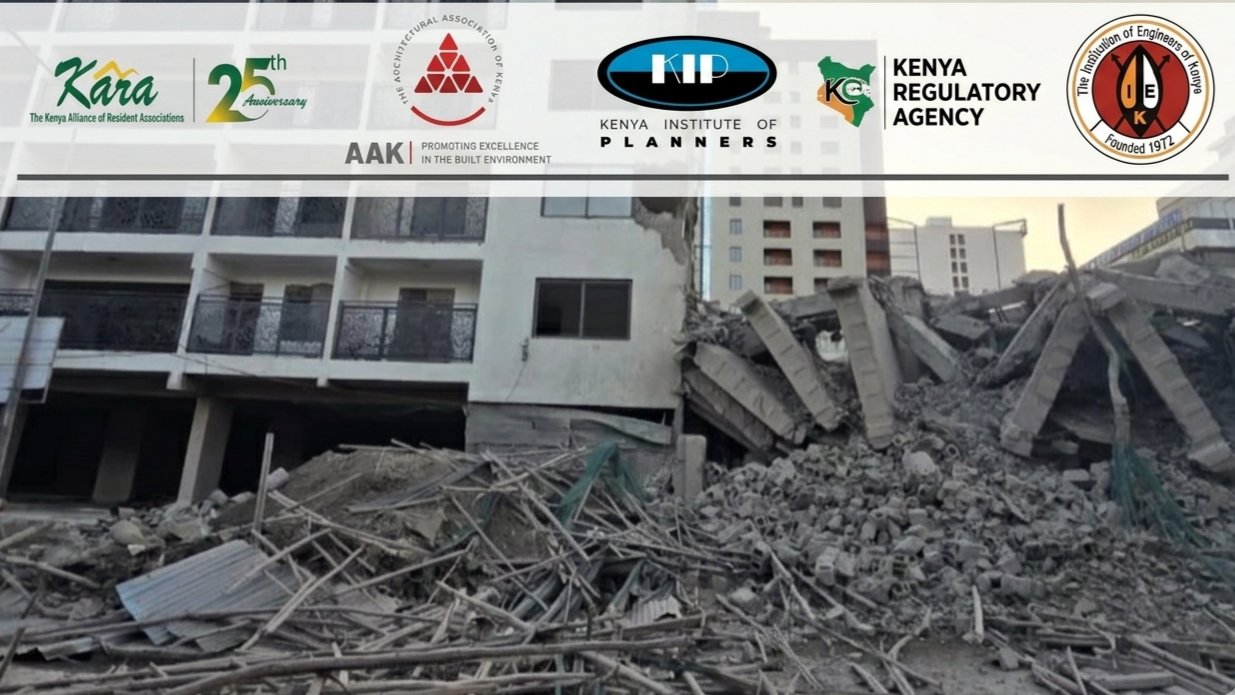

The Architectural Association of Kenya (AAK) and other built environment bodies have issued strong statements opposing criminal charges filed by the Office of the Director of Public Prosecutions against members of the Nairobi City County Urban Planning Technical Committee following the collapse of Manzil Towers.
In a statement, AAK described the committee as an advisory body with no executive authority. It argued that statutory approval power lies solely with the County Executive Committee Member, who can override technical recommendations. The association demanded immediate review and withdrawal of the charges against the full committee membership.
AAK warned that prosecuting independent professionals and civil society nominees creates fear and could discourage competent oversight of public projects. The statement was signed by George A. Ndege, AAK President.
This position drew immediate and sharp public criticism on social media. Several users accused AAK of shielding incompetence and normalising mediocrity in the industry. One commenter stated that professional bodies protecting compromised standards become part of the problem rather than defenders of the profession.
Others questioned the value of advisory roles if they carry no accountability. “What’s the point if having professionals in that committee if they don’t bare any form of responsibility?” one post asked. Several called on AAK to withdraw its members from the committee if they cannot help ensure responsible decisions.
A joint statement issued on June 6 by the Kenya Alliance of Resident Associations (KARA), AAK, Kenya Institute of Planners (KIP) and Institution of Engineers of Kenya (IEK) reinforced the concerns. Addressed to the DPP and copied to key oversight bodies and county officials, it highlighted the distinction between advisory recommendations and executive decisions.
The UPTC, the organisations explained, provides multidisciplinary technical perspectives but holds no final approval power. Recommendations remain non-binding, and the County Executive Committee Member alone exercises statutory authority.
The joint document labelled the blanket prosecution a critical miscarriage of justice that conflates advisory participation with executive responsibility. It risks intimidating professionals and weakening urban planning oversight by deterring talent from public service.
The bodies called for the DPP to terminate the broad charges and focus instead on individuals with clear evidence of fraud, corruption or personal gain. They specifically sought withdrawal of charges against named representatives: Arch. Christopher Naicca (KARA), Arch. Brenda Nyawara (AAK) and Plan. Alfred Eshitera (KIP).
They urged collaboration between the DPP, EACC, county government and professional associations to legally separate advisory functions from executive authority.
The statements come after the ODPP approved manslaughter charges and other counts linked to the January 2 collapse in South C that claimed lives and exposed serious questions about building approvals in Nairobi. The case has heightened public scrutiny of how responsibility is assigned across planning, technical advice and final decision-making.
Online reactions reflect deep frustration with repeated building failures in the city. Commenters demanded consequences for needless loss of life and argued that advisory roles should not equate to immunity when standards appear compromised. Some viewed the associations’ defence as institutional self-preservation rather than introspection.
The controversy underscores ongoing tensions in Kenya’s construction sector between calls for accountability following disasters and concerns about over-criminalising professional advisory input. Court proceedings for those charged are expected to test these boundaries in the coming weeks.
Comments (1)
Leave a Comment
Bennie
Jun 07