
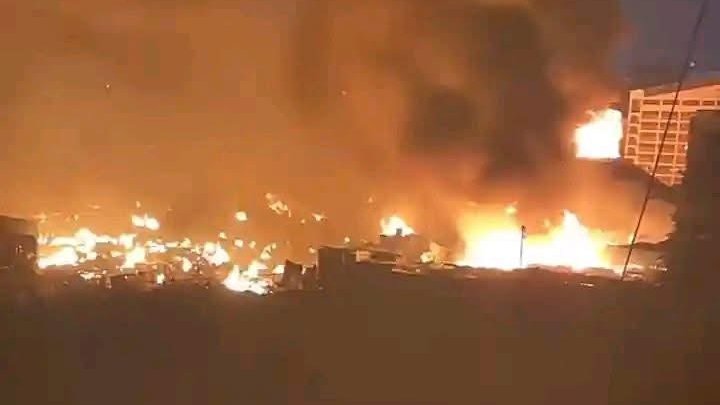

A fire broke out in the fish section of Gikomba Market in Nairobi early on Sunday morning. The Kenya Red Cross Nairobi Branch reported the incident around 4 a.m., dispatching response teams to the scene.
Emergency personnel from a multi-agency team arrived quickly. They worked to assess the situation and bring the blaze under control. At the time of the initial update, the full extent of damage remained unclear.
Videos and images shared online captured intense flames moving through parts of the market. Responders urged the public to keep access routes open for fire engines and ambulances.
Authorities advised motorists to avoid the Gikomba area. Traffic disruptions were expected along Landhies Road, Kamukunji, Majengo, and nearby streets as operations continued.
Traders and residents nearby received calls to follow instructions from emergency teams. The focus stayed on safety while efforts to contain the fire progressed.
Gikomba Market has a long record of fire incidents. Over the past two decades, multiple blazes have hit different sections of the sprawling trading hub.
One of the worst occurred in September 2000, when flames in the second-hand clothing area burned for more than eight hours. Another deadly fire in 2018 claimed 15 lives in the Kwa-Mbao section.
Since 2010, the market has seen at least ten major outbreaks. Recent ones took place in 2024, 2025, and as recently as February 2026. These events often disrupt thousands of livelihoods.
The densely packed stalls and mix of goods make fire spread rapid. Narrow pathways complicate access for rescue vehicles during emergencies.
Gikomba serves as one of Nairobi’s largest open-air markets. It supports a wide network of traders dealing in second-hand clothes, household items, and fresh produce sections like fish.
Sakaja has since confirmed 2 deaths, 17 injuries following sunday morning Gikomba Market fire.
The latest incident revives long-standing questions about fire safety measures in informal trading spaces. Market structures often evolve without full adherence to modern building standards.
Engineers and urban planners have noted the challenges of retrofitting such sites. Congestion, electrical wiring, and storage of flammable materials remain recurring issues in similar Nairobi markets.
As the sun rose over the scene, traders began to gather. Many waited for clearance to check on their stalls and salvaged goods. The human and economic cost will become clearer in coming hours.
Comments (0)
Leave a Comment
No comments yet. Be the first to share your thoughts!