
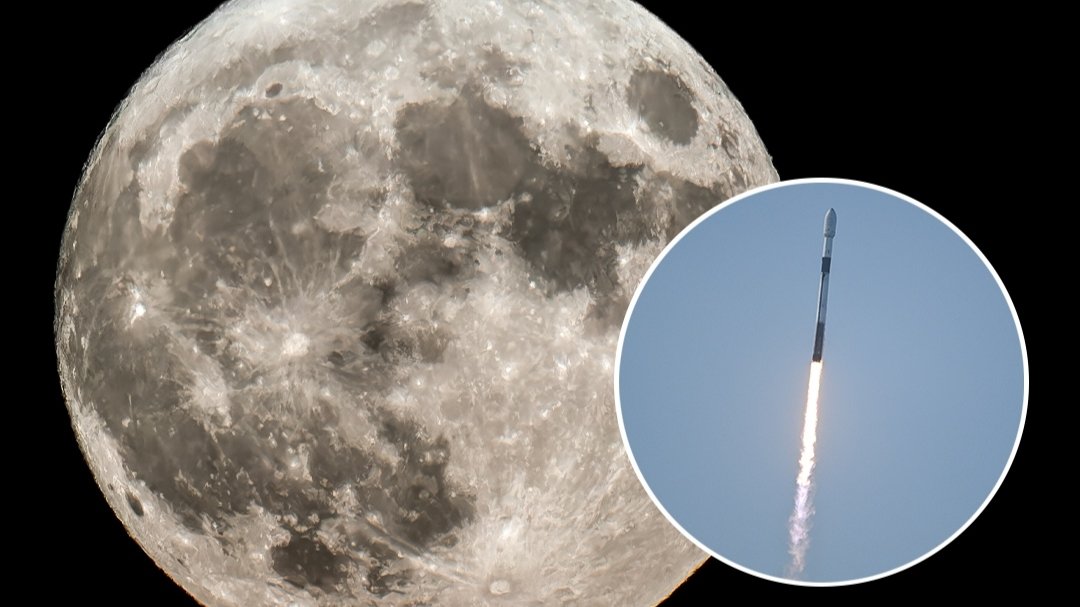

Scientists expect the upper stage of a SpaceX Falcon 9 rocket to collide with the Moon on Wednesday. The object has been travelling at about 2.43 kilometres per second, or roughly 5,400 miles per hour.
Nasa’s Centre for Near-Earth Object Studies confirmed the trajectory after independent astronomers using public data identified the path. The impact is predicted for approximately 02:35 EDT, or 06:35 GMT.
There is no danger to Earth, according to a Nasa spokesperson. The agency will track the booster for training purposes and later examine the impact site for scientific study.
The rocket stage comes from a Falcon 9 launched in January 2025. That mission carried a pair of lunar landers and scientific equipment for a joint US and Japanese effort.
Part of the Falcon 9 is designed to return to Earth for reuse. The upper stage, however, remained in space. It is roughly the size of a five-storey building and has a mass of at least 4,000 kilograms.
Astronomer Bill Gray, who first noted the trajectory, calculates that the object will land near the Einstein Crater on the Moon’s day side, which faces Earth. He expects it to form a crater more than 17 metres across.
The collision is expected to send up a large plume of dust, possibly reaching 50 kilometres or higher. Because the Moon has no atmosphere and weaker gravity than Earth, the debris will rise and spread without the slowing effects seen on our planet.
Dr Matt Bothwell, public astronomer at the University of Cambridge, described the event as something people can simply watch. He said the impact will be more dramatic than a comparable explosion on Earth.
Telescopes in the Americas, Nasa’s Lunar Reconnaissance Orbiter and South Korea’s Danuri probe are prepared to record the flash, the plume and the new crater. A citizen-science project is also recruiting amateurs to film the moment.
Observing the dust plume will help refine models of lunar impacts. It should also reveal fresh material from just below the surface at the strike site.
The event adds to a longer history of human-made objects reaching the Moon. In 2022 a Chinese Long March upper stage struck the far side. Earlier Nasa missions deliberately sent objects into the lunar surface to gather data for the Apollo programme.
Bothwell noted that the collision also highlights the growing problem of space debris. Each year more objects enter orbit, raising the risk of further collisions and fragmentation.
The Moon has absorbed countless impacts over millions of years from asteroids and meteors. This latest one, though accidental, offers scientists a rare chance to observe a known object strike the surface in real time.
Comments (0)
Leave a Comment
No comments yet. Be the first to share your thoughts!