
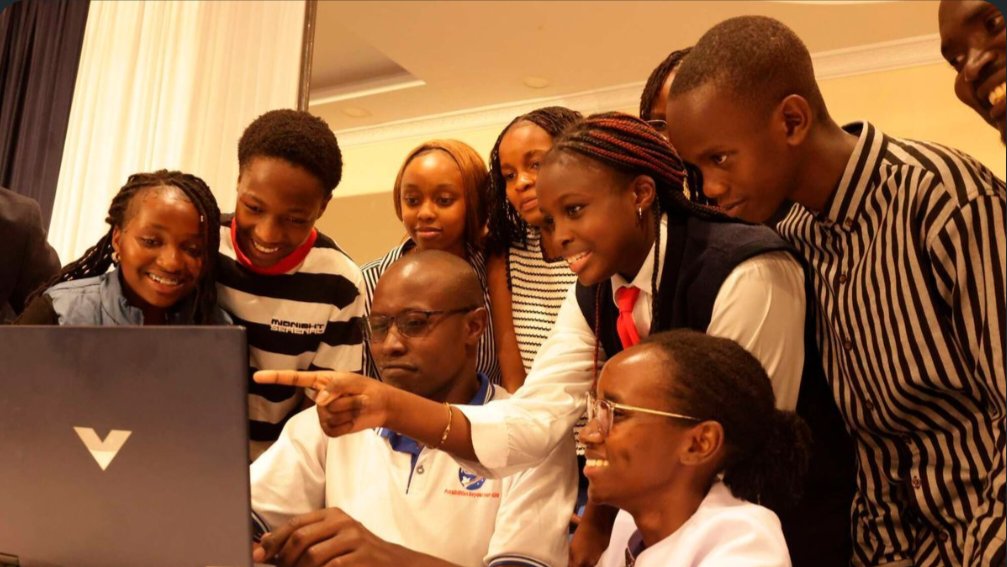

Students at Shree Cutch Satsang Swaminarayan Academy in Nairobi established live voice communications with orbit on Wednesday. The interaction linked learners directly with an orbital research outpost traveling 400 kilometers above Earth.
The direct exchange was organised under the Kenya Space Agency (KSA) in collaboration with international partners. It represents the first time a radio link of this nature was executed within the country.
Participants utilized specialized transmission equipment through the Amateur Radio on the International Space Station (ARISS) framework. They made contact as the complex traversed overhead at more than 28,000 kilometers per hour.
European Space Agency (ESA) astronaut Sophie Adenot fielded real-time questions from the Nairobi classroom. Adenot answered queries regarding operational routines, microgravity research, and long-duration flight protocols.
The astronaut joined the International Space Station (ISS) crew following a launch from the National Aeronautics and Space Administration (NASA) Kennedy Space Centre in Florida. Her launch took place on February 13 aboard a Falcon 9 rocket.
Adenot is serving as part of a four-member expedition team on a nine-month mission. During this tour, the crew will execute up to 36 distinct European research experiments.
Seven of those scientific investigations were designed specifically by the National Centre for Space Studies (CNES), which is the French space agency. The experiments form a core component of the orbital laboratory's current payload.
During the broadcast, the astronaut offered visual demonstrations of daily living quarters inside zero gravity. She showed learners how orbital workers sleep, brush their teeth, and use personal hygiene facilities in orbit.
The orbital passing offered a brief operational window lasting only a few minutes before the facility moved beyond line of sight. Technicians maintained stable radio frequencies throughout the brief communication window.
Local coordinators positioned in Nairobi worked alongside Pan-African Citizen Science e-Laboratory representatives to align ground hardware. Liaison officers ensured the radio antennas tracked the orbital track without signal dropouts.
Educational stakeholders intend to use the initiative to foster technical discipline among primary and secondary learners. The session aimed to bolster interest in Science, Technology, Engineering, and Mathematics (STEM) subject areas across local institutions.
Selection for the global educational initiative followed competitive international evaluations conducted early in the year. Kenya was chosen as the sole African nation participating in this specific broadcast cycle.
The orbiting platform has operated continuously as a collaborative science station since 1998, when construction began. Over 250 personnel representing 15 partner nations have lived aboard the orbital laboratory.
Flight controllers based at mission control centers in Houston monitor orbital parameters continuously during crewed operations. They assist astronaut crews with ongoing maintenance schedules and daily research schedules.
Similar radio engagements have routinely taken place across North America, Europe, and Asia over recent decades. The Nairobi session expands local infrastructure capabilities for future educational radio experiments.
School administrators noted that direct dialogue with active researchers provides practical context to classroom learning. Teachers observed strong student engagement during the live transmission phase.
Ground crews dismantled the temporary antenna array shortly after the space station passed beyond the local horizon. The event concluded without technical disruptions, which validated local communications readiness.
Comments (0)
Leave a Comment
No comments yet. Be the first to share your thoughts!