
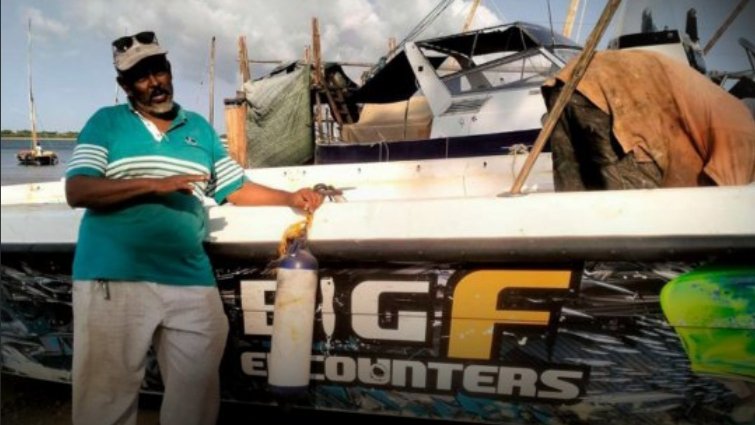

The sun beats down on Mohamed Khuzema and Ali Ahmed as they hammer teak wood in their open-air workshop at Lamu’s Shella waterfront. Both men have been making boats and dhows for more than 30 years.
Dhow and boat building along the Swahili Coast, particularly in Lamu, Malindi, Kilifi and Mombasa, has employed thousands of artisans. Mr Khuzema, a father of nine, entered the sector in 1992 after learning through apprenticeship.
“While I was young, I learnt to build the wooden boats and dhows from my parents and elders since I worked with them side-by-side. Years later, I joined a college in Nairobi where I was trained on fiberglass manufacturing, including making fibreglass vessels. I became the first artisan to model and manufacture a fibreglass boat in Lamu,” said Khuzema.
Today he earns a daily income of between Sh4,000 and Sh10,000, depending on the scope of work. In a good month he takes home between Sh150,000 and Sh200,000. He employs nine young people at his Shella workshop.
A standard fibreglass vessel costs between Sh1.5 million and Sh3 million. A larger, fully equipped deep-sea or customised utility boat ranges from Sh3 million to as high as Sh5 million depending on size, seating and engine power.
Khuzema takes between one and two months to construct a complete fibreglass boat. The process begins with a precise negative mould coated with release paint and gel coat, followed by lamination of fibreglass layers saturated with resin.
Ali Ahmed entered the business in 1994. He mainly manufactures wooden dhows and boats for fishing, cargo, passenger and tourist use. The cost ranges from Sh1.5 million to Sh3 million depending on size and specifications.
He spends between two and six months on a fully equipped wooden dhow. After materials and labour, his profit sits between Sh50,000 and Sh100,000 per vessel. The craft has enabled him to educate his children and support his family of eight.
Another artisan, Mohamed Yahya, describes the work as highly profitable. He makes between Sh500,000 and Sh800,000 for each contract to construct large vessels known locally as the water buses of Lamu.
These heavy-duty wooden vessels, built from mangrove timber, carry 150 to 300 passengers across the archipelago’s deep-sea channels. Clients include long-distance cargo shippers, fishermen and tour operators.
Ali Salim, a young trainee, says the hands-on craft is deeply satisfying. He joined last year and urges other youth to enter the sector to preserve the maritime legacy while earning a living.
The traditional skills of lofting, framing, planking, sealing and finishing continue alongside modern fibreglass methods. Both approaches sustain livelihoods in Lamu’s boat yards.
Comments (0)
Leave a Comment
No comments yet. Be the first to share your thoughts!