
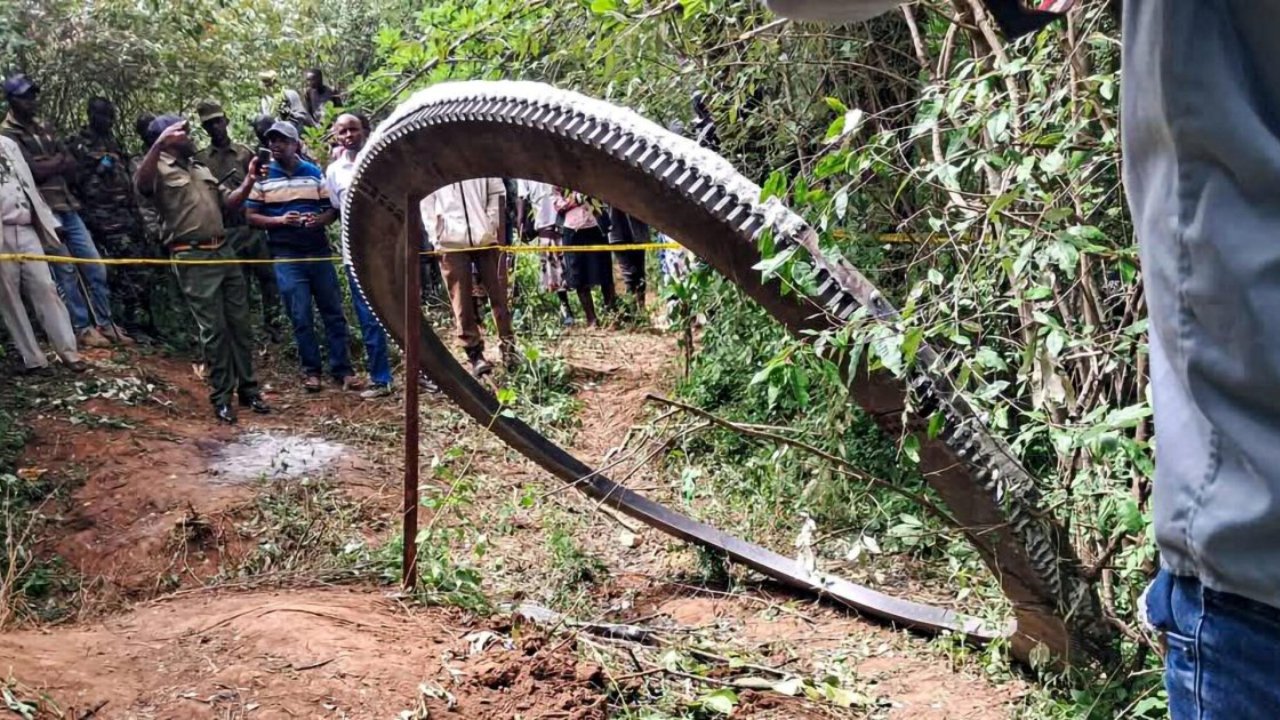

The Kenya Space Agency remains engaged in a complex investigation regarding a 500-kilogram metallic ring that plummeted from the sky into Mukuku village, Makueni County. Despite the passage of more than a year since the incident, the exact origin of the debris, which measures approximately 2.5 meters in diameter, has not been officially confirmed by international aerospace authorities.
Witnesses in the rural community reported hearing a loud whizzing sound followed by a significant boom when the object impacted the ground. The residents described the structure as being red-hot upon arrival, narrowly missing populated areas. The Kenya Space Agency, or KSA, quickly deployed a multi-agency team to secure the site after reports surfaced of individuals attempting to move the object for its scrap metal value.
Preliminary assessments by KSA technicians, including Major Alois Were, identified the hardware as a separation ring from a launch vehicle. These components are designed to detach from rockets during various stages of ascent. While most such parts are engineered to burn up upon re-entry or fall into remote oceanic regions, this particular fragment survived the atmospheric friction intact.
The recovery of the half-ton ring has sparked a broader conversation regarding the liability of spacefaring nations under the Outer Space Treaty. If the originating country is identified, Kenya may seek compensation for the impact and the subsequent recovery operations. KSA officials have noted that tracking such objects is difficult due to the low inclination of certain orbits and a lack of monitoring stations near the equator.
Under the administration of President Ruto, Kenya has been expanding its interest in space-based infrastructure and data sharing. However, this incident highlights the physical risks that accompany the global surge in orbital activity. There are currently over 29,000 tracked objects larger than 10 centimeters in orbit, creating a cluttered environment that increases the likelihood of uncontrolled re-entries.
The debris is currently held in KSA custody for further technical analysis. Independent space trackers have suggested the ring could potentially be linked to European or Indian rocket launches from previous decades, though no state has formally claimed ownership of the hardware. For now, the artifact remains a stark reminder of the intersection between high-altitude technology and ground-level safety in East Africa.
Comments (0)
Leave a Comment
No comments yet. Be the first to share your thoughts!