
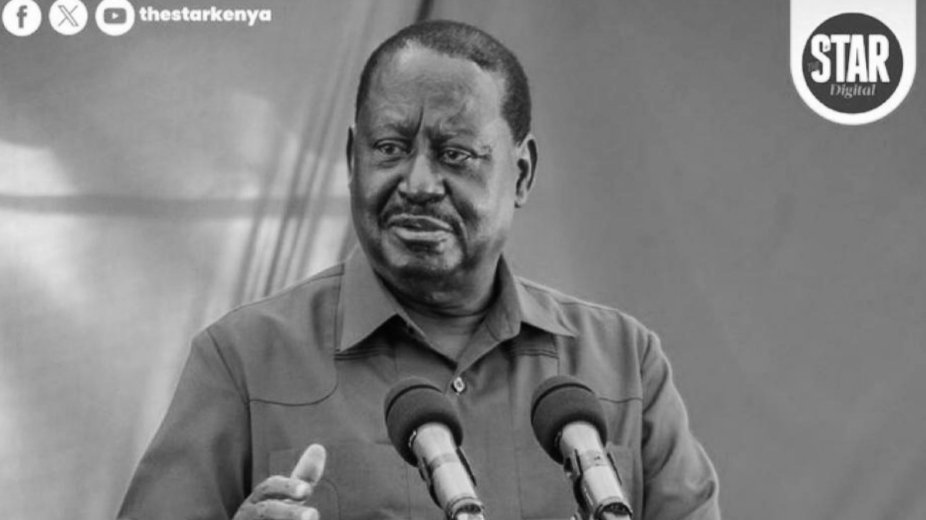

The passing of veteran politician and statesman, The Right Honourable Raila Amolo Odinga, on October 15, 2025, at the age of 80, marks the end of an era in Kenyan and African politics.
While he is most often celebrated as the towering figure of democracy and reform, his indelible contribution to the physical development and connectivity of the continent, from roads and railways to energy lines, remains a powerful part of his legacy.
The Early Engineering and Ministerial Foundations
Raila Odinga’s relationship with infrastructure began not in the political trenches, but in the realm of industry and engineering.
A graduate in Mechanical Engineering from East Germany, he returned home in the 1970s and quickly demonstrated his belief in local industrial capacity by founding East African Spectre, a company that pioneered the local manufacturing of liquid petroleum gas (LPG) cylinders.
This foundation in technical capacity was essential when he later entered public service. As Minister for Energy (2001-2002), his focus was on expanding the national power grid and advocating for investments in sustainable sources like geothermal and hydroelectric power.
Even during his decades as the Member of Parliament for Langata, a constituency housing Africa's largest informal settlement, he championed local infrastructure development through projects like the Kibera slum upgrading initiative, which aimed to replace dilapidated housing with modern residential infrastructure.
His most direct executive impact on national infrastructure came as the Minister for Roads, Public Works and Housing (2003-2005), a critical tenure widely credited for injecting fresh momentum into road construction and establishing the ambitious targets that defined the sector for the next two decades.
Prime Minister and Architect of Vision 2030
The effort to build national connectivity continued when he became the Prime Minister (2008-2013) in the Grand Coalition Government. This powerful role gave him national policy oversight and a critical hand in coordinating the execution of the country's national development blueprints.
The period defined his most institutional contribution to Kenya's long-term development. As Prime Minister, he co-launched the Kenya Vision 2030 development blueprint alongside President Mwai Kibaki on June 10, 2008.
By launching the plan together, the two leaders transformed the 22-year roadmap into a joint, bipartisan national agenda necessary for national healing and stability after the 2007 post-election crisis.
He then presided over the initial implementation of the Vision's flagship projects under its First Medium Term Plan, which included key road projects like the reconstruction of the Northern Corridor and the conceptualization of the Standard Gauge Railway (SGR). This role was critical, as it formalized his commitment to Kenya's growth under a universally accepted national strategy.
Continental Leadership and Regional Integration
The nature of his influence transitioned from direct executive authority to collaborative statesmanship.
Following the contentious 2017 elections, the pivotal 2018 ‘Handshake’ with President Uhuru Kenyatta calmed the political atmosphere, provided the basis for the government to accelerate key infrastructure projects, and paved the way for his ascension to a major continental post: the African Union High Representative for Infrastructure Development.
From 2018 to 2023, he transformed into Africa’s chief infrastructure champion. His mission was to fast-track the Programme for Infrastructure Development in Africa (PIDA), tirelessly advocating for the completion of the "missing links" in the Trans-African Highways Network to enable seamless trade under the AfCFTA.
He marshaled political support for mega-regional projects like the Lamu Port, South Sudan, Ethiopia Transport Corridor (LAPSSET) and championed the development of a Continental High-Speed Freight Railways Network (C-HSfRN).
A tangible example of his regional commitment was his active involvement in the revival of the Kisumu Port and the dredging of Lake Victoria, a critical effort to restore maritime trade between Kenya, Uganda, and Tanzania.
Final Vision: The LV Marina Blueprint
Beyond his public service roles, his final, personal vision for transforming urban infrastructure was exemplified by the Ksh. 120 billion LV Marina project in Kisumu.
This ambitious mixed-use development, launched in partnership with private developers on a 285-acre parcel of family land that once housed a defunct molasses plant, represented his blueprint for the future: a transformative hub blending waterfront villas, commercial centers, and affordable housing units.
This initiative not only underscored his vision for maximizing the potential of the Blue Economy but also demonstrated his commitment to creating modern, self-sustaining communities that offer higher standards of life for all economic classes.
Even in his final years, his political gravity continued to directly shape Kenya's development agenda.
Raila Odinga’s journey, from a local manufacturer of gas cylinders to an engineer overseeing Kenya’s roads, and ultimately to Africa’s voice for continental connectivity, is a testament to a life spent not just campaigning for political freedom, but also actively building the physical structures necessary for economic liberation.
His legacy is thus permanently etched not only in Kenya's democratic journey but also in the very roads, bridges, and energy lines that now crisscross and connect the continent.
May mzee rest in peace!
Comments (3)
Leave a Comment
Blinks
Oct 15Phabian Muok ✓
Oct 16Joshua Muok
Oct 15Phabian Muok ✓
Oct 16Joy
Oct 15Phabian Muok ✓
Oct 16