
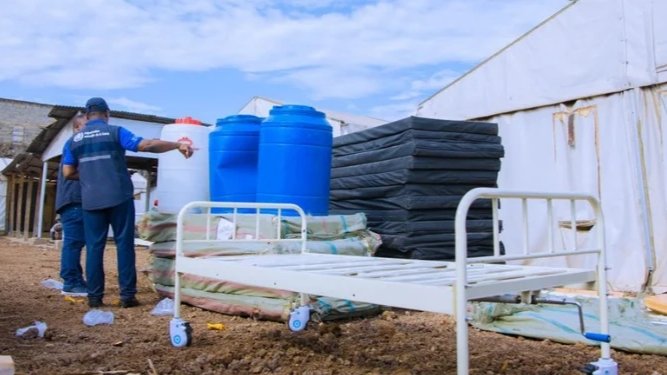

The United States has confirmed awareness of legal action in Kenya stopping plans for an Ebola isolation facility. At the same time, US health authorities have gone ahead with deployment of a response team on the ground.
A widely shared post from Money Academy KE on X reported the development on May 30. It stated that the team will monitor and support care for American citizens returning from the Democratic Republic of Congo, proceeding despite the court suspension.
This comes one day after the US issued its official response. Officials said they are in direct contact with Kenyan authorities and remain optimistic about resolving the objections raised in court.
Justice Patricia Nyaundi of the High Court issued interim orders on the petition filed by the Katiba Institute. The orders restrain Kenyan government agencies from proceeding with any Ebola-related quarantine, isolation, monitoring or treatment facility linked to the United States or foreign partners.
A separate directive bars the admission or transfer into Kenya of individuals exposed to or infected with Ebola under the proposed setup. The matter returns for mention on June 2.
The petitioners highlighted lack of public participation and transparency in the plans. They expressed concern that the facility could introduce health risks to a country with no recorded Ebola cases so far.
The Law Society of Kenya also filed its own challenge, pointing to constitutional questions, biosafety concerns and the need for proper parliamentary approval before any construction or operational steps.
Reports suggested the original arrangement focused on managing returning US personnel from outbreak zones in the DRC. Instead of full repatriation, it would have used a dedicated Kenyan site built to international containment standards.
Regional Ebola numbers continue to drive the urgency. The outbreak has claimed hundreds of lives, prompting stepped-up cooperation between Kenya and the US.
On May 28, US Secretary of State Marco Rubio held a phone conversation with President William Ruto. The call covered medical supplies and bolstering Kenya’s overall health infrastructure.
Accompanying these talks were fresh funding pledges. The US committed an additional $13.5 million, equivalent to about KSh1.74 billion, specifically for Kenyan Ebola preparedness. Total regional bilateral support stands higher, at $112 million.
Senior Advisor Massad Boulos outlined further assistance. This included $80 million layered on an earlier $32 million commitment for the broader response.
These funds typically flow into supply chains, laboratory upgrades, training and physical infrastructure elements such as controlled isolation spaces with specialised ventilation and waste systems.
The Katiba Institute formally notified US officials of the court orders. It emphasised that global health partnerships must observe Kenyan judicial and constitutional requirements.
"While international cooperation in global health is necessary, it cannot bypass constitutional safeguards," the group stated. "The people of Kenya possess a fundamental right to transparency, public participation, and a government that acts explicitly in their best interest."
From a construction viewpoint, such isolation facilities require precise engineering. Features often include negative-pressure rooms, restricted access protocols and multiple containment layers to eliminate transmission risks.
Kenya has expanded health infrastructure through various international collaborations in recent years. This particular episode shows how court interventions can alter project timelines and implementation methods.
The US response so far avoids escalation. Officials have signalled willingness to continue discussions on finding common ground that addresses legal, technical and public concerns.
The deployment of the response team, as noted on social media, adds a practical layer to the story. It indicates that some operational elements are moving forward even while the physical facility remains blocked.
Public reactions on X have been sharp. Several users questioned whether the deployment respects Kenyan sovereignty and court authority. Others raised fears over biosafety and perceived overreach.
The coming days will likely clarify how negotiations unfold. The June 2 court date may shape the next phase, especially as the US team operates in the country.
For the moment, the core infrastructure project sits on hold. Attention has turned to diplomacy, funding flows and the hands-on work of the deployed health personnel.
Comments (0)
Leave a Comment
No comments yet. Be the first to share your thoughts!