
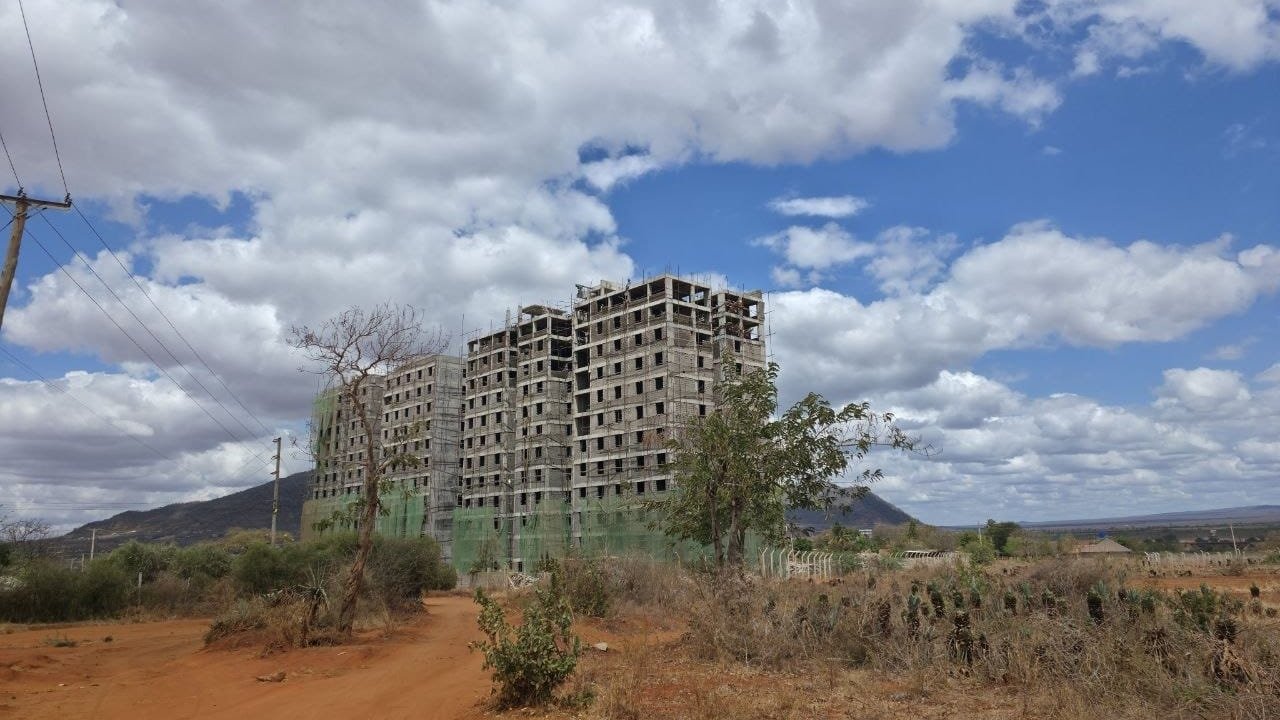

Kenya’s affordable housing debate appears to have entered another round, with the latest arguments moving beyond politics and into the economics and technical realities of building homes at scale.
Recent online discussions have focused on the Affordable Housing Programme projects in places such as Samburu, where questions have been raised about the size of the developments relative to local populations and the demand for the completed units.
Images of tall affordable housing blocks in Archer’s Post have particularly reignited the debate, with some questioning whether high-rise housing is appropriate for a relatively small town and whether enough households will be able or willing to take up the units.
Others have shifted the conversation to construction mathematics, arguing that the cost of affordable housing should be assessed against the prescribed unit sizes, construction rates and financing structure rather than simply the appearance or height of the buildings.
One calculation circulating online places social housing construction at KSh42,000 per square metre, affordable housing at KSh48,000 per square metre and market-driven units at KSh72,000 per square metre.
Using those figures, a 15-square-metre social housing studio would have a baseline construction cost of KSh630,000, while a 30-square-metre affordable one-bedroom unit would come to KSh1.44 million.
A 60-square-metre three-bedroom affordable unit would work out to KSh2.88 million under the same calculation, while an 80-square-metre premium three-bedroom market unit would reach KSh5.76 million.
But even these figures have become part of the argument, with different commentators disputing assumptions around construction costs, taxation, land and what should be included when calculating the actual cost of delivering a housing unit.
The debate has also moved to the amount of housing that can realistically be delivered through the Housing Levy. One argument suggests that KSh90 billion annually could finance a very large number of units if the cost per unit were kept around KSh1 million.
Others counter that such calculations raise questions about unit sizes, infrastructure, services and whether extremely small homes would simply reproduce some of the problems associated with informal settlements. A few cautiously optimistic commentators want guarantees against gentrification.
That is perhaps why the affordable housing conversation continues to return to the same fundamental questions: What exactly should an affordable home look like, where should it be built, who should it serve, and how much should it cost?
Those questions cannot be answered by politics alone.
They require evidence on household incomes, local housing demand, land availability, infrastructure, construction costs, financing, unit sizes and long-term maintenance.
The continuing disagreement also shows that Kenya’s affordable housing programme is being judged on more than the number of units under construction.
For many Kenyans, the bigger question is whether the homes being delivered represent good value, meet the needs of the communities they are intended for and can remain affordable beyond the initial purchase or allocation.
So, beyond the political arguments, will this discussion ever end?
Probably not until there is broader agreement on what Kenya means by affordable housing and a transparent way of measuring whether the programme is actually delivering it.
Comments (0)
Leave a Comment
No comments yet. Be the first to share your thoughts!