
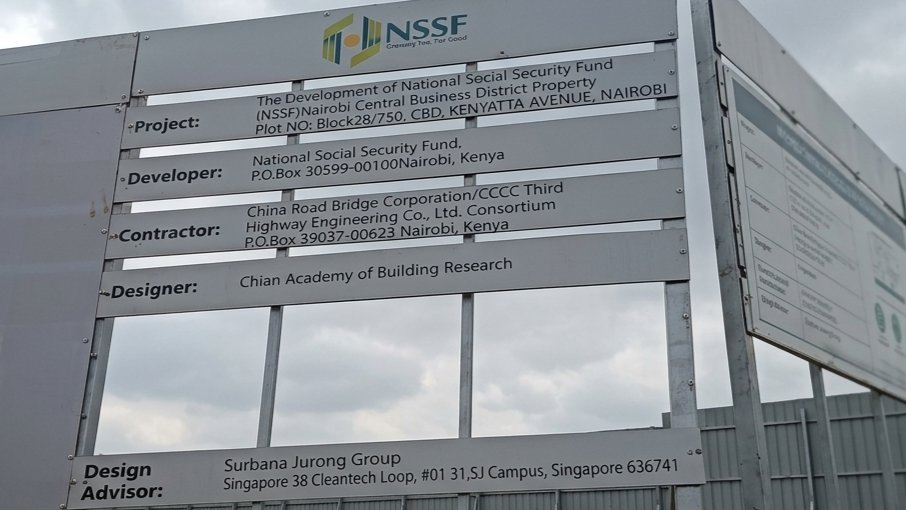

The site board for the National Social Security Fund’s twin towers project now stands at the junction of Uhuru Highway and Kenyatta Avenue in Nairobi’s central business district. It lays out the main players in plain text.
Developer: National Social Security Fund.
Contractor: China Road and Bridge Corporation in consortium with CCCC Third Highway Engineering Co. Ltd.
Designer: China Academy of Building Research.
Design Advisor: Surbana Jurong Group of Singapore.
Only two Kenyan names appear. Architect Engineer Francis Ikere of Shelter Solutions Ltd and Structural Engineer Wilson Wamahiu Munene.
Nashon Okowa, a project manager and director at Beacon Africa, posted the image with a direct message. While the Engineers Board of KENYA (EBK) and the Board of Registration of Architects and Quantity Surveyors (BORAQS) stay busy with CPD workshops, benchmarking trips and what he described as endless petty gatekeeping, the industry is slipping away.
He wrote that members of these bodies have largely refused to demand better. The board, he said, could just as well have been put up in China. Okowa warned that upcoming construction professionals face a tough road unless the profession takes stronger action, including taking over the regulatory bodies.
The project calls for Tower A to rise 60 storeys to around 260 metres and Tower B 35 storeys to about 140 metres. The mixed-use development will hold offices, a business hotel, serviced apartments, retail, conference facilities, an observation deck and parking. It sits on plot Block 28/750.

Early site preparation has begun. Fencing and gates are up. Some excavation work is visible in recent images from the location. The NSSF is funding the entire scheme from its own resources.
Francis Ikere and Wilson Wamahiu Munene provide the listed local expertise. Their roles help meet registration and compliance requirements on Kenyan soil. Yet the primary design work and construction contract rest with the international firms. China Academy of Building Research brings experience in tall structures. Surbana Jurong offers advisory input. CRBC has delivered multiple large projects in Kenya and across Africa.
Okowa’s post touched a raw nerve among engineers and architects. Many commented that major projects funded by Kenyan contributions continue to sideline local professionals in key technical packages.
At the same time, the Institution of Engineers of Kenya (IEK) has been consumed by its own internal battles. Elections for the 2026-2028 council faced a court petition from graduate engineer Sam Aberi. He challenged provisions in the IEK constitution that limit voting rights to certain membership categories, excluding graduates, technicians and students despite their payment of subscriptions. The Kiambu High Court issued orders suspending the planned March 2026 polls.
These disputes, along with related manoeuvring and committee issues have dragged on. Critics argue the time and energy spent on such fights distract from bigger questions about market access, skills transfer and the ability of Kenyan professionals to compete on landmark projects.
EBK and BORAQS continue their regular programmes of workshops and regulatory work. Yet the NSSF board stands as a public reminder of the current balance of power on one of Nairobi’s most visible developments. If completed as planned, Tower A would become the tallest building in East and Central Africa.
The two Kenyan engineers listed bring practical local knowledge to the team. Their firms handle aspects of architecture and structural input. Still, the absence of broader Kenyan design leadership on the board has fuelled the ongoing debate. Many engineers are still complaining about implementation of fees as this goes on with some engineers reportedly earning as low as 30k a month as salary and cannot even afford the expensive engagements with the regulators.
Okowa’s blunt assessment cuts through industry pleasantries. He points to a profession where regulatory focus appears disconnected from the reality seen on project boards across the country. Whether this sparks any shift in how bodies like EBK, BORAQS and IEK engage with such issues will be watched closely by younger professionals entering the field.
Comments (0)
Leave a Comment
No comments yet. Be the first to share your thoughts!