
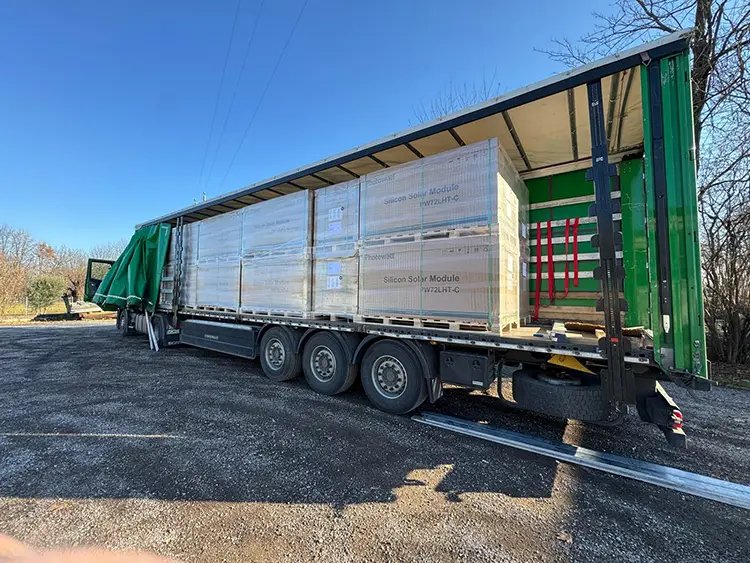

Sweden's annual volume of decommissioned solar panels could balloon from just 17 metric tonnes (MT) in 2021 to as much as 150,000 MT a year by around 2060, according to a new circular-economy roadmap released this week.
The roadmap was developed by Axfoundation and KTH Royal Institute of Technology, working alongside industry partners including Svea Solar, El-Kretsen, Stena Recycling and REMONDIS. It forms part of the CircSolar project, financed in part by Vinnova, Sweden's innovation agency.
Scenario modelling behind the roadmap, carried out by RISE Research Institutes of Sweden, points to a wide range depending on how fast solar deployment grows and how much of the existing panel fleet gets replaced before reaching the end of its technical life. Annual decommissioning volumes could land anywhere between 40,000 MT under slower deployment and 150,000 MT under a rapid-expansion scenario, with larger volumes beginning to appear from around 2035 onward.
Johanna Olofsson Behrman, project manager for future materials at Axfoundation, said the roadmap represents a starting point rather than a finished solution. She said the CircSolar project has shown that building circular solutions for solar panels requires system-wide innovation, shared responsibility and practical cooperation across the value chain.
A typical solar panel weighs about 20 kilograms and is made up of roughly 67 per cent glass, 16 per cent aluminium, 11 per cent plastic and 4 per cent silicon, along with smaller amounts of metals including silver and copper, according to the roadmap. RISE estimates that dedicated photovoltaic (PV) recycling infrastructure would need a steady annual inflow of around 10,000 MT to become economically viable, a threshold Sweden has yet to approach.
The roadmap also flags a structural problem in how panels are currently handled. Decommissioned units are frequently processed alongside general electronic waste, a practice that limits opportunities for reuse or specialised recycling. Research led by KTH found that a significant share of panels removed from service remain functional or repairable rather than genuinely at the end of their working life.
Beatriz Pérez Horno, a KTH researcher and one of the roadmap's authors, said the document highlights both the opportunities and the barriers across the solar value chain, and helps identify where further collaboration is needed to build circular, resource-efficient solar systems.
Under the European Union's Waste Electrical and Electronic Equipment (WEEE) Directive, member states must collect either 65 per cent of the average weight of electrical equipment placed on their market over the preceding three years, or 85 per cent of the electronic waste generated domestically. Separately collected PV panels face specific treatment targets of 85 per cent recovery and 80 per cent preparation for reuse and recycling by weight. Only six of 12 European countries reporting PV-specific data met the 85 per cent recovery target in 2021, according to the European Environment Agency.
The roadmap sets out five priority areas for action: circular design and responsible production, safer handling and transport of panels, extending the usable life of installed systems, higher-value material recovery, and stronger governance and data-sharing across the industry. Proposed steps include creating a dedicated PV waste category under the WEEE Directive and building a national database tracking installed, decommissioned and planned solar capacity.
Mattias Ringqvist, chief executive of Svea Solar, said the company helped initiate the roadmap because it sees both a responsibility and an opportunity to help shape a more circular future for the industry, adding that extending panel lifespans and handling end-of-life units responsibly needs to become a standard part of how the sector grows.
Sweden's challenge mirrors a wider trend across Europe. The European Commission's Joint Research Centre estimates the EU could accumulate between 21 million and 35 million MT of cumulative photovoltaic waste by 2050, with global volumes potentially reaching 60 million to 80 million MT over the same period.
Comments (0)
Leave a Comment
No comments yet. Be the first to share your thoughts!