
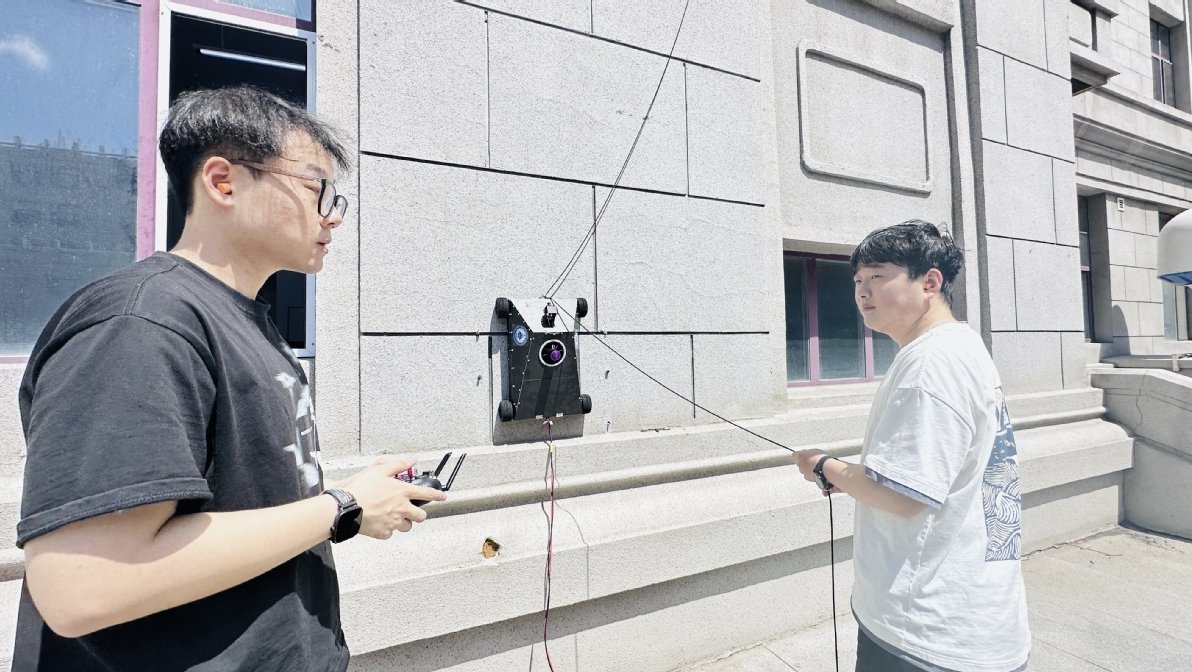

A research team at Harbin Engineering University in Heilongjiang province has deployed a wall-climbing robot at a wind power plant in Nanjing, Jiangsu province, in what marks the first real-world test of technology designed to replace manual inspections on wind turbine towers.
The robot uses suction rather than magnetic force to grip surfaces, allowing it to climb metal, glass, and other smooth vertical materials without damaging the protective coatings on turbine towers. Conventional magnetic-adsorption systems cannot make that claim. It carries up to five kilograms of detection equipment and is fitted with a camera system capable of identifying cracks, rust, and structural defects on tower surfaces, according to Zhang Lanyong, a professor from the university's College of Intelligent Systems Science and Engineering.
The eight-member team behind it comprises two teachers and six students from the university's Xiaoping National Innovation and Technology Team. Development began in July 2025 in response to a brief from Nanjing Wind Power Technology, and a working prototype was completed by March 2026. The team members average around 20 years of age.
"When we first received the company's demand, we were both excited and nervous," said He Kai, a first-year master's student on the team. "Wind turbine towers can be tens of meters high, making traditional manual inspections risky and costly, so we wanted to use robots to climb high instead of people."
From initial blueprints to the first prototype, the team ran hundreds of suction force tests and climbing algorithm optimisations. Each failure prompted adjustments until the machine could navigate uneven wall surfaces reliably.
The technology is also heading north. The university has signed an agreement with State Grid Heilongjiang Electric Power Company to use the robot for winter inspections of transmission towers and substation infrastructure across Heilongjiang, where cold temperatures make manual climbing operations particularly hazardous.
"The harsh winter in Heilongjiang makes it extremely challenging to inspect power grid facilities, and manual tower climbing operations are very risky," Zhang said. "The robot is resistant to low temperatures and strong winds, which will empower the intelligent upgrade of power operation and maintenance with cutting-edge technology and fill the technical gap in the field of high-altitude power intelligent inspection within the province."
Wind turbine towers typically exceed 80 metres in hub height on modern onshore installations, with next-generation designs pushing well past 150 metres. At those heights, manual inspection involves significant risk and is heavily dependent on weather windows. Robotic systems that can operate independently of those constraints are attracting growing interest from wind farm operators worldwide.
Comments (0)
Leave a Comment
No comments yet. Be the first to share your thoughts!