
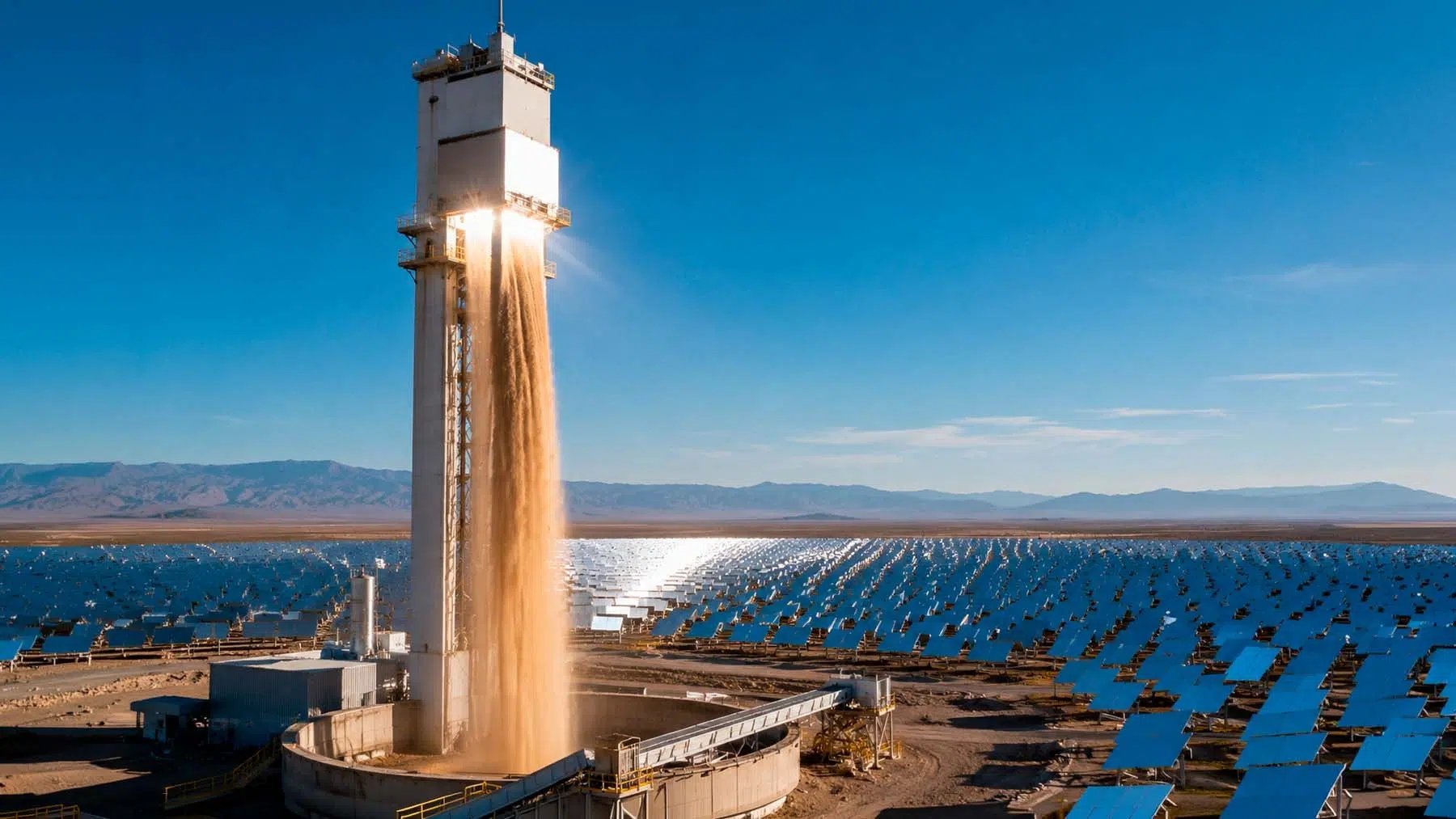

A new solar tower in New Mexico is testing an unusual method for storing the sun's heat after dark: dropping ceramic sand through concentrated sunlight rather than circulating oil or molten salt. Hundreds of mirrors, known as heliostats, reflect sunlight onto a single point atop the tower.
Most concentrated solar power facilities currently rely on synthetic oils or molten salts to carry heat through sealed piping systems. Synthetic oils begin to degrade at high temperatures, while molten salts can freeze inside the pipes used to move them, both persistent limitations for the technology.
The New Mexico tower avoids that problem by using chemically inert ceramic particles instead. A hopper at the top of the tower releases millions of dark ceramic grains every second, forming a falling curtain that passes directly through the concentrated beam of sunlight, absorbing heat without any tubing or barrier standing between the particles and the light.
Once the grains reach peak temperature, they fall into insulated storage containers, where testing at Sandia National Laboratories has shown they can retain extreme heat for more than six hours. The research is funded by the US Department of Energy as part of a broader push to improve long-duration clean power storage.
To generate electricity, the hot particles are later released into a pressurized heat exchanger, where pressurized carbon dioxide flows through and collects the stored thermal energy in a closed-loop system. Using solid particles rather than liquids removes the operational risks of pipe corrosion and chemical leakage associated with molten salt systems.
The receiver at the top of the tower is built with an internal cavity and angled construction designed to minimise heat loss, with metal channels temporarily catching falling grains before releasing them again to slow the stream and keep the falling curtain consistent, allowing the particles to absorb more heat during their exposure to concentrated light.
Sensors inside the receiver continuously monitor particle flow rates across the width of the curtain, with automated systems adjusting grain density in response to real-time solar radiation levels. After passing through the heat exchanger, an insulated bucket elevator carries the cooled particles back to the top of the tower to begin the cycle again.
Because ceramic sand is inexpensive and widely available compared with synthetic oils or molten salts, researchers say the approach could lower the cost of delivering reliable, round-the-clock electricity from solar power as grid operators look for cheaper long-duration storage options to meet growing demand.
Comments (0)
Leave a Comment
No comments yet. Be the first to share your thoughts!