

A research team has found a way to make smaller artificial intelligence systems vastly more efficient at uncovering hidden information, using an unexpected training tool.
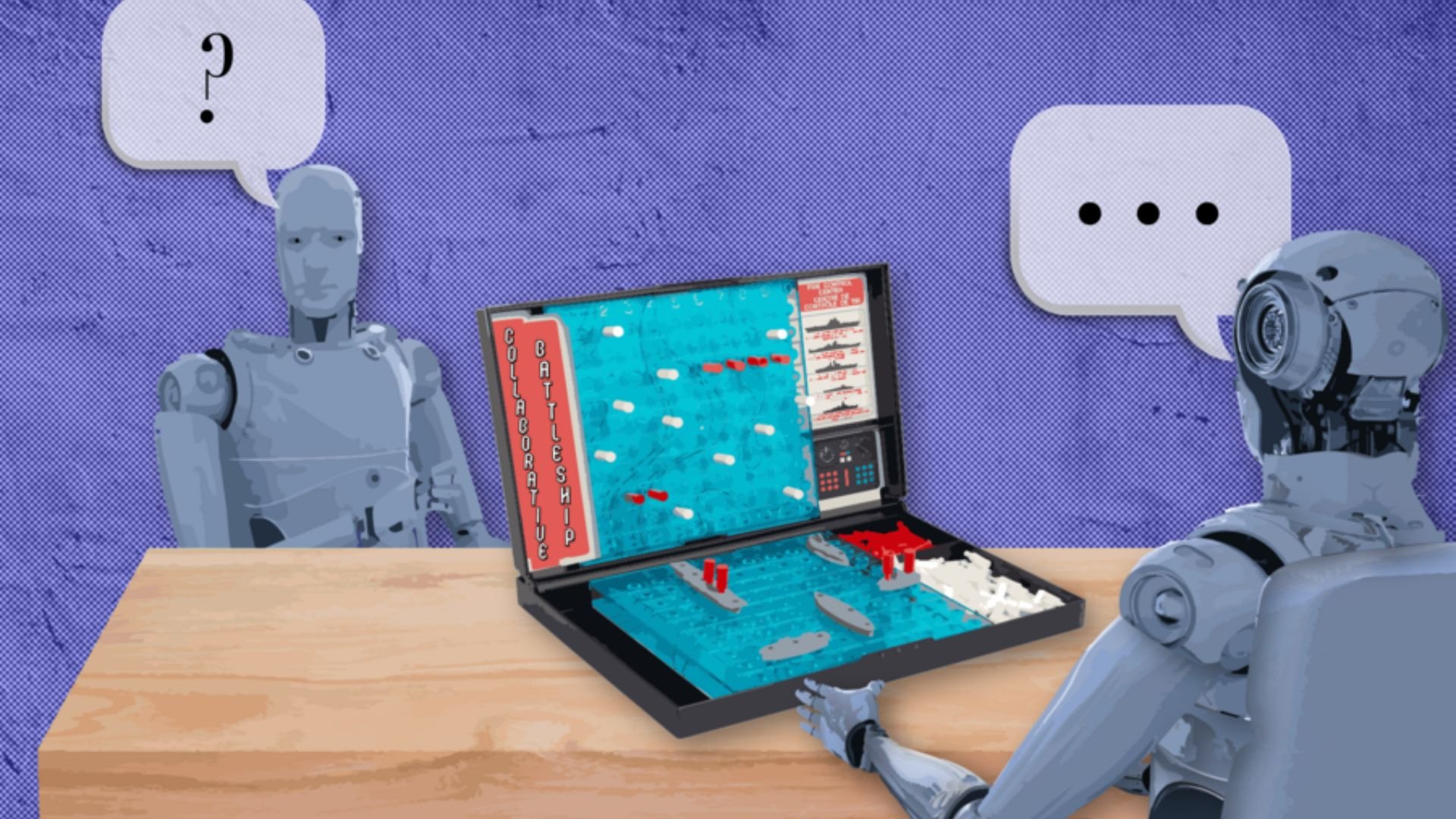
The strategy relies on a modified version of the classic naval guessing game, Battleship.
Scholars at the Massachusetts Institute of Technology (MIT) Computer Science and Artificial Intelligence Laboratory (CSAIL) and Harvard University’s School of Engineering and Applied Sciences (SEAS) created the experiment.
They wanted to address how language models operate in high-stakes environments where active exploration is required.
The team designed a natural language variant called Collaborative Battleship. In this setup, one model acts as a captain inquiring about hidden ship locations, while a teammate plays the spotter, responding to those questions in real time.
To build a point of comparison, the researchers first recorded more than 40 human-to-human games, establishing a baseline data collection known as the BattleshipQA dataset.
They then introduced both leading large language models and smaller systems to the board game environment. The raw tests showed that advanced frontier models, such as GPT-5, could complete the game in fewer turns than humans.
Smaller systems, however, proved far less rational on their own. To bridge this gap, the researchers implemented a Monte Carlo inference strategy.
This procedure repeatedly samples possible game states, weighting options based on incoming answers to evaluate the expected information gain of each question. The results were particularly visible in a smaller model, Llama 4 Scout.
Without the strategy, the model was largely inefficient, defeating human players just 8 percent of the time.
Once equipped with the refined inference strategy, its performance shifted radically. The model achieved an 82 percent win rate against humans.
By carefully calculating its line of questioning, the compact model managed to outpace GPT-5. It achieved this benchmark while operating at approximately 1 percent of the computing cost of the frontier model.
The researchers also targeted the accuracy of the spotter models by integrating the programming language Python. When the captain asked a question, the system automatically converted the inquiry into an encoded command.
A question about whether a ship occupies a specific column, for example, becomes instructions to search the digital area and assess the game piece.
This code conversion gave the models clear verification parameters. As a result, answer accuracy increased by an average of 15 percent, and up to 30 percent in some tests.
The strategic exploration capability holds relevance beyond simple board games. The study indicates that targeted information-seeking skills are highly applicable to complex problem-solving tasks.
The methodology can be transferred to real-world tasks requiring the exploration of massive data spaces.
The researchers point to needle-in-a-haystack scientific discoveries, such as identifying complex molecular structures, as areas where these assistant models could excel.
Comments (0)
Leave a Comment
No comments yet. Be the first to share your thoughts!