
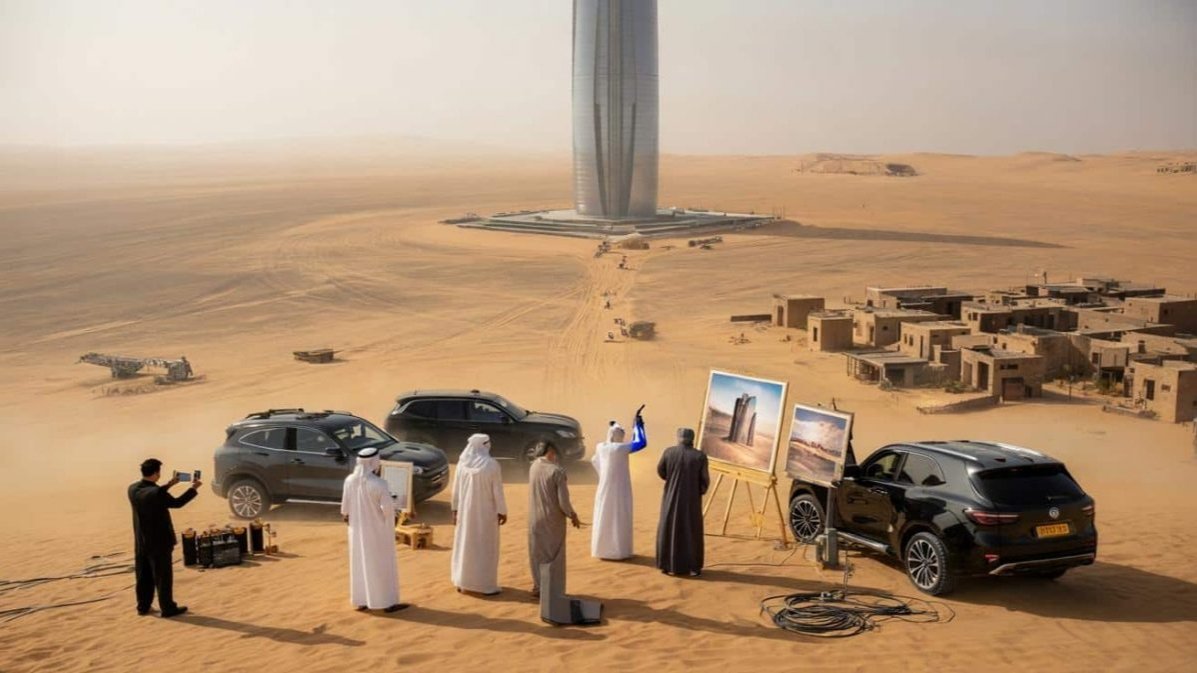

A commentary published on Gormanuplifts.co.uk has dismissed the recurring vision of a one-kilometre tower rising from desert sand as an exercise in architectural vanity rather than sound development strategy.
The piece paints a telling picture: a helicopter circles above endless dunes while black SUVs cluster below, their occupants gazing up at renderings of a gleaming mega-structure pitched as the ultimate symbol of progress. The author contends that this image captures the disconnect at the heart of such proposals, grand promises delivered in isolation from the harsh conditions on the ground.

Heat is the first and most obvious barrier. Daytime temperatures regularly exceed 45 degrees Celsius in many desert zones, turning any occupied floor into an energy-intensive box that requires constant mechanical cooling. Pumps would need to haul water hundreds of metres vertically, elevators would face extreme vertical travel times, and every material from glass to steel would expand and contract dramatically with daily temperature swings. Foundations, meanwhile, must contend with shifting sand, high wind loads, and potential seismic activity common across large parts of the region.
The commentary draws a direct line to the Jeddah Tower, the closest real-world attempt at this scale. After years of announcements and partial construction, the project has stalled repeatedly, weighed down by financing gaps, design revisions, and ballooning costs that have reportedly reached tens of billions of dollars. Delays have become so protracted that the original height target now looks more aspirational than achievable.
Instead of stacking floors skyward, the author advocates approaches already proven in hot climates. Dubai’s district cooling networks, shaded public spaces, and updated building codes demonstrate ways to slash energy demand without chasing records. Older techniques, thick masonry walls, internal courtyards, narrow streets, borrowed from traditional architecture in North Africa and the Arabian Peninsula routinely cut cooling loads by half or more. These methods require far less exotic technology and deliver comfort at street level rather than in isolated vertical silos.
Practical questions pile up quickly. Who pays the ongoing electricity and maintenance bills once the opening ceremonies end? How does the building function during prolonged grid outages or water shortages? Where do the thousands of support staff live, and how do they commute across empty terrain? What happens to occupancy and value if global investment trends shift or tourism patterns change? The piece insists that real success should be measured by ordinary life five or ten years later, affordable rents, reliable utilities, functioning schools, local shops, not by viral drone shots or entries in height record books.
An urban planner based in Riyadh is quoted saying skyscrapers themselves are not the problem; the mistake lies in treating them as a complete urban solution rather than one limited tool among many. When the tower becomes the entire strategy, the commentary argues, the result is fragile spectacle instead of resilient place-making.
For regions like Kenya, where cities grapple with rapid population growth, housing shortages, flood risks, and the need for affordable, climate-appropriate infrastructure, these distant debates serve mainly as cautionary examples. Local projects tend to prioritise mid-rise buildings, improved transport corridors, and incremental upgrades that respond directly to daily pressures rather than headline-grabbing scale.
The desert tower concept, in this view, reflects a broader pattern: resources channelled into singular, high-risk statements while more distributed, adaptable solutions receive less attention. The author closes by suggesting that genuine advancement in arid environments will come from building with, not against, the landscape, using intelligence and restraint rather than sheer height as the measure of ambition.
Comments (0)
Leave a Comment
No comments yet. Be the first to share your thoughts!