
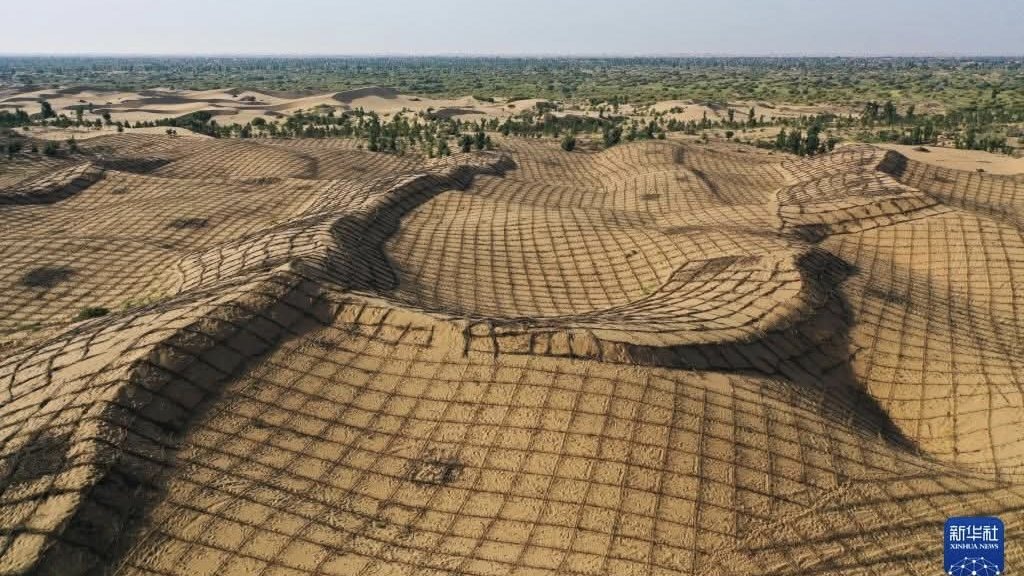

Forests planted under China's decades-long campaign against desertification now cover a cumulative 500,000 square kilometers, or roughly 200,000 square miles, according to figures released by the Chinese government. The initiative, known as the Three-North Protective Forest Program or the Green Great Wall, began in 1978.
For nearly half a century, workers have repeated the same task across deserts in northern China. Forearm-length sticks are pushed into shifting sand in intersecting rows, forming a grid, with saplings planted at the centre of each square to stabilize the dunes.
China's desertified land has shrunk by about 10 percent overall since 2000, while areas classified as severely or extremely desertified have decreased by more than 40 percent. Forest cover across the program area has climbed from around 5 percent in 1978 to 14 percent by 2022.
Barron Joseph Orr, chief scientist for the United Nations Convention to Combat Desertification, said the programme's significance lies partly in the long-term political commitment behind it, adding that reversing desertification becomes achievable once built into sustained development strategy.
The Gobi and Taklamakan deserts still span roughly 618,000 square miles between them, an area only slightly smaller than Alaska, and the Gobi alone continues to absorb about 1,400 square miles of grassland each year despite the gains.
Even so, a related milestone landed this year around the Taklamakan itself, where authorities completed a roughly 3,000 kilometre green belt encircling the desert after planting the final stretch of trees along its southern edge, according to state media.
The program is designed to run in three phases through 2050, targeting forest coverage of around 15 percent across its 13-province footprint. Scientists caution that holding onto these gains will require continued investment well beyond current milestones.
Comments (0)
Leave a Comment
No comments yet. Be the first to share your thoughts!