
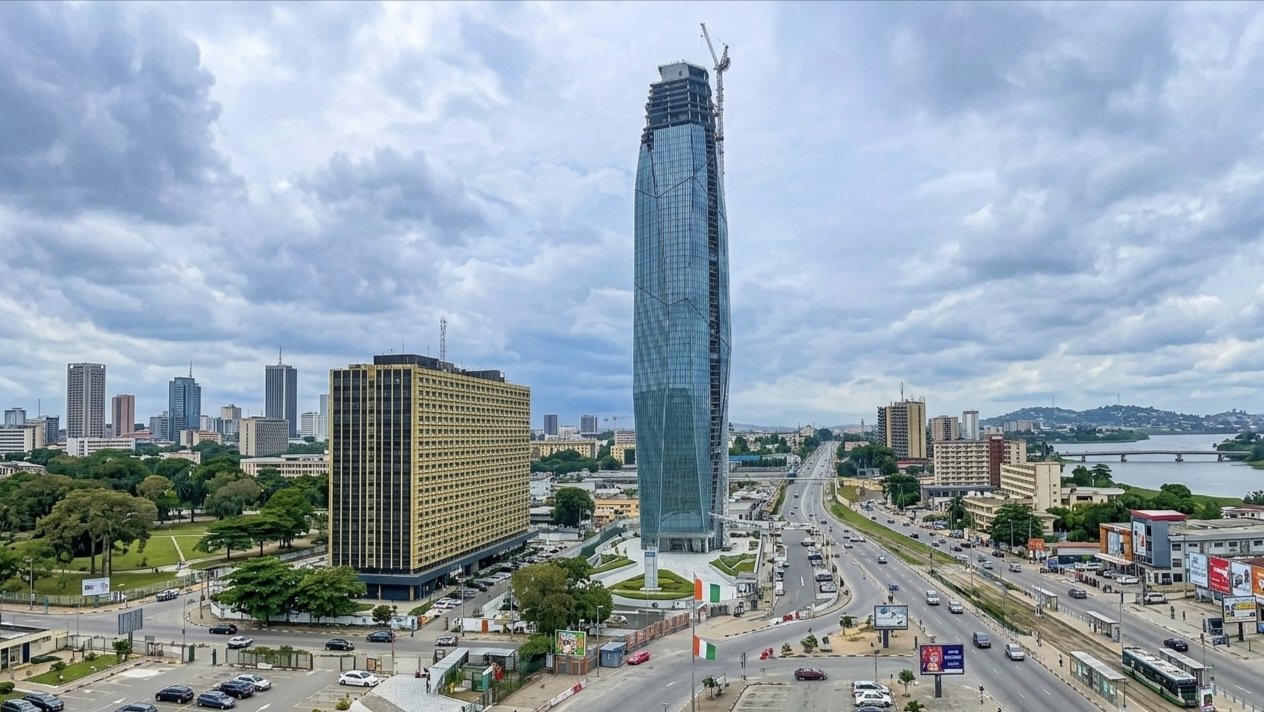

Africa is about to have the new tallest building. It is not in Lagos, not in Nairobi, and not in Cairo. It is in Abidjan, Ivory Coast, and it has been coming for more than half a century.
Tour F, also known as Tower F, stands 1,381 feet tall across 64 storeys and was designed by Lebanese-Ivorian architect Pierre Fakhoury. When it opens, it will edge past Egypt's Iconic Tower, the current continental record holder, by less than 100 feet. That margin is slim. The symbolic distance between the two buildings is considerably wider.
This is the sixth tower in Abidjan's administrative district, following Tours A through E, all of which were completed by the early 1980s. Tour F has been part of the city's urban development plans for over 50 years. It was never abandoned exactly, but it was repeatedly deferred, interrupted by the kind of instability that does not appear on architectural drawings. Ivory Coast experienced civil wars in 2002 and 2010. Construction finance dried up. Political conditions shifted. The tower waited.
What finally got it built is a version of the same logic that drives skyscraper construction everywhere. Tall buildings are not just about floor space. They project a message. In Abidjan's case, that message is directed squarely at investors and at a wider world that has not always associated West Africa with political stability or long-term economic confidence. A 64-storey tower nearing completion in 2026 says something that a press release cannot.
Fakhoury's design reflects that intent. The angled planes of the building's glass facade are meant to evoke a stylised African mask, grounding a very modern structure in a distinctly local visual language. Whether that reading holds up at street level is a matter of perspective, but the gesture is deliberate. This is not a building that arrived wholesale from a foreign design studio with no consideration of where it was going. Fakhoury, who died in 2020 after a career that shaped much of Abidjan's built environment, spent decades working within the city's architectural and political landscape.
The broader context around Tour F is also worth noting. Abidjan is not standing still while the tower goes up. A rapid transit system is under development and expected to open in 2028. A highway stretching over 1,000 kilometres is being planned to connect the Ivory Coast to Nigeria, passing through the capitals of Ghana, Benin and Togo. That corridor, often described as the Abidjan-Lagos Corridor, represents one of the most consequential infrastructure bets in West Africa's recent history, linking some of the continent's most commercially active cities along its southern coast.
Tour F sits at the tip of that ambition. It is the most visible structure in a city that is clearly trying to reintroduce itself to the world, and it is arriving at a moment when African cities are generating more architectural attention than at any point in recent memory.
For the continent's construction and design community, the building's completion carries specific weight. Africa has long had the raw material for landmark architecture, the land, the labour, the cultural depth and increasingly the capital. What has been harder to sustain is the political and financial continuity required to take a 64-storey building from concept to completion. Tour F has managed that. It took 50 years, two civil wars and multiple financing cycles to get there, but it is getting there.
When it formally opens, it will be the tallest structure on a continent of 1.4 billion people. That is a fact worth sitting with.
Comments (0)
Leave a Comment
No comments yet. Be the first to share your thoughts!