
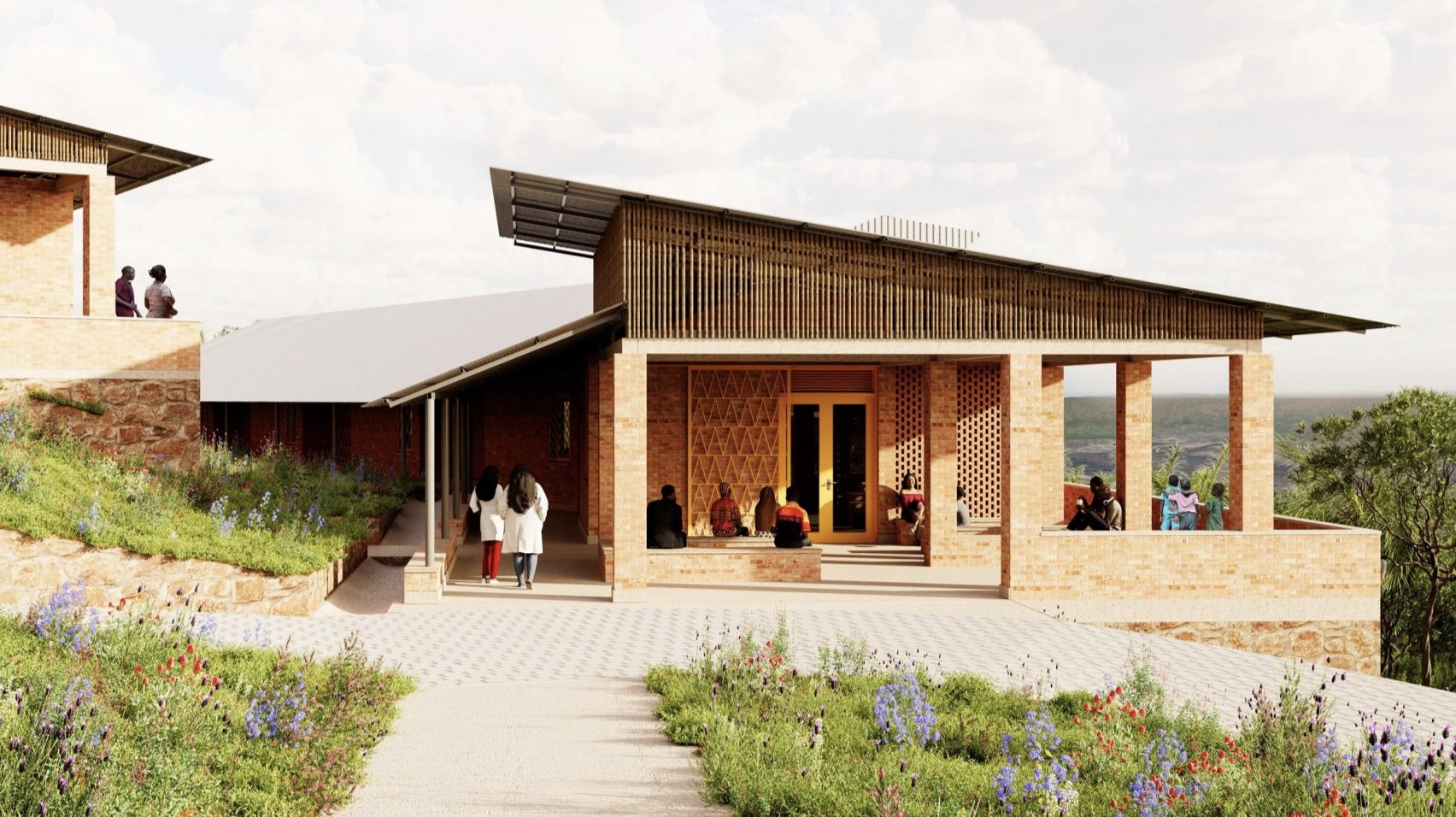

Diébédo Francis Kéré was born in Gando, a small village in Burkina Faso with no electricity and no running water. He became the first African architect to win the Pritzker Prize in 2022. He is currently building a hospital on a hillside in Burundi using bricks fired within 30 kilometres of the site.
That thread, from a village in West Africa to the most prestigious award in global architecture and back to a rural hillside in Central Africa, is the lens through which the Ineza Clinic makes most sense.
The project is located in the Bubanza region of Burundi, approximately 40 kilometres north of Bujumbura, the country's former capital. It was commissioned by the NGO Ineza Clinic, founded by Eva Weissman, who has described the maternal mortality risk for women in Burundi as one in 57 over a lifetime. The clinic is designed to provide affordable maternity and surgical care for a rural population that currently has to travel long distances over poor roads to reach any specialist healthcare facility. Getting to the nearest hospital from parts of Bubanza can take up to three hours, despite the distance being less than 40 kilometres.
Kéré's response to that reality is architectural and logistical at the same time. The site is a steep, north-facing hillside accessible from the national road connecting Bujumbura to the country's northern regions. Rather than cutting into the hill or flattening the terrain, the design organises the entire healthcare programme around the topography that exists. Ten pavilions are distributed along a primary spine road that zigzags up the hill from the lower access point to an upper visitor zone. Each building follows the existing contour lines, minimising excavation and preserving the natural profile of the slope.
The arrangement is not purely aesthetic. Separating the clinic into ten distinct pavilions breaks down what could have been an overwhelming institutional building into a series of approachable, human-scaled structures. Circulation between departments is clear. Public functions are separated from clinical spaces by the road itself.
The materials are almost entirely local. Walls and perforated screens are built from clay bricks fired within 30 kilometres of the site. Foundations, retaining walls and ramps use white and red granite from nearby quarries. High fuel costs in Burundi made long-distance material transport economically untenable, but Kéré's studio, Kéré Architecture, has worked this way before. The approach is a direct continuation of the practice developed at the Léo Surgical Clinic and Health Centre in Burkina Faso, completed in 2014.
The construction process also functions as a training programme. Local workers are being coached in refined masonry techniques throughout the build, with the explicit intention that the knowledge required to maintain and replicate the structures stays within the community after the project is complete. The general contractor is Robuco Group, based in Bujumbura, and the engineering team is EVAN Company, also from Bujumbura.
The climate design is precise. All ten pavilions are oriented according to prevailing wind patterns to maximise cross-ventilation without mechanical systems. The birthing and outpatient units share a typology with irregular perimeter profiles that create shaded waiting areas and integrated seating along their facades. Above, a ventilated roof system adapted from earlier Kéré Architecture projects separates the ceiling from the outer shell, allowing heat to rise and exit while protecting against Burundi's heavy seasonal rainfall.
The surgical ward takes a different approach. Vertical chimneys provide stack ventilation, drawing air upward through the building. Each patient bay has its own individual window with views of the surrounding landscape, a decision made deliberately to support recovery and preserve dignity during what are often the most vulnerable moments in a patient's life.
The project is being delivered in two phases. The first half of the buildings is scheduled to open in summer 2026, when the clinic will begin operations. The remaining structures will follow in 2027. At 3,000 square metres in total, the Ineza Clinic is modest in scale by international standards. By the standards of rural Bubanza, it is transformative.
Kéré Architecture is currently working on several other projects simultaneously, including the Las Vegas Museum of Art and the Biblioteca dos Saberes in Rio de Janeiro. Both feature facades of perforated brick, a material language that has become a signature of the studio. In Burundi, that same language is being expressed with bricks made down the road, by workers who will know how to make more when the architects have gone home.
Comments (0)
Leave a Comment
No comments yet. Be the first to share your thoughts!