
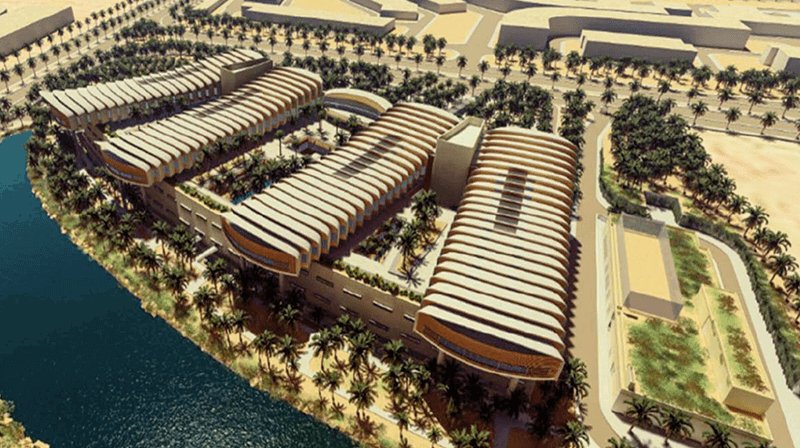

Most hospitals are designed around efficiency. This one was designed around healing.
The Magdi Yacoub Global Heart Centre in Cairo, is under construction in 6th of October City, on a 35-acre site bordering the Zewail City of Science and Technology and within sight of the Pyramids of Giza. Designed by Foster and Partners in collaboration with Dar Al-Handasah, the 300-bed facility will provide free cardiac care to patients from Egypt and across sub-Saharan Africa.
The man behind it is Sir Magdi Yacoub, the Egyptian-British surgeon widely regarded as one of the greatest heart specialists alive. He founded the Aswan Heart Centre in 1999, which has been operating beyond capacity for years. The Cairo centre triples that capacity, moving from 4,000 patients annually to 12,000, with five operating theatres, one hybrid theatre, four catheterization labs and 124 intensive care unit beds.
What separates this from a conventional hospital is the design philosophy. The entire 85,000 square metre complex is embedded in lush gardens, native planting and a purpose-built lake on the northern edge of the site. Every intensive care room on the first floor is oriented to face landscaped views.
Natural light enters through a series of internal courtyards running through the deep plan building. The surgical department and intensive care units are co-located on the same floor, reducing the distance between the operating theatre and recovery bed. Warm, soft colour palettes drawn from Egyptian history run through the interiors.
The approach draws directly on biophilic design research, the growing body of evidence showing that patients exposed to natural light, greenery and views of water recover faster and require less pain medication than those in conventional clinical environments.
Foster and Partners Head of Studio Nigel Dancey described the project as bringing together the latest research on biophilia with pioneering work on collaborative healthcare environments. The passive design strategy eliminates the need for mechanical cooling in most areas, using shaded pedestrian routes, natural cross-ventilation and the thermal mass of the building's structure to manage Egypt's intense heat.
Beyond clinical care, the centre includes a dedicated research hub, advanced laboratories and a telemedicine facility designed to extend the foundation's reach into more remote parts of Africa. The training programme will expand from 550 healthcare professionals annually to 1,750. Eighty percent of cardiovascular disease deaths occur in low and middle-income countries. That figure sits at the centre of everything the foundation is trying to do.
Construction is underway. The building that emerges at the foot of the Pyramids will offer some of the most advanced cardiac care in Africa, at no cost to the patients.
Comments (0)
Leave a Comment
No comments yet. Be the first to share your thoughts!