
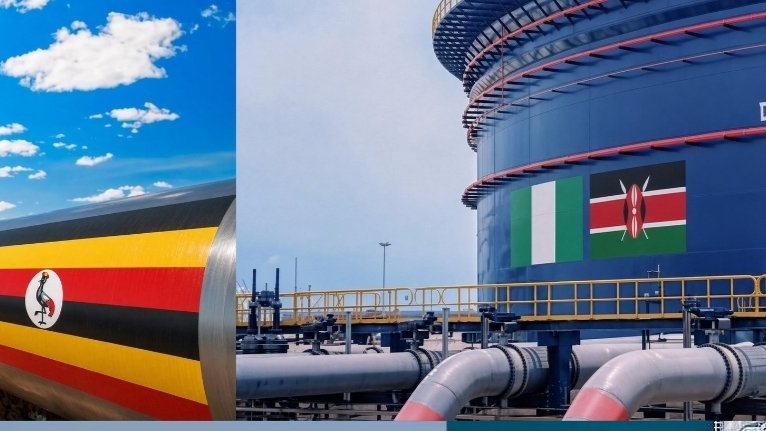

A version of this analysis on X by Charles Onyango-Obbo examines the intensifying competition between Tanga in Tanzania and Lamu in Kenya over East Africa’s petroleum infrastructure.
What Arthur Mutrio has called the war of the refineries is heating up. The contest involves multi-billion-dollar plans for refining capacity, storage and export facilities along the East African coast. The unity of the East African Community (EAC) is about to face its biggest test yet.
On one side, Tanzania and Uganda have signed a Memorandum of Understanding with commodity-trading giant Vitol Bahrain. The agreement covers development of the Tanga Regional Energy Hub at Tanzania’s Port of Tanga.
Potential investment exceeds $20 billion. The complex is expected to include a regional crude-oil refinery, vast storage tank farms and export facilities. These would be supplied directly by the 1,443 km East African Crude Oil Pipeline (EACOP).
The agreement remains non-binding. Exact infrastructure details and costs are still being worked out.
Uganda is also advancing its own domestic refinery at Kabaale in Hoima. That project is intended to serve local demand first, with any surplus available for the wider regional market. It sits alongside the Tanga plans as a separate but related development in Uganda’s energy strategy.
Just up the coast, Africa’s richest man Aliko Dangote is advancing his own plans in Kenya. Dangote Industries is developing a $17 billion mega-refinery on Lamu Island.
The facility is designed to process 700,000 barrels a day. It would mirror the scale of his flagship Lagos plant and position Lamu Port as a main fuel-processing artery for East and Central Africa.
Current plans remain at the feasibility and early engineering stage. Construction is expected to begin later this year.
The rivalry has clear diplomatic roots. Kenyan President William Ruto initially announced at the African Finance Corporation summit and Kenya Mining Investment Conference in Nairobi in April 2026 that a Dangote-backed regional refinery would be built in Tanga.
Tanzanian President Samia Suluhu Hassan publicly pushed back several days later at a joint business forum in Dar es Salaam. She said she had not been consulted and knew nothing about the proposed project on Tanzanian soil.
After that diplomatic exchange, Dangote shifted his proposal to Kenya’s Lamu Port. Tanzania and Uganda pressed ahead on their own, joining forces with Vitol Bahrain to develop downstream infrastructure at Tanga.
East Africa currently imports nearly all its refined fuel. Both coastal projects are racing to reduce that dependence and gain greater control of the region’s energy value chain. Uganda’s Hoima refinery adds a third processing centre to the emerging picture.
Kenya’s deep-water Lamu Port and the Tanga facilities are now facing off to become the leading shipping and export hub on the continent’s eastern seaboard.
Whoever comes out ahead could supply refined petroleum products to Kenya, Uganda, Rwanda, Burundi, South Sudan and the Democratic Republic of Congo. That combined market exceeds 200 million people in a region whose energy map is being redrawn.
The wider contest for energy supremacy across Africa is also turning the western Indian Ocean into one of the world’s most strategic energy corridors. Major offshore discoveries, shifting alliances and growing multinational involvement have produced a scramble for control of both upstream reserves and downstream refining capacity.
In Mozambique’s Cabo Delgado province, TotalEnergies has resumed work on its $20 billion Mozambique LNG project at Afungi following an improvement in regional security. Italy’s Eni is already exporting LNG through its Coral South floating liquefied natural gas vessel and is expanding with a second floating platform, Coral North. US major ExxonMobil is advancing plans for its neighbouring Rovuma LNG project.
While East Africa is still laying foundations for its energy infrastructure, West Africa has already moved into active production. In Senegal and Mauritania, Woodside Energy brought the offshore Sangomar field online. BP and Kosmos Energy have launched the joint Greater Tortue Ahmeyim floating LNG project.
Nigeria continues to overhaul its downstream sector around the Dangote Refinery in Lagos. Deep-water discoveries in Namibia’s Orange Basin by Shell, TotalEnergies and Galp are turning Africa’s Atlantic coast into one of the world’s hottest exploration frontiers.
Taken together, these parallel contests show that the stakes extend well beyond any single refinery or pipeline. Whoever controls the ports and processing hubs will help set the price, direction and pace of energy security for entire regions.
Comments (0)
Leave a Comment
No comments yet. Be the first to share your thoughts!