
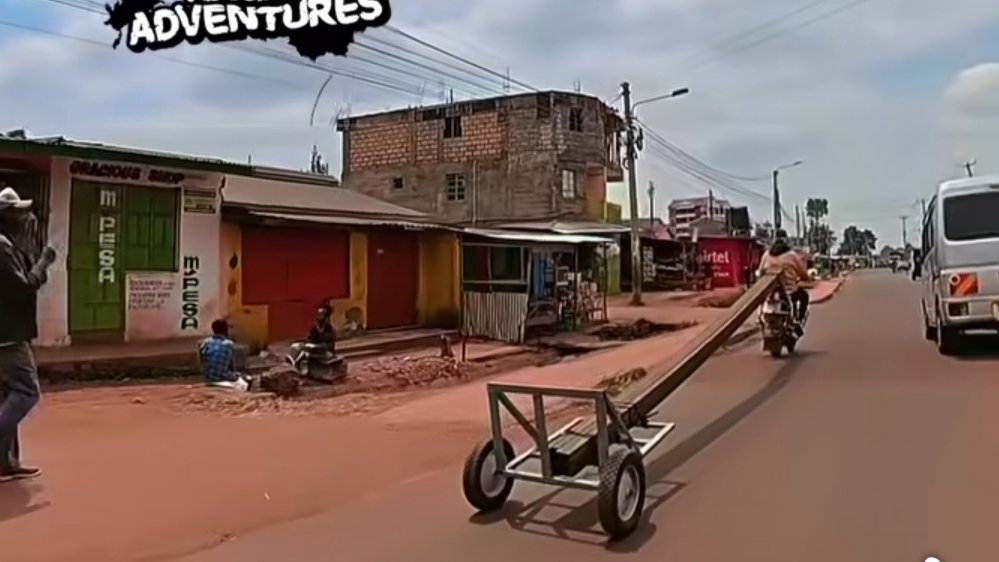

A simple two-wheeled trolley being used behind a boda boda (commercial motorcycle) has raised an interesting road maintenance question in Kenya: could a better way of carrying long construction materials help reduce unnecessary damage to roads?
The trolley supports long square tubes that would otherwise be difficult to transport on a motorcycle. Instead of allowing the material to trail along the tarmac, the load is supported by its own wheels and pulled behind the motorcycle.
The approach is particularly relevant because long materials are sometimes transported on motorcycles in ways that leave part of the load in contact with the road. That practice can create a safety hazard while also subjecting the road surface to unnecessary scraping and abrasion.
The trolley does not, however, automatically make the arrangement safe or legal. Its design, attachment to the motorcycle, braking performance, stability, visibility and ability to negotiate corners would all need to be considered before such equipment could be treated as a proper transport solution.
The issue also brings back a proposed change to Kenya’s motorcycle regulations. The Public Transport (Motorcycle Regulation) Bill, 2023, sponsored by Kakamega Senator Boni Khalwale, sought to introduce tighter rules covering how boda bodas carry passengers and loads.
Under the Bill, a motorcycle would not be allowed to carry a load projecting more than 15 centimetres beyond the outside ends of the handlebars, rising more than two metres from the ground or extending more than 60 centimetres beyond the motorcycle’s maximum overall length.
The proposed legislation also stated that no part of a load carried by a motorcycle should drag on the road. Rear projections would have to be marked with a conspicuous red marker during the day and a red light at night.
The Bill went further by proposing a 50-kilogramme limit in provisions dealing with the simultaneous carriage of passengers and loads. It also proposed separate regulatory treatment for delivery motorcycles, including requirements for appropriate storage compartments.
The proposed law has not become an Act of Parliament. The Bill remained under consideration, while a National Assembly motion seeking to discharge it from further consideration was defeated on May 28, 2025.
A National Assembly committee later recommended that the Bill be rejected, arguing that many of its proposed provisions were already covered by existing laws and regulations, including the National Transport and Safety Authority (Operation of Motorcycles) Regulations, 2015.
Last month, the High Court dismissed a petition seeking to compel the government to enforce stricter regulation of commercial motorcycle operators, ruling that the case lacked the precision required in constitutional matters.
That leaves an important distinction in the trolley discussion. The proposed Bill specifically addressed loads being carried by motorcycles, including the requirement that loads should not drag on roads. It did not establish that a motorcycle towing a separate trolley would automatically be permitted.
The existing regulatory framework therefore remains relevant to anyone attempting to use such equipment commercially. A trolley could keep long materials away from the pavement, but its roadworthiness and compliance would still need to be established.
The public reaction has also focused on visibility. Suggestions include fitting the trolley with reflective material, chevrons or a red flag so that motorists and other riders can clearly see the equipment from behind.
Braking is another practical concern. Adding a separate wheeled load behind a motorcycle changes the dynamics of the combination, making questions about stopping distance, connection strength and stability important before the idea can move beyond an improvised solution.
From a road maintenance perspective, however, the underlying principle is straightforward. Keeping long steel sections from scraping directly against the pavement is preferable to allowing them to drag along the road.
Whether this particular trolley is the right solution is another question. Proper engineering, roadworthiness checks and regulatory approval would be needed before it could reasonably become a wider method of transporting construction materials by motorcycle.
#ShareBarabara
Comments (0)
Leave a Comment
No comments yet. Be the first to share your thoughts!