
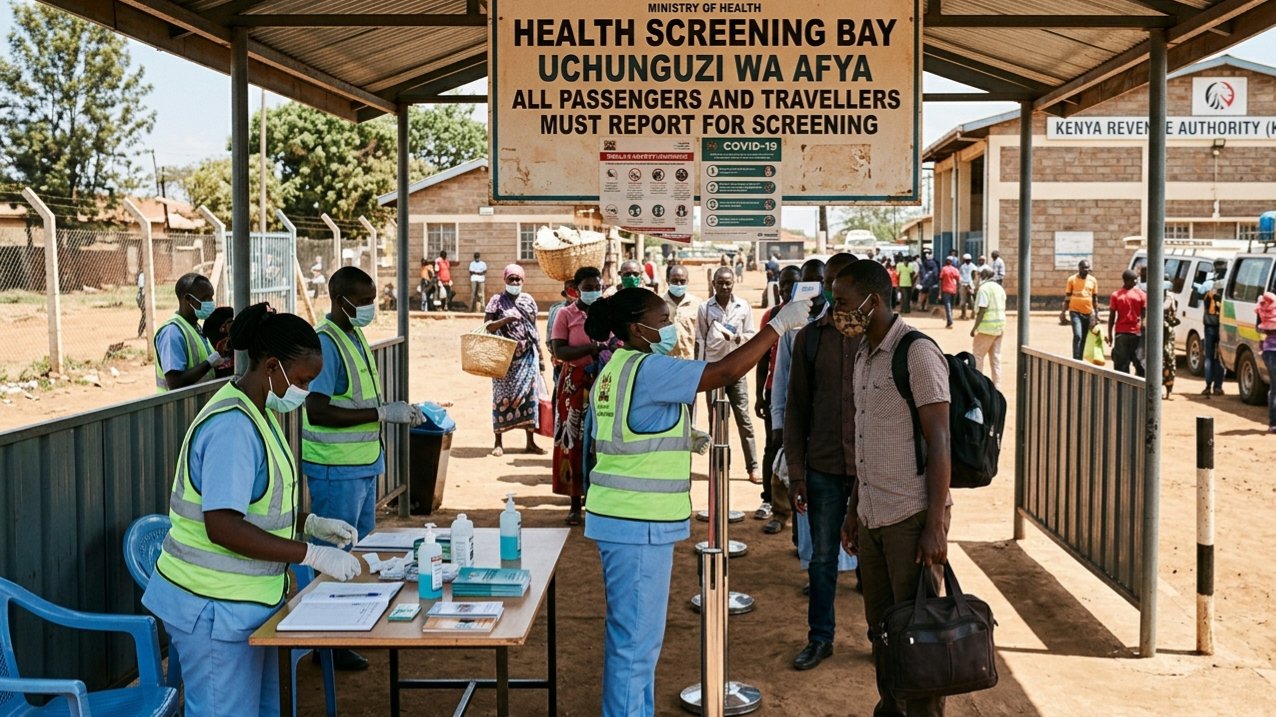

The government has stepped up emergency readiness measures following a regional outbreak of Ebola in neighboring countries, triggering immediate adjustments to local containment infrastructure.
President William Ruto directed the formation of the National Response Committee to coordinate public health strategies, awareness campaigns, and defensive field assets.
Prime Cabinet Secretary (PCS) Musalia Mudavadi will head the multi-agency team, which assumes immediate responsibility for structural interventions, resource mobilization, and inter-ministerial logistics.
The administrative directive targets a unified approach across key public bodies, if regional cross-border transmission risks continue to escalate.
The operational focus centers on upgrading regional screening structures, laboratory networks, and dedicated holding facilities.
The Ministry of Health (MOH) has already activated emergency management networks to support field surveillance and border entry points.
The Kenya National Public Health Institute (KNPHI) is supervising early warning systems, particularly at high-density transit corridors.
Four national reference laboratories are operating on extended schedules to support diagnostic capacity, if rapid detection becomes necessary.
Isolation units and dedicated referral infrastructure are undergoing technical assessments to handle potential caseloads safely.
The administrative shift comes as state departments align financial frameworks to address critical deficits in medical logistics.
The Parliamentary Health Committee recently examined allocations under the Health Emergency Preparedness, Response and Resilience Programme (HEPRRP) to verify equipment procurement schedules.
Lawmakers allocated 700 million Kenyan Shillings (KES) toward specialized containment equipment, emergency infrastructure, and personnel protections.
The parliamentary review highlighted structural gaps in national referral networks, including Kenyatta National Hospital (KNH) and Moi Teaching and Referral Hospital (MTRH).
Legislators emphasized that stable health infrastructure financing remains critical, but recent legal developments have altered near-term isolation facility planning.
The High Court of Kenya recently suspended plans for a foreign-backed containment facility in Laikipia County, citing procedural oversight and a lack of public participation.
Justice Patricia Nyaundi issued conservatory orders restraining government agencies from establishing the proposed 14 million US Dollar (USD) quarantine center at the Laikipia Air Base.
The suspension halts the deployment of a planned 50-bed field hospital, which was designed for rapid expansion to a 250-bed capacity.
The legal challenge, initiated by the Katiba Institute (KI), focused on the absence of formal legislative approvals for the specialized site.
The judicial intervention requires the newly formed executive team to rely strictly on existing public medical installations.
Musalia Mudavadi indicated that national operations will proceed under strict compliance with regional health guidelines.
The committee will hold joint simulation exercises along border points, including Busia, to evaluate rapid response infrastructure.
Technical collaborations continue with the World Health Organization (WHO) and the Africa Centres for Disease Control and Prevention (Africa CDC) to maintain international safety baselines.
The national taskforce will supervise county-level health deployments, ensuring standard containment designs are implemented uniformly across high-risk jurisdictions.
Resource distribution will prioritize personal protective equipment (PPE) distribution, border thermal screening frameworks, and dedicated specimen transport corridors.
Comments (0)
Leave a Comment
No comments yet. Be the first to share your thoughts!