
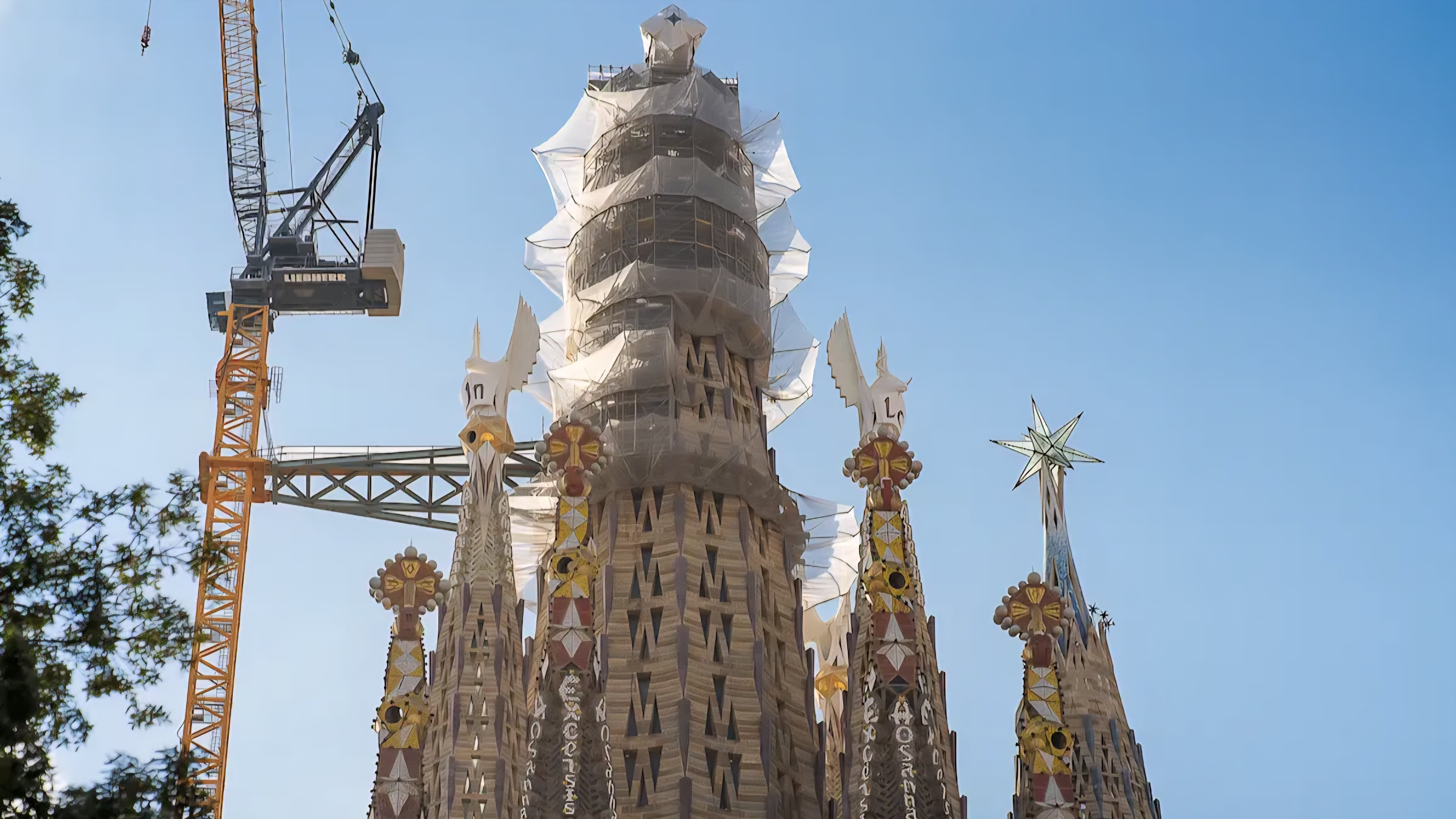

Misconceptions regarding the final completion date of the Sagrada Familia continue to circulate, prompting clarification from the site leadership as a critical architectural milestone is reached.
The Tower of Jesus Christ was officially inaugurated today, completing the central spires of the world-famous basilica.
Lead architect Mauricio Cortés, who has spent two decades working on the monument, pointed out that headlines claiming the entire church would be finished this year are inaccurate.
The central towers are now complete with the addition of the Jesus tower, but substantial engineering obstacles remain on the horizon.
The largest pending task is the construction of the Glory Facade, which serves as the main elevation for the building.
According to Cortés, a definitive timeframe for this section has not been established, and the schedule remains fluid.
He estimated that work on the main facade could take a decade, noting that a fixed schedule cannot be determined yet.
Before the visible elements of the Glory Facade can take shape, crews must complete several levels of underground construction, which are currently ongoing beneath the site.
The Mexican architect joined the project in 2006, starting on the ground floor to extend the neo-gothic cloisters around the Nativity facade.
That section was the only portion of the church that Antoni Gaudí lived to see completed before his death a century ago.
Reflecting on the integration of historic designs with modern construction techniques, Cortés stated that extensive testing is required to make the two distinct eras match together.
He dismissed the idea that contemporary technology compromises the original architectural vision, arguing instead that digital tools allow the team to follow Gaudí’s intentions more closely.
For instance, structural assumptions in the original plans suggested the Tower of Jesus Christ required internal intermediate slabs to achieve stability.
Modern engineering enabled the team to build a hollow spire with a central staircase, allowing the interior space to be utilised for theological and artistic programming.
The design team collaborated with an internal theologian committee and an artistic committee to align the interior spaces with the external symbolic elements of the basilica.
Gaudí himself was known for structural innovation, having used prefabricated concrete back in 1925 for the spire of the Saint Barnabas tower on the Nativity facade.
However, Cortés highlighted that executing the project without modern cranes, contemporary scaffolding, and advanced materials would have presented severe safety and durability challenges.
The ultra-high performance concrete utilized in the modern era provides a level of longevity that was entirely unavailable during the initial phases of construction in the 1920s.
With the central spires now standing complete, the timeline for the remaining exterior elevations and underground works depends entirely on solving these deep-set structural demands.
Comments (0)
Leave a Comment
No comments yet. Be the first to share your thoughts!